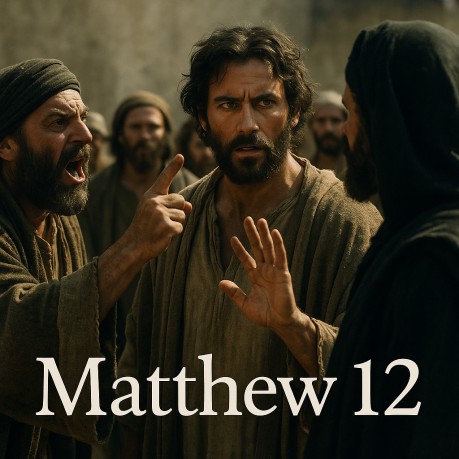
Matthew 12 Matthew 12:1-2 † The Pharisees interpreted Sabbath laws
rigidly. Yet the law allowed gleaning (Deuteronomy 23:25). They added
burdens beyond Scripture. † The Mishnah adds layers of Sabbath
restrictions (Shabbat 7:2). Jesus confronts this distortion. † To us today, it shows that man-made
traditions cannot bind where God has given freedom. Matthew 12:3-4 † Jesus cites 1 Samuel 21. David, the anointed
one, was not condemned when necessity arose. Christ, greater than
David, has authority over the Sabbath. † Josephus notes that David was honored as
God's chosen, even when breaking custom (Antiquities 6.239). † To us today, it shows that mercy and purpose
outweigh rigid ritual. Matthew 12:5-8 † Jesus claims authority above the temple
itself, fulfilling Hosea 6:6. He is Lord of the Sabbath, greater than
the temple system. † Tacitus describes the Jews as devoted to the
temple rites (Histories 5.4). Jesus declares His supremacy over them. † To us today, it shows Christ is our Sabbath
rest. Matthew 12:9-13 † Jesus proves the Sabbath was made for doing
good. Human need outweighs ritual regulation. † Philo wrote that the Sabbath should promote
human well-being, not misery (On the Decalogue 96). Jesus fulfills
that truth. † To us today, it shows love fulfills the law. Matthew 12:14 † Their hardness of heart turned healing into a
reason for murder. † Josephus noted how Jewish leaders often
sought to eliminate rivals out of envy (Antiquities 20.200). † To us today, it shows religious pride resists
truth even in the face of undeniable good. Matthew 12:15-17 † Isaiah 42:1 is fulfilled. The Servant brings
justice to Israel and the nations. † To us today, it shows Christ's mission was
not nationalistic but universal. Matthew 12:18-21 † Christ fulfills the Servant Song, gentle,
merciful, yet victorious. Gentiles put their hope in Him. † The Dead Sea Scrolls hoped for a Messiah of
war, but Jesus fulfills Isaiah's picture of mercy (1QM 9.5). † To us today, it shows Christ's power is
expressed in mercy, not violence. Matthew 12:22-24 † The miracle proves messianic power, but the
Pharisees attribute it to Satan. Their hardness fulfills covenant
judgment. † Tacitus said rulers often slandered their
opponents with false accusations (Annals 4.34). The Pharisees do the
same. † To us today, it shows unbelief twists truth
to resist Christ. Matthew 12:25-28 † Jesus proves His authority is from God. The
kingdom had come, shown in His power over demons. † Origen taught that this proved the binding of
Satan had begun in Christ (Against Celsus 1.6). † To us today, it shows the kingdom is here and
Satan's defeat is real. Matthew 12:29-30 † Jesus is binding Satan, the strong man. The
kingdom mission plunders his house. † To us today, it shows Christ's victory is
decisive. Neutrality is impossible. Matthew 12:31-32 † The unforgivable sin is attributing God's
work to Satan, rejecting the Spirit's testimony. † To us today, it shows that hardened unbelief
against God's Spirit leaves no hope. Matthew 12:33-37 † Jesus exposes the Pharisees as corrupt trees
with corrupt fruit. Judgment would reveal their hearts. † The Mishnah warned that words reveal the
heart (Avot 1:17). Jesus expands this into covenant judgment. † To us today, it shows our words matter, for
they reveal the heart. † This is the fulfilled perspective we proclaim at
Fulfilled Prophecies † Source Index
By Dan Maines
At that time Jesus went
through the grainfields on the Sabbath, and His disciples became
hungry and began picking the heads of grain and eating them. Now when
the Pharisees saw this, they said to Him, "Look, Your disciples
are doing what is not lawful to do on a Sabbath!"
But He said to them, "Have
you not read what David did when he became hungry, he and his
companions-how he entered the house of God, and they ate the
consecrated bread, which was not lawful for him to eat nor for those
with him, but for the priests alone?"
"Or have you not read in
the Law, that on the Sabbath the priests in the temple violate the
Sabbath, and yet are innocent? But I say to you that something
greater than the temple is here. But if you had known what this
means: 'I desire compassion, rather than sacrifice,' you would not
have condemned the innocent. For the Son of Man is Lord of the
Sabbath."
Departing from there, He
went into their synagogue. And a man was there with a withered hand.
And they questioned Jesus, asking, "Is it lawful to heal on the
Sabbath?"-so that they might bring charges against Him. And He
said to them, "What man is there among you who has a sheep, and
if it falls into a pit on the Sabbath, will he not take hold of it
and lift it out? How much more valuable then is a person than a
sheep! So then, it is lawful to do good on the Sabbath." Then He
said to the man, "Stretch out your hand!" He stretched it
out, and it was restored to health, like the other.
But the Pharisees went out and
conspired against Him, as to how they might destroy Him.
But Jesus, aware of this,
withdrew from there. Many followed Him, and He healed them all, and
warned them not to tell who He was. This happened so that what was
spoken through Isaiah the prophet would be fulfilled: "Behold,
My Servant whom I have chosen; My Beloved in whom My soul delights; I
will put My Spirit upon Him, and He will proclaim justice to the
Gentiles."
"He will not quarrel,
nor cry out; nor will anyone hear His voice in the streets. A bent
reed He will not break off, and a dimly burning wick He will not
extinguish, until He leads justice to victory. And in His name the
Gentiles will hope."
Then a demon-possessed man
who was blind and unable to speak was brought to Jesus, and He healed
him so that the man who was unable to speak talked and could see. And
all the crowds were amazed, and were saying, "This man cannot be
the Son of David, can he?" But when the Pharisees heard this,
they said, "This man casts out demons only by Beelzebul the
ruler of the demons."
And knowing their thoughts
Jesus said to them, "Every kingdom divided against itself is
laid waste; and no city or house divided against itself will stand.
And if Satan is casting out Satan, he has become divided against
himself; how then will his kingdom stand? And if I by Beelzebul cast
out the demons, by whom do your sons cast them out? Therefore, they
will be your judges. But if I cast out the demons by the Spirit of
God, then the kingdom of God has come upon you."
"Or how can anyone
enter the strong man's house and carry off his property, unless he
first ties up the strong man? And then he will plunder his house. The
one who is not with Me is against Me; and the one who does not gather
with Me scatters."
"Therefore I say to
you, every sin and blasphemy shall be forgiven people, but blasphemy
against the Spirit shall not be forgiven. And whoever speaks a word
against the Son of Man, it shall be forgiven him; but whoever speaks
against the Holy Spirit, it shall not be forgiven him, either in this
age or in the age to come."
"Either assume the
tree to be good as well as its fruit good, or assume the tree to be
bad as well as its fruit bad; for the tree is known by its fruit. You
offspring of vipers, how can you, being evil, express anything good?
For the mouth speaks from that which fills the heart. The good person
brings out of his good treasure good things; and the evil person
brings out of his evil treasure evil things. But I tell you that for
every careless word that people speak, they will give an account of
it on the day of judgment. For by your words you will be justified,
and by your words you will be condemned."
† Mishnah,
Shabbat 7:2; Niddah 7:1; Avot 1:17
†
Josephus, Antiquities 6.239; 18.85; 20.200
†
Tacitus, Histories 5.4; Annals 4.34
† Philo,
On the Decalogue 96
† Dead Sea Scrolls: 1QM
9.5
† Origen, Against Celsus 1.6
Links