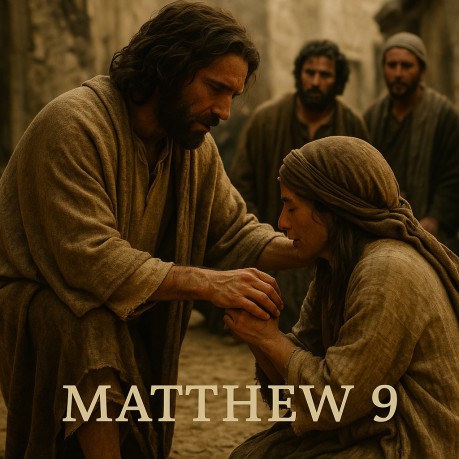
Matthew 9 Matthew 9:1-2 † Jesus begins by addressing sin, not just
sickness. Forgiveness is the greater healing. † The Mishnah taught that sickness could be
linked with sin (Nedarim 3:11). Jesus reveals His authority to
forgive, surpassing traditional views. † To us today, it shows Christ heals both body
and soul, with forgiveness as the true foundation. Matthew 9:3-6 † The scribes accuse Jesus of blasphemy. By
healing, He proves His authority to forgive sins. † Josephus described how blasphemy was treated
as a grave charge (Antiquities 13.293). Jesus redefines true
authority. † To us today, it proves Christ alone has the
authority to forgive sins. Matthew 9:7-8 † The miracle amazed the people, showing God’s
authority present in Christ. † To us today, it proves God's kingdom is not
future but was revealed in power through Christ. Matthew 9:9 † Tax collectors were despised, seen as
traitors to Israel. Christ calls Matthew, showing the kingdom
embraces even the outcast. † Tacitus noted how tax collectors were hated
across the empire (Annals 1.10). Jesus chose one as a disciple. † To us today, it shows Christ’s grace
extends beyond social barriers. Matthew 9:10-13 † Jesus cites Hosea 6:6, showing mercy is
greater than ritual. The kingdom calls sinners, not the
self-righteous. † Philo observed how true piety must include
mercy (On the Virtues 27). Jesus places this above outward sacrifice. † To us today, it shows that Christ’s mission
was to seek the broken, not the self-satisfied. Matthew 9:14-17 † Jesus identifies Himself as the groom. The
new covenant cannot fit into old covenant forms. † The Dead Sea Scrolls anticipated a new
covenant community (CD 6.19). Jesus fulfills it with His disciples. † To us today, it shows we live in the new
covenant, not bound to old forms. Matthew 9:18-19 † Faith in Jesus’ authority over death itself
is displayed. † To us today, it shows Christ has power over
life and death. Matthew 9:20-22 † The woman was unclean under the law, yet
Jesus makes her clean by faith. † The Mishnah details how such bleeding caused
exclusion (Niddah 7:1). Jesus overturns exclusion with healing. † To us today, it shows Christ restores those
considered untouchable. Matthew 9:23-26 † Jesus calls death "sleep," showing
His power to awaken the dead. † Josephus records flute players at funerals
(Wars 3.437). Matthew highlights the contrast between mourning and
Christ’s authority. † To us today, it shows Christ brings life
where the world sees only death. Matthew 9:27-31 † The title "Son of David" shows
messianic recognition. Faith opens their eyes physically and
spiritually. † To us today, it shows that Christ answers
those who come in faith, even when commanded to be silent. Matthew 9:32-34 † The Pharisees reject the obvious, accusing
Jesus of being empowered by Satan. Their blindness shows hardened
hearts. † Tacitus recorded how leaders often slandered
those they feared (Annals 4.34). Jesus faces the same treatment. † To us today, it shows unbelief twists truth
to resist Christ. Matthew 9:35-38 † Jesus fulfills Ezekiel 34, where God promised
to shepherd His people. The kingdom mission requires workers. † Eusebius said this verse pointed to the
apostolic mission spreading across the empire (Ecclesiastical History
3.1). † To us today, it shows the urgency of
proclaiming the fulfilled kingdom. † This is the fulfilled perspective we proclaim at
Fulfilled Prophecies † Source Index
By Dan Maines
Getting into a boat, Jesus
crossed over the sea and came to His own city. And they brought to
Him a paralytic lying on a stretcher. Seeing their faith, Jesus said
to the paralytic, "Take courage, son; your sins are forgiven."
And some of the scribes said
to themselves, "This man is blaspheming!" And Jesus,
perceiving their thoughts, said, "Why are you thinking evil in
your hearts? For which is easier, to say, 'Your sins are forgiven,'
or to say, 'Get up and walk'? But so that you may know that the Son
of Man has authority on earth to forgive sins"—then He said to
the paralytic, "Get up, pick up your stretcher and go home."
And he got up and went home.
But when the crowds saw this, they were awestruck, and they glorified
God, who had given such authority to men.
As Jesus went on from there, He
saw a man called Matthew sitting in the tax office; and He said to
him, "Follow Me!" And he got up and followed Him.
Then it happened that as
Jesus was reclining at the table in the house, behold, many tax
collectors and sinners came and were dining with Jesus and His
disciples. When the Pharisees saw this, they said to His disciples,
"Why is your Teacher eating with the tax collectors and
sinners?" But when Jesus heard this, He said, "It is not
those who are healthy who need a physician, but those who are sick.
Now go and learn what this means: 'I desire compassion, rather than
sacrifice,' for I did not come to call the righteous, but sinners."
Then the disciples of John
came to Him, asking, "Why do we and the Pharisees fast, but Your
disciples do not fast?" And Jesus said to them, "The
attendants of the groom cannot mourn as long as the groom is with
them, can they? But the days will come when the groom is taken away
from them, and then they will fast. But no one puts a patch of
unshrunk cloth on an old garment; for the patch pulls away from the
garment, and a worse tear results. Nor do people put new wine into
old wineskins; otherwise the wineskins burst, and the wine pours out,
and the wineskins are ruined; but they put new wine into fresh
wineskins, and both are preserved."
While He was saying these
things to them, behold, a synagogue official came and bowed down
before Him, and said, "My daughter has just died; but come and
lay Your hand on her, and she will become alive again." Jesus
got up from the table and began to accompany him, along with His
disciples.
And behold, a woman who had
been suffering from a hemorrhage for twelve years came up behind Him,
and touched the border of His cloak; for she was saying to herself,
"If I only touch His cloak, I will get well." But Jesus,
turning and seeing her, said, "Daughter, take courage; your
faith has made you well." And at once the woman was made well.
When Jesus came into the
official's house, and saw the flute players and the crowd in noisy
disorder, He said, "Leave; for the girl has not died, but is
asleep." And they began laughing at Him. But when the crowd had
been sent out, He entered and took her by the hand, and the girl got
up. And this news spread throughout that land.
As Jesus went on from there,
two men who were blind followed Him, crying out, "Have mercy on
us, Son of David!" And after He entered the house, the men who
were blind came up to Him, and Jesus said to them, "Do you
believe that I am able to do this?" They said to Him, "Yes,
Lord." Then He touched their eyes, saying, "It shall be
done for you according to your faith." And their eyes were
opened. And Jesus sternly warned them, saying, "See that no one
knows about this!" But they went out and spread the news about
Him throughout that land.
And as they were going out,
a demon-possessed man who was unable to speak was brought to Him.
After the demon was cast out, the man who was previously unable to
speak talked; and the crowds were amazed, and were saying, "Nothing
like this has ever been seen in Israel." But the Pharisees were
saying, "He casts out the demons by the ruler of the demons."
Jesus was going about all
the cities and villages, teaching in their synagogues, and
proclaiming the gospel of the kingdom, and healing every disease and
every sickness. Seeing the crowds, He felt compassion for them,
because they were distressed and downcast, like sheep without a
shepherd. Then He said to His disciples, "The harvest is
plentiful, but the workers are few. Therefore, plead with the Lord of
the harvest to send out workers into His harvest."
† Mishnah,
Nedarim 3:11; Niddah 7:1
† Josephus,
Antiquities 13.293; Wars 3.437
† Tacitus,
Annals 1.10; 4.34
† Philo, On the Virtues
27
† Dead Sea Scrolls, CD 6.19
†
Origen, Homilies on Luke 6
† Justin Martyr,
Dialogue with Trypho 91
† Eusebius,
Ecclesiastical History 3.1
Links