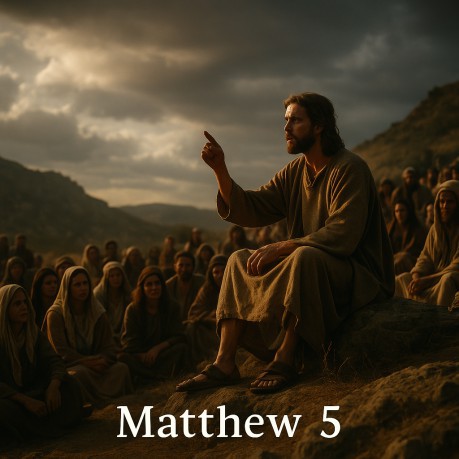
Matthew 5 Matthew 5:1-2 † This begins the Sermon on the Mount. Just as
Moses ascended Sinai to deliver the law, Jesus ascends the mountain
to deliver the fulfilled law of the kingdom. This is covenantal
imagery. † Philo often described mountains as places of
divine revelation (On the Life of Moses 2.70). Matthew portrays Jesus
as the new lawgiver. † To us today, this shows Christ as the one who
gives the true meaning of the law. Matthew 5:3 † Poverty of spirit means recognizing total
dependence on God. The kingdom belongs to those who humble
themselves. † The Dead Sea Scrolls describe the righteous
poor as those faithful to God despite hardship (1QM 14.7). Christ
fulfills this by promising them the kingdom. † To us today, it shows the kingdom is not for
the proud but for those who know their need for God. Matthew 5:4 † Mourning is covenantal, lamenting sin and the
broken state of Israel. Comfort comes in the fulfillment of God's
promises. † Isaiah 61:2 promised that the Messiah would
comfort those who mourn in Zion. Jesus declares that promise
fulfilled. † To us today, it shows that God's comfort is
real and present in Christ. Matthew 5:5 † This echoes Psalm 37:11. The gentle (meek)
are not weak but those who trust God instead of power. † Josephus contrasts zealots who sought the
land by violence with those who sought peace (Wars 2.433). Jesus
reverses expectations, giving the land to the meek. † To us today, it shows that God's kingdom is
not taken by force but given to the faithful. Matthew 5:6 † This is covenant hunger, longing for justice
and God's kingdom to be established. † The Mishnah records prayers for righteousness
and justice daily (Berakhot 5:1). Jesus declares that longing
satisfied in Him. † To us today, it proves Christ fulfills the
deepest desires for justice and righteousness. Matthew 5:7 † Mercy reflects God's own character. Those who
extend it will themselves be shown mercy. † Early church fathers like Cyprian highlighted
this as central to Christian life (On the Lord's Prayer 15). † To us today, it shows that mercy is the true
mark of the kingdom. Matthew 5:8 † Purity is not external ritual but inward
devotion. Seeing God fulfills the ultimate covenant promise. † The Dead Sea Scrolls describe purity as
essential for fellowship with God (1QS 3.7-9). Jesus promises direct
vision of God. † To us today, it shows true holiness is
inward, not ritual. Matthew 5:9 † Peacemakers embody God's nature. Sons of God
imitate His reconciling work. † Josephus records how zealots brought
destruction, not peace (Wars 4.138). Christ declares peacemakers as
the true heirs. † To us today, it shows that those who make
peace reflect God's family. Matthew 5:10-12 † The kingdom is promised not to the powerful
but to the persecuted. This parallels the prophets who suffered for
truth. † Tacitus describes how Rome mocked and
persecuted those faithful to God (Annals 15.44). Jesus assures them
of reward. † To us today, it shows suffering for Christ is
participation in the prophets' legacy, and the kingdom is ours. † This is the fulfilled perspective we proclaim at
Fulfilled Prophecies † Source Index
By Dan Maines
Now when Jesus saw the crowds,
He went up on the mountain; and after He sat down, His disciples came
to Him. And He opened His mouth and began to teach them, saying:
"Blessed are the poor in
spirit, for theirs is the kingdom of heaven."
"Blessed are those who
mourn, for they shall be comforted."
"Blessed are the gentle,
for they shall inherit the earth."
"Blessed are those who
hunger and thirst for righteousness, for they shall be satisfied."
"Blessed are the merciful,
for they shall receive mercy."
"Blessed are the pure in
heart, for they shall see God."
"Blessed are the
peacemakers, for they shall be called sons of God."
"Blessed are those who
have been persecuted for the sake of righteousness, for theirs is the
kingdom of heaven. Blessed are you when people insult you and
persecute you, and falsely say all kinds of evil against you because
of Me. Rejoice and be glad, for your reward in heaven is great; for
in the same way they persecuted the prophets who were before you."
† Philo, On
the Life of Moses 2.70
† Dead Sea Scrolls:
1QM 14.7; 1QS 3.7-9
† Isaiah 61:2; Psalm
37:11
† Josephus, Wars 2.433; 4.138
†
Mishnah, Berakhot 5:1
† Cyprian, On the
Lord's Prayer 15
† Tacitus, Annals 15.44
Links