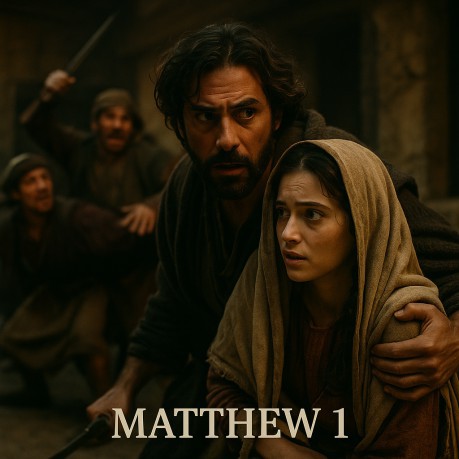
Matthew 1 Matthew 1:1 † Matthew roots Jesus directly in covenant
history. He is the son of David, the promised King, and the son of
Abraham, through whom all nations would be blessed (Genesis 12:3; 2
Samuel 7:12-16). This confirms Jesus as the rightful heir of both the
throne and the covenant. † Josephus records how the Jews carefully
preserved genealogies to verify kingship and priesthood (Against
Apion 1.30-31). Matthew uses this same standard to present Jesus as
the rightful King. † To us today, this shows our faith is grounded
in fulfilled promises, not myths. Christ is the culmination of God's
plan through history. Matthew 1:2-6 † The genealogy highlights God's grace by
including Tamar, Rahab, and Ruth. Tamar disguised herself as a
prostitute (Genesis 38), Rahab was a Canaanite prostitute (Joshua 2),
and Ruth was a Moabite foreigner. God worked His plan even through
the weak and unexpected. † Philo emphasizes that divine providence rules
history, even when human actions are questionable (On Providence II).
This principle is seen in how God used these women. † To us today, it proves no one is excluded by
background or past. God's kingdom embraces all nations, just as seen
in Christ's lineage. Matthew 1:7-11 † Matthew points to the exile, the lowest point
in Israel's history, when the Davidic throne seemed lost. Yet the
line of David was preserved, showing that God's promises could not be
broken. † Tacitus notes how Jews clung to hope of
restoration during exile (Histories 5.13). Matthew declares that
Christ is that restoration. † To us today, it shows that even when nations
collapse, God's covenantal plan stands firm. Matthew 1:12-16 † The line continues through exile until it
reaches Joseph. Although Joseph was not Jesus' biological father, his
adoption of Jesus gave Him full legal right to the Davidic throne. † The Dead Sea Scrolls show expectation for a
Davidic Messiah (4QFlorilegium, 4Q252). Matthew shows Jesus is that
fulfillment. † To us today, this proves God's timing is
perfect. Even when centuries passed, His plan was not abandoned. Matthew 1:17 † Matthew organizes history into three sets of
fourteen. The number fourteen corresponds to the numeric value of
David's name (דוד
= 14). This reinforces Jesus as the true
Davidic heir. † The Mishnah records how genealogies were used
to prove heritage (Kiddushin 4:1). Matthew shows divine order and
intention in Jesus' arrival. † To us today, it proves history is not random.
God arranges it with purpose to lead to Christ. Matthew 1:18-19 † Joseph's dilemma shows the tension between
law and mercy. To the world, Mary appeared unfaithful. Yet the
conception was by the Holy Spirit, fulfilling Isaiah 7:14. † Josephus testifies to the strict standards of
Jewish marriage law (Antiquities 15.259). Joseph's choice of mercy
demonstrates true righteousness. † To us today, Joseph's example teaches us to
act with grace even when we don't understand God's plan. Matthew 1:20-21 † The angel calls Joseph “son of David,”
reminding him of his royal lineage. The name Jesus (Yeshua) means
Yahweh saves, pointing directly to His mission of redemption. † Justin Martyr stressed this as fulfillment of
prophecy in Isaiah (Dialogue with Trypho 43). † To us today, it assures us that salvation is
God's work, not man's. Matthew 1:22-23 † Matthew ties Jesus' birth directly to Isaiah
7:14. The sign of Immanuel is fulfilled here, not postponed for
another age. † Irenaeus pointed to this as proof of Christ's
divinity (Against Heresies 3.21.4). † To us today, it means we live in covenant
fellowship with God. He is with us, not distant. Matthew 1:24-25 † Joseph obeyed, giving Jesus legal claim to
David's throne. His faith secured the line of promise. † Origen noted Joseph's obedience as part of
God's providential plan (Commentary on Matthew 1.5). † To us today, obedience is the true mark of
faith. When God directs, we act. † This is the fulfilled perspective we proclaim at
Fulfilled Prophecies † Source Index
By Dan Maines
The record of the genealogy of
Jesus the Messiah, the son of David, the son of Abraham:
Abraham fathered Isaac, Isaac
fathered Jacob, and Jacob fathered Judah and his brothers. Judah
fathered Perez and Zerah by Tamar, Perez fathered Hezron, and Hezron
fathered Ram. Ram fathered Amminadab, Amminadab fathered Nahshon, and
Nahshon fathered Salmon. Salmon fathered Boaz by Rahab, Boaz fathered
Obed by Ruth, and Obed fathered Jesse. Jesse fathered David the king.
Solomon fathered Rehoboam,
Rehoboam fathered Abijah, and Abijah fathered Asa. Asa fathered
Jehoshaphat, Jehoshaphat fathered Joram, and Joram fathered Uzziah.
Uzziah fathered Jotham, Jotham fathered Ahaz, and Ahaz fathered
Hezekiah. Hezekiah fathered Manasseh, Manasseh fathered Amon, and
Amon fathered Josiah. Josiah fathered Jeconiah and his brothers, at
the time of the deportation to Babylon.
After the deportation to
Babylon: Jeconiah fathered Shealtiel, and Shealtiel fathered
Zerubbabel. Zerubbabel fathered Abihud, Abihud fathered Eliakim, and
Eliakim fathered Azor. Azor fathered Zadok, Zadok fathered Achim, and
Achim fathered Eliud. Eliud fathered Eleazar, Eleazar fathered
Matthan, and Matthan fathered Jacob. Jacob fathered Joseph the
husband of Mary, by whom Jesus was born, who is called the Messiah.
So all the generations from
Abraham to David are fourteen generations; from David to the
deportation to Babylon, fourteen generations; and from the
deportation to Babylon to the Messiah, fourteen generations.
Now the birth of Jesus the
Messiah was as follows: when His mother Mary had been betrothed to
Joseph, before they came together she was found to be pregnant by the
Holy Spirit. And her husband Joseph, since he was a righteous man and
did not want to disgrace her, planned to send her away secretly.
But when he had thought this
over, behold, an angel of the Lord appeared to him in a dream,
saying, “Joseph, son of David, do not be afraid to take Mary as
your wife; for the Child who has been conceived in her is of the Holy
Spirit. She will give birth to a Son; and you shall name Him Jesus,
for He will save His people from their sins.”
Now all this took place so
that what was spoken by the Lord through the prophet would be
fulfilled: “Behold, the virgin will conceive and give birth to a
Son, and they shall name Him Immanuel,” which translated means,
“God with us.”
And Joseph awoke from his
sleep and did as the angel of the Lord commanded him, and took Mary
as his wife, but kept her a virgin until she gave birth to a Son; and
he named Him Jesus.
† Josephus,
Against Apion 1.30-31; Antiquities 15.259
†
Philo, On Providence II
† Tacitus, Histories
5.13
† Dead Sea Scrolls: 4QFlorilegium,
4Q252
† Mishnah Kiddushin 4:1
†
Justin Martyr, Dialogue with Trypho 43
†
Irenaeus, Against Heresies 3.21.4
† Origen,
Commentary on Matthew 1.5
Links