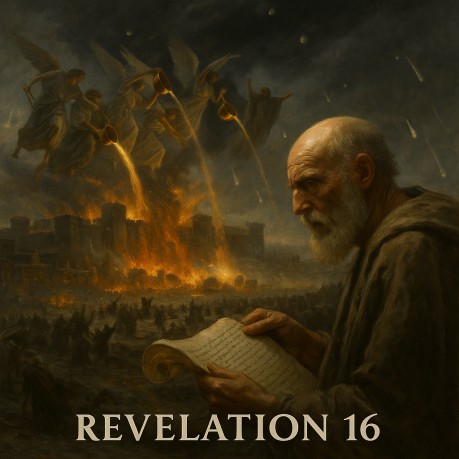
Revelation 16:1 † The bowls are covenant judgments, paralleling
the plagues of Egypt. They are poured out upon the land (Greek: ge),
meaning the land of Israel. Revelation 16:2 † The sores recall the sixth plague of Egypt
(Exodus 9:9-11). They symbolize inner corruption and judgment on
those who gave allegiance to Caesar instead of Christ. Revelation 16:3 † This echoes the first Egyptian plague (Exodus
7:20-21). The sea represents the nations. The Jewish revolt led to
bloody battles on the Sea of Galilee, where thousands perished. Revelation 16:4-6 † Rivers turned to blood symbolize divine
justice. Those who shed the blood of the saints now drink judgment
themselves. Revelation 16:7 † The altar represents the prayers of the
martyrs (Revelation 6:9-10). Their cry for vindication is answered in
the bowls of wrath. Revelation 16:8-9 † The scorching sun symbolizes oppressive
judgment. Instead of repenting, the people blaspheme, proving their
hardness of heart. Revelation 16:10-11 † Darkness recalls the ninth Egyptian plague
(Exodus 10:21-23). The throne of the beast refers to Rome's authority
exercised through Jerusalem's leaders. Revelation 16:12 † The Euphrates marked the boundary of invading
powers. Its drying recalls Cyrus drying the Euphrates to conquer
Babylon (Isaiah 44:27-28). Here, Rome's eastern legions advanced into
Judea. Revelation 16:13-14 † Frogs recall Egypt's second plague (Exodus
8:2-6). Here they symbolize demonic propaganda drawing nations into
battle. Revelation 16:15 † This interjection from Christ recalls His
warnings in Matthew 24:42-44. His coming as a thief was imminent, not
delayed thousands of years. Revelation 16:16 † Har-Magedon (Armageddon) means "mountain
of Megiddo." Symbolically, it recalls decisive battles of
Israel's history. Here it represents the climactic war against
Jerusalem. Revelation 16:17-18 † The declaration "It is done"
signals the completion of covenant judgment. Earthquake language
symbolizes the collapse of nations and cities. Revelation 16:19-21 † The "great city" is Jerusalem,
divided by factions during the war. Josephus records how three rival
groups slaughtered each other inside the walls (Wars 5.1.1). How it applies to us today † God's judgments are just and certain. The
fall of Jerusalem proves Christ's words cannot fail. † This is the fulfilled perspective we proclaim at
Fulfilled Prophecies † Source Index
By Dan MainesRevelation 16
Then I heard a loud voice
from the temple, saying to the seven angels, "Go and pour out on
the earth the seven bowls of the wrath of God."
† Proof, Josephus
(Wars 5.13.6) records the unparalleled horrors of Jerusalem's
destruction, showing God's wrath poured out on the covenant breakers.
So the first angel went and
poured out his bowl on the earth; and a harmful and painful sore
afflicted the people who had the mark of the beast and who worshiped
his image.
†
Proof, the moral and spiritual decay of Jerusalem's leaders was
evident, as Josephus describes their cruelty and blasphemies (Wars
5.10.5).
The second angel poured out
his bowl into the sea, and it became blood like that of a dead
person, and every living thing in the sea died.
†
Proof, Josephus (Wars 3.10.9) describes the lake filled with corpses
and blood, matching this imagery.
Then the third angel
poured out his bowl into the rivers and the springs of waters; and
they became blood. And I heard the angel of the waters saying,
"Righteous are You, the One who is and who was, the Holy One,
because You judged these things; for they poured out the blood of
saints and prophets, and You have given them blood to drink. They
deserve it."
† Proof, Jesus accused Jerusalem
of killing the prophets (Matthew 23:37). Josephus records rivers of
blood flowing during the Roman siege (Wars 6.9.4).
And I heard the altar
saying, "Yes, Lord God, the Almighty, true and righteous are
Your judgments."
The fourth angel poured
out his bowl upon the sun, and it was given power to scorch people
with fire. And the people were scorched with fierce heat; and they
blasphemed the name of God who has the power over these plagues, and
they did not repent so as to give Him glory.
† Proof, Josephus (Wars
5.13.6) laments that even under extreme suffering, the people grew
more defiant against God.
Then the fifth angel
poured out his bowl on the throne of the beast, and his kingdom
became darkened; and they gnawed their tongues because of pain, and
they blasphemed the God of heaven because of their pain and their
sores, and they did not repent of their deeds.
†
Proof, Tacitus (Histories 5.13) records famine, disease, and chaos in
Judea, showing the beast's realm consumed in darkness.
The sixth angel poured out
his bowl on the great river Euphrates, and its water was dried up, so
that the way would be prepared for the kings from the east.
† Proof, Josephus (Wars 3.4.2) lists
auxiliaries from the east who joined Rome in the war.
And I saw coming out of
the mouth of the dragon, and out of the mouth of the beast, and out
of the mouth of the false prophet, three unclean spirits like frogs;
for they are spirits of demons, performing signs, which go out to the
kings of the entire world, to gather them together for the war of the
great day of God, the Almighty.
† Proof, Josephus (Wars 4.6.3)
describes false prophets in Jerusalem, deceiving people with lying
signs while Rome prepared its assault.
"Behold, I am coming
like a thief. Blessed is the one who stays awake and keeps his
clothes, so that he will not walk about naked, and people will not
see his shame."
And they gathered them
together to the place which in Hebrew is called Har-Magedon.
† Proof, Josephus (Wars 5.1.5)
records multitudes gathered in Jerusalem, where the final
confrontation occurred.
Then the seventh angel
poured out his bowl upon the air, and a loud voice came out of the
temple from the throne, saying, "It is done." And there
were flashes of lightning and sounds and peals of thunder; and there
was a great earthquake such as there had not been since mankind came
to be on the earth, so great an earthquake was it, and so mighty.
†
Proof, Josephus (Wars 4.4.5) records earthquakes and cosmic signs
before Jerusalem's fall.
The great city was split
into three parts, and the cities of the nations fell. Babylon the
great was remembered before God, to give her the cup of the wine of
His fierce wrath. And every island fled, and no mountains were found.
And huge hailstones, weighing about a talent each, came down from
heaven upon people; and people blasphemed God because of the plague
of the hail, because the plague was extremely severe.
†
The hailstones represent the Roman catapult stones hurled into the
city, some weighing nearly a talent. Josephus (Wars 5.6.3) describes
massive white stones crashing into Jerusalem.
†
The bowls reveal that rebellion and idolatry bring wrath, while
faithfulness brings preservation.
† The
church today rests secure in Christ's finished work, knowing His
kingdom is unshakable.
† Exodus
7:20-21; 9:9-11; 10:21-23 – Egyptian plagues
†
Leviticus 26; Deuteronomy 28 – covenant curses
†
Matthew 23:37; 24:42-44 – judgment on Jerusalem, thief imagery
†
Isaiah 44:27-28 – Cyrus drying the Euphrates
†
Josephus, Wars 3.4.2; 3.10.9; 4.4.5; 4.6.3; 5.1.1; 5.6.3; 5.10.5;
5.13.6; 6.9.4 – rivers of blood, catapult stones, corruption,
factional divisions, earthquakes, famine
†
Tacitus, Histories 5.13 – chaos in Judea
†
Jeremiah 7:16 – intercession forbidden
Links