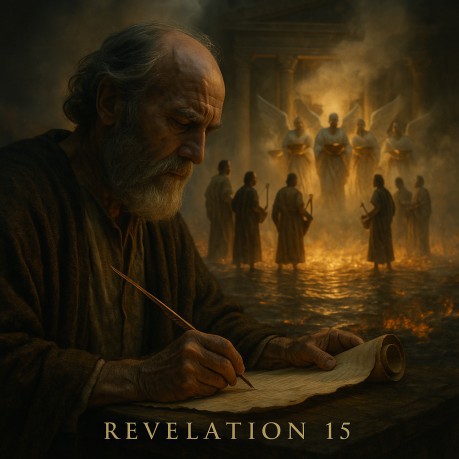
Revelation 15:1 † The seven last plagues correspond to the
covenant curses of Leviticus 26 and Deuteronomy 28. These plagues
complete God's wrath, signifying the final judgment on apostate
Jerusalem. Revelation 15:2 † The sea of glass reflects God's throne, as in
Revelation 4:6. The fire mixed with it symbolizes judgment. The
faithful stand victorious, showing that even in death, they overcame
the beast. Revelation 15:3-4 † The song of Moses recalls Exodus 15, when
Israel celebrated deliverance from Egypt. The song of the Lamb
celebrates deliverance from the old covenant's bondage and judgment
on Jerusalem. Revelation 15:5-6 † The heavenly temple, not the earthly, is the
source of true judgment. The angels are clothed in priestly attire,
showing that judgment is holy and righteous. Revelation 15:7 † Golden bowls recall temple vessels used in
worship, now filled with wrath instead of incense. This signifies the
transfer from worship to judgment. Revelation 15:8 † The smoke recalls the Shekinah glory filling
the tabernacle (Exodus 40:34-35). Here it shows God's presence in
judgment. No one could enter until judgment was complete, meaning
intercession had ended. How it applies to us today † God's judgments are righteous and complete,
leaving no doubt of His sovereignty. † This is the fulfilled perspective we proclaim at
Fulfilled Prophecies † Source Index
By Dan MainesRevelation 15
Then I saw another sign in
heaven, great and marvelous, seven angels who had seven plagues,
which are the last, because in them the wrath of God is finished.
† Proof, Jesus declared, "All
these things will come upon this generation" (Matthew 23:36).
The destruction of Jerusalem in AD 70 is the historical fulfillment.
And I saw something like a
sea of glass mixed with fire, and those who had been victorious over
the beast and his image and the number of his name, standing on the
sea of glass, holding harps of God.
† Proof, Tacitus (Annals 15.44)
records Christians enduring persecution under Nero, showing their
triumph through martyrdom.
And they sang the song of
Moses, the bond-servant of God, and the song of the Lamb, saying,
"Great and marvelous are Your works, Lord God, the Almighty;
righteous and true are Your ways, King of the nations! Who will not
fear You, Lord, and glorify Your name? For You alone are holy; for
all the nations will come and worship before You, for Your righteous
acts have been revealed."
† Proof, the merging of both
songs shows continuity and fulfillment, the old covenant shadow and
the new covenant reality. Philo wrote of Israel's songs of
deliverance as rehearsals of God's greater redemption (Philo, On the
Life of Moses 1.19).
After these things I
looked, and the temple of the tabernacle of testimony in heaven was
opened, and the seven angels who had the seven plagues came out of
the temple, clothed in linen, clean and bright, and their chests
wrapped with golden sashes.
†
Proof, Josephus (Wars 5.5.7) notes that the temple priests wore white
linen garments, paralleling the angelic attire here.
And one of the four living
creatures gave the seven angels seven golden bowls full of the wrath
of God, who lives forever and ever.
† Proof,
the Mishnah (Tamid 5:4) describes priests using golden bowls for
offerings. John reverses this imagery to show that Jerusalem's
offerings now result in wrath.
And the temple was filled
with smoke from the glory of God and from His power; and no one was
able to enter the temple until the seven plagues of the seven angels
were finished.
† Proof, Jeremiah
7:16 shows God forbidding intercession for Jerusalem when its
judgment was sealed. Revelation echoes this finality.
† The
saints' victory song shows that even in death, faith conquers the
beast.
† The merging of Moses' song and the
Lamb's song proves that all of God's promises are fulfilled in
Christ.
† We live in the reality of the new
covenant temple, where God's presence is not in stone buildings but
in His people.
† Leviticus
26; Deuteronomy 28 – covenant curses
†
Matthew 23:36 – all judgment on that generation
†
Exodus 15 – song of Moses
† Philo, On the
Life of Moses 1.19 – songs of deliverance
†
Josephus, Wars 5.5.7 – priestly garments
†
Mishnah, Tamid 5:4 – golden bowls in worship
†
Exodus 40:34-35 – glory filling the tabernacle
†
Jeremiah 7:16 – no intercession for Jerusalem
†
Tacitus, Annals 15.44 – Nero's persecution of Christians
Links