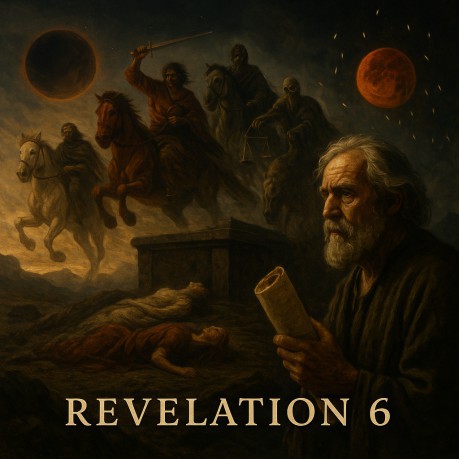
Revelation 6:1-2 † The rider is not Christ, since Christ opens
the seals, He does not ride out from His own hand. The sequence
mirrors the order of the Olivet Discourse, false deliverers and
imperial aggression first, wars second, famine third, pestilence and
death fourth, martyrdom fifth, cosmic signs sixth, which argues this
is a judgment cycle, not Christ's personal advance. Revelation 6:3-4 † The red horse removes peace and unleashes
internecine killing. The Greek term for earth, ge, often means the
land, that is, the land of Israel, not the globe. The scope matches
the covenant land under judgment. Revelation 6:5-6 † Scales indicate rationing and price control.
A denarius is a day's wage, Matthew 20:2. A quart of wheat is roughly
one person's daily ration. The math means a laborer spends an entire
day's pay to feed only himself, which proves severe scarcity rather
than routine inflation. Revelation 6:7-8 † The pallid horse gathers the prior judgments
into a compound catastrophe, sword, famine, pestilence, chaos. The
fraction, a fourth of the land, again points to a bounded, regional
judgment, not total planetary destruction. Revelation 6:9-11 † The martyrs are beneath the altar because
their blood has been poured out like sacrificial blood at the base of
the altar, Leviticus 4:7. The image proves temple liturgy is in view,
which grounds the scene in covenantal judgment on the land that shed
righteous blood, Matthew 23:35. Revelation 6:12-14 † The prophets used identical cosmic language
for historical downfalls, which proves the genre here, Isaiah against
Babylon, Isaiah 13:10, Ezekiel against Egypt, Ezekiel 32:7 to 8, Joel
against a near day of the Lord, Joel 2:30 to 31. John's signs signal
covenant collapse, not astrophysical annihilation. Revelation 6:15-17 † The plea to the mountains quotes Hosea 10:8
and is cited by Jesus on the way to the cross about Jerusalem's
coming doom, Luke 23:30. That intertext anchors the scene to first
century judgment on the covenant people who rejected the Messiah. Synthesis and timeline proof † The six seals track Jesus's sequence in
Matthew 24, false deliverers and imperial force, wars, famines,
pestilences and death, persecution, cosmic signs, followed by the
acknowledgment of wrath. The same order in two independent texts is
strong internal evidence that Revelation is expounding the same
predicted crisis, culminating in the destruction of Jerusalem in the
first century. How it applies to us today † Christ governs history. The same Lamb who
opened judgments then rules nations now, which gives the church
courage in unstable times. † This is the fulfilled perspective we proclaim at
Fulfilled Prophecies † Source Index
By Dan MainesRevelation 6
Then I saw when the Lamb
broke one of the seven seals, and I heard one of the four living
creatures saying as with a voice of thunder, "Come." I
looked, and behold, a white horse, and the one who sat on it had a
bow, and a crown was given to him, and he went out conquering and to
conquer.
†
Proof, the crown is granted by permission, not by right, and the bow
without arrows fits the imagery of imposed dominance more than
righteous rule. Roman imperial expansion in the late 60s, coupled
with client king movements, matches a conqueror granted authority.
†
Historical fit, Josephus recounts Rome's move to suppress Judea and
surrounding territories in stages before the final siege, showing a
conqueror going out and prevailing repeatedly, Wars 2.18.
When He broke the second
seal, I heard the second living creature saying, "Come."
And another, a red horse, went out, and to him who sat on it, it was
granted to take peace from the earth, and that people would kill one
another, and a great sword was given to him.
† Proof,
Josephus records factional slaughters inside Jerusalem before and
during the siege, with zealot groups and Idumeans butchering one
another while Romans encircled the city, Wars 4.3 and 4.5.
†
Parallel with Jesus, "You will be hearing of wars and rumors of
wars," Matthew 24:6, appears first in His list, then comes
famine, then pestilence, then persecution, exactly the seal order.
When He broke the third
seal, I heard the third living creature saying, "Come." I
looked, and behold, a black horse, and the one who sat on it had a
pair of scales in his hand. And I heard something like a voice in the
center of the four living creatures saying, "A quart of wheat
for a denarius, and three quarts of barley for a denarius, and do not
damage the oil and the wine."
† Proof, Josephus
narrates that famine inside Jerusalem became so extreme that people
fought over scraps and committed unspeakable acts, Wars 5.10.2 to
5.10.3. The protected oil and wine fit vineyards and groves that can
be spared by besiegers or survive briefly while grain markets
collapse, which matches siege economics.
†
The order again aligns with Jesus, "famines," Matthew 24:7,
immediately after wars.
When the Lamb broke the
fourth seal, I heard the voice of the fourth living creature saying,
"Come." I looked, and behold, an ashen horse, and the one
who sat on it had the name Death, and Hades was following with him.
Authority was given to them over a fourth of the earth, to kill with
sword and famine and plague, and by the wild animals of the earth.
†
Proof, Tacitus writes of portents and disasters in Judea during the
war years, and Josephus confirms mass deaths from sword, hunger, and
disease in the besieged land, Tacitus, Histories 5.13, Josephus, Wars
6.9.
† The inclusion of wild animals reflects
the breakdown of civil order and sanitation outside fortified areas,
which followed depopulation during the campaigns.
When the Lamb broke the
fifth seal, I saw underneath the altar the souls of those who had
been killed because of the word of God, and because of the testimony
which they had maintained, and they cried out with a loud voice,
saying, "How long, O Lord, holy and true, will You refrain from
judging and avenging our blood on those who live on the earth."
And a white robe was given to each of them, and they were told that
they were to rest for a little while longer, until the number of
their fellow servants and their brothers who were to be killed even
as they had been, was completed also.
† Proof, in
Acts and early Roman accounts, believers are slain for the testimony
of Jesus before 70, Stephen, James, Peter's imprisonment, Paul's
beatings, with Nero's later massacre as wider Roman corroboration,
Acts 7, Acts 12, Tacitus, Annals 15.44.
† The
white robe now, the vengeance soon, shows a measured delay that
matches the brief interval before the fall of Jerusalem, a little
while longer, not millennia.
And I looked when He
broke the sixth seal, and there was a great earthquake, and the sun
became as black as sackcloth made of hair, and the whole moon became
like blood, and the stars of the sky fell to the earth, as a fig tree
drops its unripe figs when shaken by a great wind. The sky was split
apart like a scroll when it is rolled up, and every mountain and
island was removed from its place.
†
Proof, Jesus applies the same sun darkened, stars falling language to
the fall of Jerusalem in that generation, Matthew 24:29 to 34, which
sets the interpretive template.
†
Corroboration, Josephus reports portents in the skies over Jerusalem
and a great comet like a sword, and Tacitus also mentions prodigies,
Josephus, Wars 6.5.3, Tacitus, Histories 5.13. These do not
constitute literal starfall, they are signs accompanying the city's
doom.
Then the kings of the
earth, the eminent people, the commanders, the wealthy, the strong,
and every slave and free person hid themselves in the caves and among
the rocks of the mountains, and they said to the mountains and the
rocks, "Fall on us and hide us from the sight of Him who sits on
the throne, and from the wrath of the Lamb, for the great day of
Their wrath has come, and who is able to stand."
†
Proof, when the siege tightened, citizens and rebels alike hid in
caves, cisterns, and subterranean vaults. Josephus describes people
retreating into underground passages and tombs to escape slaughter,
Wars 6.7.3, 6.9.4.
† The conclusion, the day
of wrath has come, fits the near time statements that frame
Revelation, must soon take place, the time is near, Revelation 1:1 to
3. The sixth seal is the public acknowledgment that judgment has
arrived.
† The repeated use of ge,
land, and the temple altar imagery, plus Hosea's mountains text and
Jesus's citation in Luke, concentrate the target on the covenant
land, not on distant future global cataclysm.
†
External sources, Josephus and Tacitus, independently report civil
war, famine, pestilence, portents, mass death, and hiding in caves
during the exact period. This convergence of prophetic pattern,
covenant imagery, and historical reportage functions as proof, not
mere quotation.
† God's prophetic
word is trustworthy. The precise match between Jesus's outline,
John's seals, and verified events teaches us to read Scripture in its
covenant context and to expect fulfillment according to God's
timetable.
† Our suffering is seen and kept
under the altar. The prayers of the persecuted rise as incense, and
vindication is certain, whether in history or at the final
judgment.
† Faithfulness under pressure is
the church's calling. We endure with calm confidence, since the Lamb
reigns and no sword, famine, or plague can sever us from His love.
† Josephus,
Jewish War 2.18, 4.3 to 4.5, 5.10.2 to 5.10.3, 6.5.3, 6.7.3, 6.9.4
†
Tacitus, Histories 5.13
† Tacitus, Annals
15.44
† Matthew 20:2, daily wage as a
denarius
† Matthew 24:6 to 34, order of wars,
famine, pestilence, persecution, cosmic signs, this generation
†
Luke 23:30, mountains fall on us applied to Jerusalem
†
Hosea 10:8, mountains fall on us
† Leviticus
4:7, blood poured at the base of the altar
†
Joel 2:30 to 31, Isaiah 13:10, Ezekiel 32:7 to 8, prophetic cosmic
language for historical judgment
†
Tertullian, Apology 50, martyr blood as testimony
Links