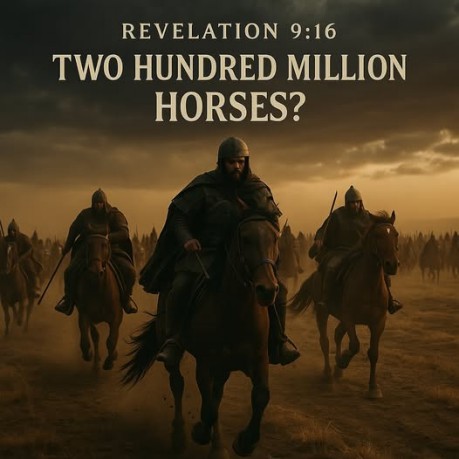
Revelation
9:16 †
This verse is often used by futurists to claim that Revelation
cannot be fulfilled in the first century, since no literal army of
200 million ever marched in history. But this assumes John's vision
should be read as a newspaper report rather than as apocalyptic
imagery. The book of Revelation is written in symbolic, prophetic
language, just as Ezekiel, Daniel, and Zechariah employed. John
"heard the number of them," emphasizing the visionary and
symbolic nature of the army. It is not meant to be taken as a census
report but as a symbol of overwhelming judgment. † For starters
there never was and never will be two hundred million horsemen, let
alone two hundred million horses. The impossibility of a literal
reading forces us to see the symbolic nature of the vision. The
number of locust soldiers in Revelation 9:16 is not literal, just as
a similarly over inflated figure is found in the Apocalypse of
Daniel 2:3-4 and in Pseudo-Philo 31:2, which could not have been
literal. The prophetic style often employs exaggerated numbers to
drive home the scope of judgment. † If the army of
the sixth trumpet is Titus' army at the siege of Jerusalem, then
what about verse 16: "The number of the mounted troops was two
hundred million"? Revelation 9:16 most literally reads, "And
the number of the armies of the cavalry [was] twice ten thousand ten
thousands." To reach the figure "two hundred million,"
translators of the NIV multiplied 20,000 by 10,000. But "two
hundred million" is an inconceivable and irrational number for
any army in history. The phrase "twice ten thousand ten
thousands" is far better understood as a symbolic way of
describing a countless multitude, an overwhelming force beyond human
reckoning. It is not meant to be an arithmetic equation but a
prophetic picture. † The book of
Revelation consistently uses symbolic numbers to express spiritual
truths. For example, the 144,000 in Revelation 7 and 14 is not a
literal census of saved Israelites but a symbolic representation of
the complete covenant people, twelve times twelve, multiplied by a
thousand for fullness. Likewise, the 1,600 stadia in Revelation
14:20, a measurement of blood flowing from the winepress of
judgment, is not to be taken as a literal river of blood stretching
hundreds of miles, but as a symbolic picture of total devastation.
In the same way, "twice ten thousand ten thousands" in
Revelation 9:16 conveys the vastness of the army without requiring a
literal count of soldiers or horses. † This same method
of symbolic numbers is found in Daniel, which provides the
background for Revelation. Daniel 9 speaks of seventy weeks that are
"decreed for your people and your holy city" (Daniel
9:24). The seventy weeks are not literal seven-day weeks but a
symbolic framework of seventy sevens, leading to the coming of
Messiah and the destruction of the city and sanctuary. This shows
that prophetic numbers were never intended to be read in a strict
arithmetic sense but as divinely structured symbols pointing to
covenantal fulfillment. Revelation builds on this same tradition,
employing numbers not as mathematical totals but as theological
markers. † Daniel 7 also
presents a vision of a beast with ten horns, which represent kings
or kingdoms (Daniel 7:24). Revelation takes this very imagery and
applies it again in Revelation 13 and 17, where the beast also has
ten horns, explained as ten kings who would rise and give their
authority to the beast. Just as no one expects to literally see a
monster with ten horns walking the earth, the vision communicates
spiritual and political realities through symbolic numbers.
Revelation 9:16 must be read the same way: its numerical imagery is
not literal arithmetic but symbolic language consistent with the
prophetic style inherited from Daniel. † Zechariah also
provides a crucial background. In Zechariah 1:8-11 and Zechariah
6:1-8, the prophet sees visions of horsemen and chariots sent out
over the earth. These horses are not literal armies but symbolic
agents of God's judgment and activity in the nations. Revelation
takes this same imagery and expands it with the four horsemen in
Revelation 6, and later the countless cavalry in Revelation 9. John
is not describing actual horse armies that could be numbered but is
following the same prophetic tradition: horses as symbols of divine
judgment, multiplied here to an immeasurable degree to stress the
completeness of the coming destruction. † Ezekiel adds even
more context with his prophecy of Gog and Magog in Ezekiel 38-39.
There God gathers together an immense host from the nations to come
against His people, described in overwhelming and exaggerated
military terms. The language of shields, bucklers, swords, horses,
and a vast army covers the land like a cloud. This is not a literal
census of soldiers but a prophetic image of a terrifying and
unstoppable invasion used to show God's power in judgment.
Revelation later reuses this same Gog and Magog imagery in
Revelation 20 to speak of Satan's final rebellion. The style is
consistent: Ezekiel's apocalyptic war language and John's visions
both use vast numbers and imagery to describe divine judgment, not
to record military logistics. † In the ancient
world, numbers were used to express greatness, immensity, or divine
completeness. Psalm 68:17 says, "The chariots of God are
myriads, thousands upon thousands; The Lord is among them as at
Sinai." No one supposes the psalmist counted literal chariots.
Instead, the text communicates the immeasurable power of God's
armies. In the same way, Revelation 9:16 presents a vision of an
innumerable host, a symbol of judgment so vast that John could only
record the number as it was told to him. † Josephus, the
first-century Jewish historian, records the massive scale of Rome's
campaigns against Judea. In "Wars of the Jews" (Book
6.9.3), he describes how the Roman legions, auxiliaries, and allied
forces, along with countless mercenaries and noncombatants, swelled
into vast multitudes surrounding Jerusalem. While Rome's actual
armies numbered in the hundreds of thousands, not millions, John's
symbolic vision expressed the totality of judgment coming upon the
land. The language magnifies the horror to show that the destruction
was beyond human escape or resistance. † Tacitus, another
first century historian, likewise testifies that the Roman forces
gathered against Jerusalem were immense: "Thus the whole of the
east was stirred up and sent its strength into that war"
(Histories 5.1). This aligns perfectly with John's vision: not a
literal headcount of 200 million soldiers and horses, but a
prophetic picture of the full might of Rome and her allies unleashed
on apostate Jerusalem. † The purpose of
this number is to highlight the certainty and completeness of
judgment. Revelation is not telling us to expect a physical army of
200 million horsemen, or 200 million horses, but warning us that
when God's wrath was poured out on Jerusalem, no force on earth
could stand against it. This was fulfilled in AD 70 when Jerusalem
was destroyed, just as Jesus foretold in Matthew 24:34, "Truly
I say to you, this generation will not pass away until all these
things take place." How it applies today:
Revelation 9:16 reminds us not to be distracted by inflated literal
numbers or futurist speculation. The vision shows that when God
decrees judgment, it is unstoppable, vast, and overwhelming. Today
we should see this as a call to trust in Christ, who delivers His
people from wrath. We are not waiting for an army of 200 million
horsemen to rise in our time. We are called to live in the New
Covenant reality, confident that the old order has passed, the New
Jerusalem has come, and God's kingdom is established among His
people. † This is the fulfilled
perspective we proclaim at Fulfilled Prophecies † Source Index
By Dan Maines
The number of the armies of the horsemen was two
hundred million. I heard the number of them.
†
Josephus, Wars of the Jews Book 6.9.3 (Project Gutenberg, CCEL)
†
Tacitus, Histories 5.1 (Perseus Digital Library, LacusCurtius)
†
Apocalypse of Daniel 2:3-4
† Pseudo-Philo
31:2
† Daniel 7:24; Daniel 9:24-27
†
Zechariah 1:8-11; Zechariah 6:1-8
† Ezekiel
38-39; Revelation 20
† Revelation 6;
Revelation 7; Revelation 13; Revelation 14:20; Revelation 17
†
Psalm 68:17; Matthew 24:34
Links