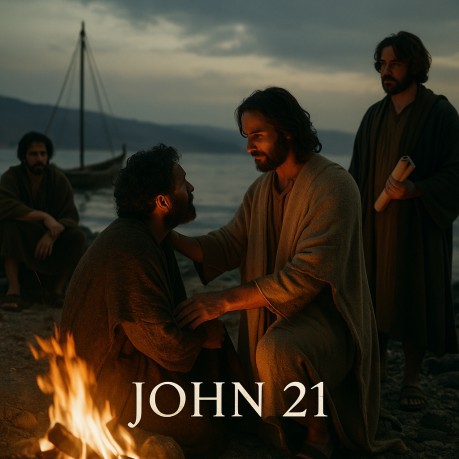
John 21:1-3 † The return to fishing symbolized
discouragement and uncertainty. Their labor without Christ bore no
fruit. John 21:4-6 † Christ directed their efforts, producing
abundance where there had been failure. His presence makes the
difference between emptiness and fruitfulness. John 21:7-8 † John recognized first, but Peter acted first.
Both faith and zeal are needed in discipleship. John 21:9-11 † The detail of 153 fish highlights eyewitness
testimony. Symbolically, it represented completeness, as Jerome noted
it was the number of known nations at the time. John 21:12-14 † The risen Christ provided both fellowship and
provision. The meal echoed His feeding miracles and the Last Supper. John 21:15-17 † Jesus restored Peter's three denials with
three affirmations of love. True love is expressed in shepherding
Christ's people. John 21:18-19 † Peter's zeal would one day be fulfilled in
martyrdom. Following Christ meant laying down his life. John 21:20-22 † Jesus rebuked Peter's curiosity. Discipleship
is individual — each must follow Christ regardless of others'
paths. John 21:23 † Misinterpretation of Jesus' words led to
rumors. Scripture clarifies misunderstandings by recording exactly
what He said. John 21:24-25 † John confirmed his eyewitness authorship. The
inexhaustible works of Christ exceed written record, pointing to His
divine fullness. How it applies to us today † Fruitless labor without Christ contrasts with
abundance in Him. † This is the fulfilled perspective we proclaim at
Fulfilled Prophecies † Source Index
By Dan MainesJohn 21
After these things Jesus
revealed Himself again to the disciples at the Sea of Tiberias, and
He revealed Himself in this way. Simon Peter, Thomas (who was called
Didymus), Nathanael of Cana in Galilee, the sons of Zebedee, and two
others of His disciples were together. Simon Peter said to them, "I
am going fishing." They said to him, "We are also coming
with you." They went out and got into the boat; and that night
they caught nothing.
But when the day was now
breaking, Jesus stood on the beach; yet the disciples did not know
that it was Jesus. So Jesus said to them, "Children, you do not
have any fish to eat, do you?" They answered Him, "No."
And He said to them, "Cast the net on the right-hand side of the
boat, and you will find the fish." So they cast it, and then
they were not able to haul it in because of the great quantity of
fish.
†
Origen noted that the net full of fish symbolized the church, drawing
in multitudes by Christ's word.
Therefore that disciple whom
Jesus loved said to Peter, "It is the Lord!" So when Simon
Peter heard that it was the Lord, he put on his outer garment (for he
was stripped for work), and threw himself into the sea. But the other
disciples came in the little boat, for they were not far from the
land, but about two hundred cubits away, dragging the net full of
fish.
So when they got out on the
land, they saw a charcoal fire already made and fish placed on it,
and bread. Jesus said to them, "Bring some of the fish which you
have now caught." So Simon Peter went up and hauled the net to
land, full of large fish, 153; and although there were so many, the
net was not torn.
Jesus said to them, "Come
and have breakfast." None of the disciples ventured to inquire
of Him, "Who are You?" knowing that it was the Lord. Jesus
came and took the bread and gave it to them, and the fish likewise.
This was now the third time that Jesus revealed Himself to the
disciples, after He was raised from the dead.
Now when they had finished
breakfast, Jesus said to Simon Peter, "Simon, son of John, do
you love Me more than these?" He said to Him, "Yes, Lord;
You know that I love You." He said to him, "Tend My lambs."
He said to him again, a second time, "Simon, son of John, do you
love Me?" He said to Him, "Yes, Lord; You know that I love
You." He said to him, "Shepherd My sheep." He said to
him the third time, "Simon, son of John, do you love Me?"
Peter was hurt because He said to him the third time, "Do you
love Me?" And he said to Him, "Lord, You know all things;
You know that I love You." Jesus said to him, "Tend My
sheep."
† Chrysostom emphasized
Peter's restoration as proof that failure does not disqualify a
repentant servant.
"Truly, truly I say to
you, when you were younger, you used to put on your belt and walk
wherever you wanted; but when you grow old, you will stretch out your
hands, and someone else will put your hands where you do not want
them to go." Now He said this, indicating by what kind of death
he would glorify God. And when He had said this, He said to him,
"Follow Me!"
†
Eusebius (Ecclesiastical History 2.25) records Peter's crucifixion in
Rome, fulfilling Jesus' words.
Peter turned around and saw
the disciple whom Jesus loved following them, the one who also had
leaned back on His chest at the supper and said, "Lord, who is
the one who is betraying You?" So Peter, upon seeing him, said
to Jesus, "Lord, and what about this man?" Jesus said to
him, "If I want him to remain until I come, what is that to you?
You follow Me!"
Therefore this account went out
among the brothers, that that disciple would not die; yet Jesus did
not say to him that he would not die, but only, "If I want him
to remain until I come, what is that to you?"
This is the disciple who is
testifying about these things and wrote these things, and we know
that his testimony is true. But there are also many other things
which Jesus did, which, if they were written in detail, I expect that
even the world itself would not contain the books that would be
written.
† Christ restores the
fallen, as He did with Peter, and calls us to love through
shepherding.
† Each disciple's path is
unique, but all are called to follow Him faithfully.
†
His works surpass all human record, but His word gives life
sufficient for faith.
† Origen –
the net of fish as symbol of the church
†
Jerome – 153 fish representing the nations
†
Chrysostom, Homilies on John – Peter's restoration
†
Eusebius, Ecclesiastical History 2.25 – Peter's martyrdom
†
Josephus, Antiquities 17.3.3 – tomb and burial context in Jerusalem
Links