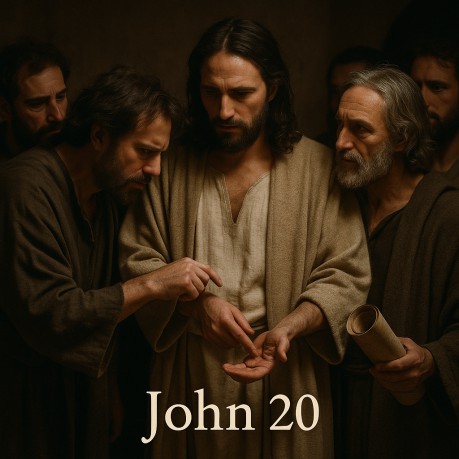
John 20:1 † Mary was the first witness, showing God's
choice of the humble and marginalized. The stone rolled away revealed
resurrection, not theft. John 20:2-4 † Her assumption was removal of the body, not
resurrection, proving the disciples were not expecting this miracle. John 20:5-7 † The orderly placement of cloths disproved
grave robbery. The folded face cloth revealed intentional
resurrection. John 20:8-9 † John believed based on evidence, though full
understanding of prophecy came later. John 20:10-12 † Angels confirmed resurrection. Their
placement recalled the cherubim on the ark of the covenant,
symbolizing God's presence. John 20:13-14 † Mary's grief blinded her recognition. Often
despair obscures Christ's presence. John 20:15-16 † Recognition came when Jesus called her name,
fulfilling John 10:3: "He calls His own sheep by name." John 20:17 † Mary was commissioned as the first herald of
the resurrection. His ascension would complete His redemptive work. John 20:18 † The first apostolic proclamation came from
Mary, overturning cultural expectations. John 20:19-20 † Jesus overcame locked doors, proving
resurrection body yet continuity with crucifixion wounds. His
greeting fulfilled John 14:27, "My peace I give to you." John 20:21-23 † This anticipates Pentecost. His breathing
paralleled Genesis 2:7, the giving of life. Apostolic authority was
rooted in Him. John 20:24-25 † Thomas embodied skepticism. His demand for
evidence makes his later confession more powerful. John 20:26-27 † Jesus condescended to Thomas' demand, turning
doubt into faith. John 20:28 † Thomas gave the highest Christological
confession in the Gospels, acknowledging Jesus as God. John 20:29 † Faith is not blind but trusts reliable
testimony. Believers after the apostolic era are especially blessed. John 20:30-31 † John's purpose statement anchors the Gospel.
Signs were selected not for curiosity but for faith and life. How it applies to us today † The resurrection is the heart of the gospel,
giving life and hope. † This is the fulfilled perspective we proclaim at
Fulfilled Prophecies † Source Index
By Dan MainesJohn 20
Now on the first day of the week
Mary Magdalene came early to the tomb, while it was still dark, and
saw the stone already removed from the tomb.
† Josephus
(Antiquities 17.3.3) notes stone-sealed tombs in Jerusalem,
confirming the historical setting.
So she ran and came to Simon
Peter and to the other disciple whom Jesus loved, and said to them,
"They have taken the Lord from the tomb, and we do not know
where they have put Him." So Peter and the other disciple left,
and they were going to the tomb. The two were running together; and
the other disciple ran ahead, faster than Peter, and came to the tomb
first.
And he stooped to look in, and
saw the linen wrappings lying there; however he did not go in. Simon
Peter also came, following him, and he entered the tomb; and he
looked at the linen wrappings lying there, and the face-cloth which
had been on His head, not lying with the linen wrappings but folded
up in a place by itself.
So the other disciple who had
first come to the tomb also entered then, and he saw and believed.
For they did not yet understand the Scripture, that He must rise from
the dead.
So the disciples went away
again to their own homes. But Mary was standing outside the tomb,
weeping; so as she wept, she stooped to look into the tomb; and she
saw two angels in white sitting, one at the head and one at the feet,
where the body of Jesus had been lying.
And they said to her, "Woman,
why are you weeping?" She said to them, "Because they have
taken away my Lord, and I do not know where they put Him." When
she had said this, she turned around and saw Jesus standing there,
and yet she did not know that it was Jesus.
Jesus said to her, "Woman,
why are you weeping? Whom are you seeking?" Thinking that He was
the gardener, she said to Him, "Sir, if you have carried Him
away, tell me where you put Him, and I will take Him away."
Jesus said to her, "Mary!" She turned and said to Him in
Hebrew, "Rabboni!" (which means, Teacher).
Jesus said to her, "Stop
clinging to Me, for I have not yet ascended to the Father; but go to
My brothers and say to them, ‘I am ascending to My Father and your
Father, and My God and your God.'"
Mary Magdalene came and announced
to the disciples, "I have seen the Lord," and that He had
said these things to her.
†
Celsus, a pagan critic (cited by Origen, Against Celsus 2.59), mocked
women as witnesses, showing why this account could not be fabricated.
Now when it was evening on
that day, the first day of the week, and when the doors were shut
where the disciples were together due to fear of the Jews, Jesus came
and stood in their midst, and said to them, "Peace be to you."
And when He had said this, He showed them both His hands and His
side. The disciples then rejoiced when they saw the Lord.
So Jesus said to them again,
"Peace be to you; just as the Father has sent Me, I also send
you." And when He had said this, He breathed on them and said to
them, "Receive the Holy Spirit. If you forgive the sins of any,
their sins have been forgiven them; if you retain any sins, they have
been retained."
But Thomas, one of the twelve,
who was called Didymus, was not with them when Jesus came. So the
other disciples were saying to him, "We have seen the Lord!"
But he said to them, "Unless I see in His hands the imprint of
the nails, and put my finger into the place of the nails, and put my
hand into His side, I will not believe."
Eight days later His disciples
were again inside, and Thomas was with them. Jesus came, the doors
having been shut, and stood in their midst and said, "Peace be
to you." Then He said to Thomas, "Place your finger here,
and see My hands; and take your hand and put it into My side; and do
not continue to be unbelieving, but be believing."
Thomas answered and said to Him,
"My Lord and my God!"
†
Polycarp and other early fathers cited this as proof against heresies
denying Christ's deity.
Jesus said to him, "Because
you have seen Me, have you now believed? Blessed are they who did not
see, and yet believed."
So then, many other signs
Jesus also performed in the presence of the disciples, which are not
recorded in this book; but these have been written so that you may
believe that Jesus is the Christ, the Son of God; and that by
believing you may have life in His name.
† Christ calls His
people by name, as He did Mary, proving intimate relationship.
†
Doubt, like Thomas', can be overcome by Christ's presence and
evidence.
† Our faith rests in apostolic
testimony, written so that we may have life in His name.
† Josephus,
Antiquities 17.3.3 – stone-sealed tombs
†
Celsus (cited in Origen, Against Celsus 2.59) – mockery of women
witnesses
† Polycarp, Epistle to the
Philippians – confession of Christ's deity
†
Dead Sea Scrolls imagery – light and truth as signs of God's
presence
Links