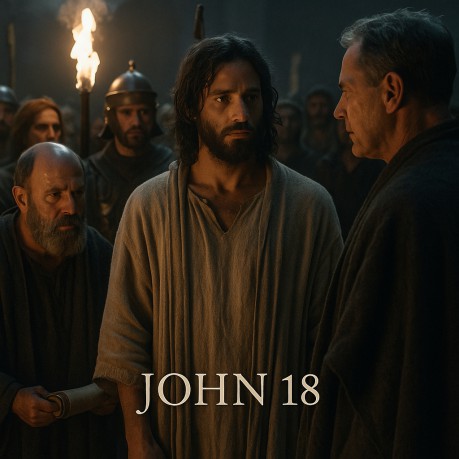
John 18:1 † The Kidron Valley had deep symbolism,
associated with judgment and purification (2 Samuel 15:23; 2 Kings
23:6). Jesus entered Gethsemane, the place of His final surrender. John 18:2-3 † Judas exploited intimacy for betrayal. The
torches highlighted the irony of seeking the Light of the world in
darkness. John 18:4-6 † The divine "I am" revealed His
authority. His enemies fell backward, showing His power even in
arrest. John 18:7-9 † Even in betrayal, Jesus protected His
disciples. His word was fulfilled in their preservation. John 18:10-11 † Peter's zeal misunderstood Christ's mission.
Jesus accepted the Father's cup, submitting to God's will. John 18:12-14 † Political power, not justice, drove the
trial. Caiaphas' earlier words (John 11:50) were now fulfilled in
God's providence. John 18:15-18 † Peter's first denial revealed fear in
contrast to his earlier zeal. The setting by the fire foreshadowed
his coming shame. John 18:19-21 † Jesus exposed the illegality of the trial.
His teaching was public, transparent, and witnessed by many. John 18:22-23 † Jesus' calm response revealed injustice.
Violence replaced truth in His unlawful trial. John 18:24-27 † Peter's threefold denial fulfilled Jesus'
prophecy. His pride gave way to fear, leaving him humbled. John 18:28-32 † Hypocrisy was evident: they avoided ritual
defilement while plotting murder. Roman authority ensured
crucifixion, fulfilling prophecy. John 18:33-36 † Jesus declared His kingdom spiritual, not
political. His mission transcended earthly power. John 18:37-38 † Jesus bore witness to truth itself. Pilate's
cynical question revealed his blindness. John 18:39-40 † The crowd chose a violent rebel over the
Prince of Peace. Their rejection fulfilled the pattern of preferring
false saviors. How it applies to us today † Jesus submitted to betrayal and unjust trial,
showing sovereignty even in suffering. † This is the fulfilled perspective we proclaim at
Fulfilled Prophecies † Source Index
By Dan MainesJohn 18
When Jesus had spoken these words,
He went away with His disciples across the Kidron Valley, where there
was a garden which He entered with His disciples.
†
Josephus (Wars 5.4.1) mentions the Kidron Valley near Jerusalem,
emphasizing its proximity to the temple and the Mount of Olives.
Now Judas, who was betraying
Him, also knew the place, because Jesus had often met there with His
disciples. So Judas, having obtained the Roman cohort and officers
from the chief priests and the Pharisees, came there with
lanterns, torches, and weapons.
† Tacitus (Histories 5.9) notes
Roman patrols in Jerusalem, fitting the description of armed cohorts.
Jesus therefore, knowing all the
things that were coming upon Him, came out into the open and said to
them, "Whom are you seeking?" They answered Him, "Jesus
the Nazarene." He said to them, "I am He." And Judas
also, who was betraying Him, was standing with them. Now then, when
He said to them, "I am He," they drew back and fell to the
ground.
He then asked them again, "Whom
are you seeking?" And they said, "Jesus the Nazarene."
Jesus answered, "I told you that I am He; so if you are seeking
Me, let these men go on their way." This took place so that the
word which He spoke would be fulfilled: "Of those whom You have
given Me I lost not one."
Then Simon Peter, since he had
a sword, drew it and struck the high priest's slave, and cut off his
right ear; and the slave's name was Malchus. So Jesus said to Peter,
"Put the sword into the sheath; the cup which the Father has
given Me, am I not to drink it?"
†
Chrysostom noted Peter's rashness contrasted with Christ's patience.
So the Roman cohort, the
commander, and the officers of the Jews arrested Jesus and bound Him,
and brought Him to Annas first; for he was the father-in-law of
Caiaphas, who was high priest that year. Now Caiaphas was the one who
had advised the Jews that it was in their best interest for one man
to die on behalf of the people.
Simon Peter was following
Jesus, and so was another disciple. Now that disciple was known to
the high priest, and he entered with Jesus into the courtyard of the
high priest, but Peter was standing at the door outside. So the other
disciple, who was known to the high priest, went out and spoke to the
doorkeeper, and brought Peter in. Then the slave woman who was the
doorkeeper said to Peter, "You are not also one of this man's
disciples, are you?" He said, "I am not." Now the
slaves and the officers were standing there, having made a charcoal
fire, because it was cold and they were warming themselves; and Peter
also was with them, standing and warming himself.
The high priest then
questioned Jesus about His disciples, and about His teaching. Jesus
answered him, "I have spoken openly to the world; I always
taught in synagogues and in the temple area, where all the Jews
congregate; and I said nothing in secret. Why are you asking Me? Ask
those who have heard what I spoke to them; look: these people know
what I said."
But when He said this, one of
the officers, who was standing nearby, struck Jesus, saying, "Is
that the way You answer the high priest?" Jesus answered him,
"If I have spoken wrongly, testify of the wrong; but if rightly,
why do you strike Me?"
So Annas sent Him bound to
Caiaphas the high priest. Now Simon Peter was still standing and
warming himself. So they said to him, "You are not one of His
disciples as well, are you?" He denied it, and said, "I am
not." One of the slaves of the high priest, who was related to
the one whose ear Peter cut off, said, "Did I not see you in the
garden with Him?" Peter then denied it again, and immediately a
rooster crowed.
Then they brought Jesus from
Caiaphas into the Praetorium, and it was early; and they themselves
did not enter the Praetorium, so that they would not be defiled, but
might eat the Passover. Therefore Pilate came out to them and said,
"What accusation are you bringing against this Man?" They
answered and said to him, "If this Man were not a criminal, we
would not have handed Him over to you." So Pilate said to them,
"Take Him yourselves, and judge Him according to your Law!"
The Jews said to him, "We are not permitted to put anyone to
death." This happened so that the word of Jesus which He said,
indicating what kind of death He was going to die, would be
fulfilled.
Therefore Pilate entered the
Praetorium again, and summoned Jesus, and said to Him, "You are
the King of the Jews?" Jesus answered, "Are you saying this
on your own, or did others tell you about Me?" Pilate answered,
"I am not a Jew, am I? Your own nation and the chief priests
handed You over to me; what have You done?" Jesus answered, "My
kingdom is not of this world. If My kingdom were of this world, My
servants would be fighting so that I would not be handed over to the
Jews; but as it is, My kingdom is not from here."
Therefore Pilate said to Him,
"So You are a king?" Jesus answered, "You say
correctly that I am a king. For this purpose I have been born, and
for this I have come into the world: to testify to the truth.
Everyone who is of the truth listens to My voice." Pilate said
to Him, "What is truth?" And after saying this, he came out
again to the Jews and said to them, "I find no grounds at all
for charges in His case."
†
Philo (On Dreams 2.18) wrote of truth as God's essence, contrasting
with Pilate's skepticism.
"But you have a custom
that I release one prisoner for you at the Passover; therefore do you
wish that I release for you the King of the Jews?" So they
shouted again, saying, "Not this Man, but Barabbas." Now
Barabbas was a rebel.
† His
"I am" still causes His enemies to fall.
†
The kingdom of Christ is not of this world, but of truth and eternal
life.
† We are warned against Peter's failure
and called to boldness in testimony.
† Josephus,
Wars 5.4.1 – Kidron Valley
† Tacitus,
Histories 5.9 – Roman patrols
† Chrysostom,
Homilies on John – Peter's rashness
† Psalm
41:9 – prophecy of betrayal
† Philo, On
Dreams 2.18 – truth as divine essence
Links