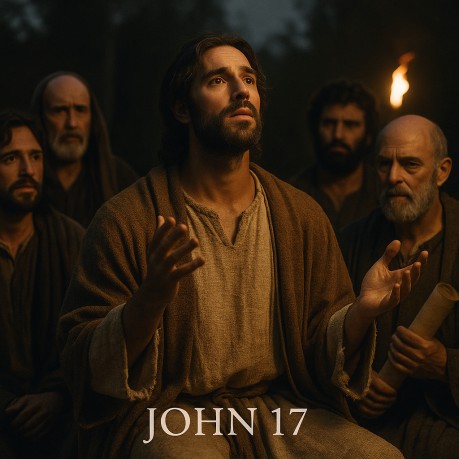
John 17:1 † This chapter is the High Priestly Prayer.
Jesus began by seeking the Father's glory through His own
glorification in the cross. His suffering was not defeat but divine
exaltation. John 17:2-3 † Eternal life is defined as relationship with
the Father through Christ, not merely endless existence. Authority
over humanity was granted to Jesus for the salvation of the elect. John 17:4-5 † Jesus claimed preexistent glory, affirming
His deity. His mission's completion prepared for restoration to
divine glory. John 17:6-8 † Jesus revealed the Father's character
("name") to the disciples. Their faith was evidence of
God's gift and Christ's successful mission. John 17:9-10 † The prayer was specific for the disciples,
not the world at large. Their union with Christ glorified Him. John 17:11-12 † Jesus prayed for unity rooted in divine
preservation. Judas' betrayal fulfilled prophecy, showing that Christ
lost none but him. John 17:13-14 † Joy was promised even in a hostile world.
Hatred from the world validated their identity in Christ. John 17:15-16 † Preservation from evil, not escape from the
world, was Jesus' request. Disciples remain in the world as
witnesses. John 17:17-19 † Holiness comes by God's word of truth.
Christ's self-consecration ensured their mission's success. John 17:20-21 † The prayer extended beyond the disciples to
future believers. Unity among Christians was to be a witness to the
world. John 17:22-23 † Christ's glory was shared with His people,
perfecting them in unity as proof of divine love. John 17:24 † The ultimate destiny of believers is to
behold Christ's glory, revealing His eternal preexistence and divine
love. John 17:25-26 † Jesus ended His prayer with love as the
ultimate mark of discipleship. Revelation of God's name brings His
love into believers' hearts. How it applies to us today † Eternal life is knowing God through Christ,
not simply endless existence. † This is the fulfilled perspective we proclaim at
Fulfilled Prophecies † Source Index
By Dan MainesJohn 17
Jesus spoke these things; and
raising His eyes to heaven, He said, "Father, the hour has come;
glorify Your Son, so that the Son may glorify You."
"Just as You gave Him
authority over all mankind, so that to all whom You have given Him,
He may give eternal life. And this is eternal life, that they may
know You, the only true God, and Jesus Christ whom You have sent."
†
Ignatius of Antioch affirmed that eternal life is the knowledge of
God through Christ, showing its relational nature.
"I glorified You on the
earth by accomplishing the work which You have given Me to do. And
now You, Father, glorify Me together with Yourself, with the glory
which I had with You before the world existed."
† Irenaeus used this verse to
refute heresies denying Christ's eternal preexistence.
"I have revealed Your name
to the men whom You gave Me out of the world; they were Yours, and
You gave them to Me, and they have followed Your word. Now they have
come to know that everything which You have given Me is from You; for
the words which You gave Me I have given to them; and they received
them and truly understood that I came forth from You, and they
believed that You sent Me."
"I ask on their behalf; I
do not ask on behalf of the world, but on the behalf of those whom
You have given Me; because they are Yours; and all things that are
Mine are Yours, and Yours are Mine; and I have been glorified in
them."
"I am no longer going to
be in the world; and yet they themselves are in the world, and I am
coming to You. Holy Father, keep them in Your name, the name which
You have given Me, so that they may be one just as We are. While I
was with them, I was keeping them in Your name which You have given
Me; and I guarded them, and not one of them perished except the son
of destruction, so that the Scripture would be fulfilled."
† Psalm 41:9 was seen as
prophetic of Judas' betrayal.
"But now I am coming to
You; and these things I speak in the world so that they may have My
joy made full in themselves. I have given them Your word; and the
world has hated them, because they are not of the world, just as I am
not of the world."
"I am not asking You to
take them out of the world, but to keep them away from the evil one.
They are not of the world, just as I am not of the world."
"Sanctify them in the
truth; Your word is truth. Just as You sent Me into the world, I also
sent them into the world. And for their sakes I sanctify Myself, so
that they themselves also may be sanctified in truth."
†
The Dead Sea Scrolls (1QS 1.9-11) emphasized truth as sanctifying,
aligning with Christ's words.
"I am not asking on
behalf of these alone, but also for those who believe in Me through
their word, that they may all be one; just as You, Father, are in Me,
and I in You, that they also may be in Us, so that the world may
believe that You sent Me."
† Ignatius of Antioch stressed unity
as the visible testimony of the church.
"The glory which You have
given Me I also have given to them, so that they may be one, just as
We are one; I in them and You in Me, that they may be perfected in
unity, so that the world may know that You sent Me, and You loved
them, just as You loved Me."
"Father, I desire that they
also, whom You have given Me, be with Me where I am, so that they may
see My glory which You have given Me, for You loved Me before the
foundation of the world."
"Righteous Father,
although the world has not known You, yet I have known You; and these
have known that You sent Me; and I have made Your name known to them,
and will make it known, so that the love with which You loved Me may
be in them, and I in them."
† The Spirit
sanctifies us in truth, empowering us for mission.
†
Unity in Christ is the witness that convinces the world.
†
Our destiny is to behold Christ's glory in perfect fellowship with
Him.
† Ignatius
of Antioch – eternal life as knowing God through Christ
†
Irenaeus, Against Heresies – Christ's preexistent glory
†
Psalm 41:9 – prophecy of betrayal
† Dead
Sea Scrolls, 1QS 1.9-11 – truth as sanctifying
†
Ignatius of Antioch – unity as the church's visible testimony
Links