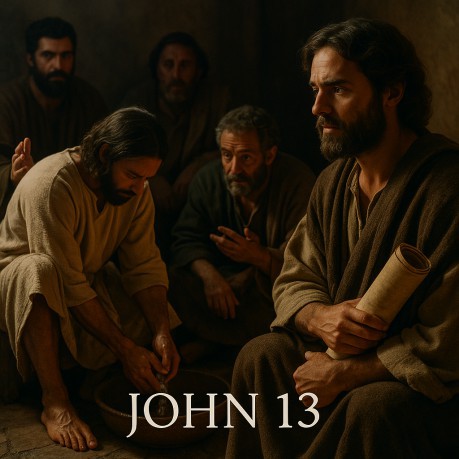
John 13:1 † This verse introduces the Upper Room
discourse. Jesus' love for His disciples was faithful, enduring even
to betrayal and death. John 13:2 † The betrayal originated in Satan's influence
but was carried out through Judas' willing heart. John 13:3-5 † The One who possessed all authority humbled
Himself in the lowest servant's task. This act foreshadowed the
cross, the ultimate act of humility and cleansing. John 13:6-9 † Peter resisted, misunderstanding the symbolic
act. Jesus revealed that cleansing by Him was essential for
fellowship. John 13:10-11 † Judas' betrayal excluded him from the
cleansing of Christ. Outward association with Jesus was not the same
as inward transformation. John 13:12-15 † Jesus established a model of servant
leadership. Greatness in His kingdom is expressed in humility. John 13:16-17 † Knowledge must lead to practice. True
blessing lies in serving others. John 13:18-19 † Jesus quoted Psalm 41:9, foretelling
betrayal. Even treachery fulfilled God's plan, confirming His
identity. John 13:20 † Union with Christ extends to His messengers.
To reject them is to reject Him. John 13:21-22 † Jesus' distress revealed His humanity. The
disciples' uncertainty showed that Judas concealed his betrayal well. John 13:23-25 † The beloved disciple (John) shared intimate
closeness with Jesus, contrasting Judas' hidden treachery. John 13:26-27 † Judas' reception of bread symbolized false
fellowship. Satan's possession marked the depth of his betrayal. John 13:28-30 † "It was night" symbolized spiritual
darkness. Judas left the Light to walk in the darkness. John 13:31-32 † Betrayal set in motion the events that would
glorify both Son and Father through the cross. John 13:33-35 † The new commandment was not love in general
but love patterned after His sacrificial example. Love became the
mark of true discipleship. John 13:36-38 † Peter's zeal was sincere but overconfident.
Jesus foretold his denial, showing human weakness apart from grace. How it applies to us today † True greatness is shown in humble service. † This is the fulfilled perspective we proclaim at
Fulfilled Prophecies † Source Index
By Dan MainesJohn 13
Now before the Feast of the
Passover, Jesus, knowing that His hour had come that He would depart
from this world to the Father, having loved His own who were in the
world, He loved them to the end.
And during supper, the devil
having already put into the heart of Judas Iscariot, the son of
Simon, to betray Him.
Jesus, knowing that the Father
had handed all things over to Him, and that He had come forth from
God and was going back to God, got up from supper and laid His outer
garments aside; and He took a towel and tied it around Himself. Then
He poured water into the basin, and began washing the disciples'
feet, and wiping them with the towel which He had tied around
Himself.
†
Philo (On the Special Laws 1.163) describes foot washing as the duty
of slaves, highlighting the radical humility of Jesus.
So He came to Simon Peter. He
said to Him, "Lord, You are washing my feet?" Jesus
answered and said to him, "What I am doing, you do not realize
right now, but you will understand later." Peter said to Him,
"Never shall You wash my feet!" Jesus answered him, "If
I do not wash you, you have no place with Me." Simon Peter said
to Him, "Lord, then wash not only my feet, but also my hands and
my head."
Jesus said to him, "He
who has bathed needs only to wash his feet; otherwise he is
completely clean. And you are clean—but not all of you." For
He knew the one who was betraying Him; it was for this reason that He
said, "Not all of you are clean."
Then, when He had washed their
feet, and taken His garments and reclined at the table again, He said
to them, "Do you know what I have done for you? You call Me
‘Teacher' and ‘Lord'; and you are correct, for so I am. So if I,
the Lord and the Teacher, washed your feet, you also ought to wash
one another's feet. For I gave you an example, so that you also would
do just as I did for you."
†
The Mishnah (Kiddushin 1.1) stresses the honor due to teachers,
making Christ's humility all the more striking.
"Truly, truly I say to
you, a slave is not greater than his master, nor is one who is sent
greater than the one who sent him. If you know these things, you are
blessed if you do them."
"I am not speaking about
all of you; I know the ones whom I have chosen; but this is happening
so that the Scripture may be fulfilled: ‘He who eats My bread has
lifted up his heel against Me.' From now on I am telling you before
it happens, so that when it does happen, you may believe that I am."
"Truly, truly I say to you,
the one who receives anyone I send receives Me; and the one who
receives Me receives Him who sent Me."
When Jesus had said these
things, He became troubled in spirit, and testified and said, "Truly,
truly I say to you that one of you will betray Me." The
disciples began looking at one another, at a loss to know of which
one He was speaking.
Lying back on Jesus' chest was
one of His disciples, whom Jesus loved. So Simon Peter nodded to this
disciple, and said to him, "Tell us who it is of whom He is
speaking." He then simply leaned back on Jesus' chest and said
to Him, "Lord, who is it?"
Jesus then answered, "That
man is the one for whom I shall dip the piece of bread and give it to
him." So when He had dipped the piece of bread, He took and gave
it to Judas, the son of Simon Iscariot. After this, Satan then
entered him. Therefore Jesus said to him, "What you are doing,
do it quickly."
Now none of those reclining at
the table knew for what purpose He had said this to him. For some
were assuming, since Judas kept the money box, that Jesus was saying
to him, "Buy the things we need for the feast"; or that he
was to give something to the poor. So after receiving the piece of
bread, he left immediately; and it was night.
Therefore when he had left,
Jesus said, "Now is the Son of Man glorified, and God is
glorified in Him; if God is glorified in Him, God will also glorify
Him in Himself, and will glorify Him immediately."
"Little children, I am
still with you a little longer. You will look for Me; and just as I
said to the Jews, now I also say to you: ‘Where I am going, you
cannot come.' I am giving you a new commandment, that you love one
another; just as I have loved you, that you also love one another. By
this all people will know that you are My disciples: if you have love
for one another."
† Ignatius of
Antioch stressed this unity of love as the evidence of the church's
authenticity.
Simon Peter said to Him,
"Lord, where are You going?" Jesus answered, "Where I
go, you cannot follow Me now; but you will follow later." Peter
said to Him, "Lord, why can I not follow You right now? I will
lay down my life for You!" Jesus replied, "Will you lay
down your life for Me? Truly, truly I say to you, a rooster will not
crow until you deny Me three times."
†
Outward association with Christ does not equal inward faith, as seen
with Judas.
† Love is the true badge of
discipleship, more than words or rituals.
†
Human zeal without dependence on Christ leads to failure, as with
Peter.
† Philo, On
the Special Laws 1.163 – foot washing as a slave's task
†
Mishnah, Kiddushin 1.1 – honor due to teachers
†
Psalm 41:9 – prophecy of betrayal
†
Ignatius of Antioch – command of love and unity as the church's
mark
† Chrysostom, Homilies on John –
Christ's humility in washing feet
Links