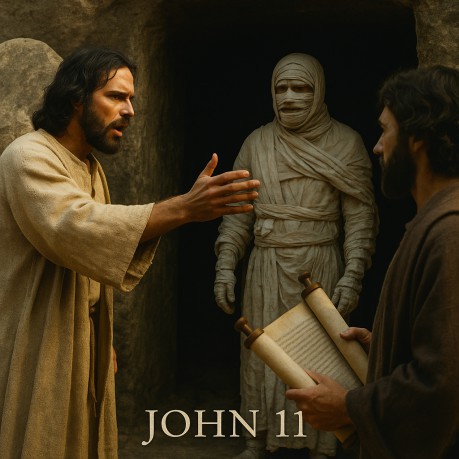
John 11:1-3 † Lazarus, from Bethany near Jerusalem, was
deeply loved by Jesus. The mention of Mary's later act of devotion
emphasized their closeness. Their message appealed to His love, not
His power. John 11:4 † Lazarus' illness was a stage for God's glory.
The end result would be the revelation of Christ's authority over
death. John 11:5-6 † His delay was intentional, ensuring that
Lazarus would die, so the miracle would be undeniable. Love sometimes
allows suffering to reveal greater glory. John 11:7-10 † The disciples feared danger in Judea, but
Jesus walked in the Father's light. His mission was unstoppable until
His hour came. John 11:11-15 † Jesus used "sleep" as a metaphor
for death, showing His power to awaken. His delay was for the
disciples' faith. John 11:16 † Thomas displayed loyalty, though with
pessimism. His words foreshadowed later boldness. John 11:17-20 † Four days confirmed death beyond doubt, as
Jewish tradition held that the soul lingered near the body for three
days. John 11:21-27 † Martha believed in a future resurrection, but
Jesus declared Himself the present source of life and resurrection.
This is one of His greatest "I am" statements. John 11:28-32 † Both sisters voiced the same grief,
reflecting shared pain and faith that Jesus could have prevented
death. John 11:33-35 † The shortest verse reveals profound truth:
Jesus shares human sorrow. He wept though knowing He would raise
Lazarus, showing empathy and love. John 11:36-37 † Some saw His love, others doubted His power.
Skepticism persisted even with His signs. John 11:38-40 † Martha's protest revealed human doubt, but
Jesus reaffirmed faith as the key to God's glory. John 11:41-44 † Jesus prayed aloud for the crowd's faith,
then commanded life with authority. Lazarus emerged alive, proof of
Christ's power over death. John 11:45-48 † Many believed, but leaders feared Roman
reprisal and loss of power. John 11:49-52 † Caiaphas spoke more than he knew. His
political calculation became divine prophecy: Christ's death would
gather God's people into one. John 11:53-54 † The raising of Lazarus became the final
trigger for plotting His death. John 11:55-57 † The stage was set for His final Passover. The
contrast was stark: purification rituals versus the true Lamb who
purifies. How it applies to us today † Jesus is the resurrection and the life,
offering eternal victory over death. † This is the fulfilled perspective we proclaim at
Fulfilled Prophecies † Source Index
By Dan MainesJohn 11
Now a certain man was sick,
Lazarus of Bethany, the village of Mary and her sister Martha. And it
was the Mary who anointed the Lord with perfume, and wiped His feet
with her hair, whose brother Lazarus was sick. So the sisters sent
word to Him, saying, "Lord, behold, he whom You love is sick."
But when Jesus heard this, He
said, "This sickness is not meant for death, but is for the
glory of God, so that the Son of God may be glorified by it."
Now Jesus loved Martha and her
sister, and Lazarus. So when He heard that he was sick, He then
stayed two days longer in the place where He was.
Then after this He said to the
disciples, "Let's go to Judea again." The disciples said to
Him, "Rabbi, the Jews were just now seeking to stone You, and
yet You are going there again?" Jesus replied, "Are there
not twelve hours in the day? If anyone walks during the day, he does
not stumble, because he sees the light of this world. But if anyone
walks during the night, he stumbles, because the light is not in
him."
This He said, and after that
He said to them, "Our friend Lazarus has fallen asleep; but I am
going so that I may awaken him from sleep." The disciples then
said to Him, "Lord, if he has fallen asleep, he will come out of
it." Now Jesus had spoken of his death, but they thought that He
was speaking about actual sleep. So Jesus then said to them plainly,
"Lazarus died, and I am glad for your sakes that I was not
there, so that you may believe; but let's go to him."
† The Mishnah (Berakhot
2.6) often equated sleep and death, confirming the cultural link.
Therefore Thomas, who was called
Didymus, said to his fellow disciples, "Let's also go, so that
we may die with Him!"
So when Jesus came, He found
that he had already been in the tomb four days. Now Bethany was near
Jerusalem, about fifteen stadia away; and many of the Jews had come
to Martha and Mary, to console them about their brother. So then
Martha, when she heard that Jesus was coming, went to meet Him, but
Mary stayed in the house.
Martha then said to Jesus,
"Lord, if You had been here, my brother would not have died.
Even now I know that whatever You ask of God, God will give You."
Jesus said to her, "Your brother will rise from the dead."
Martha said to Him, "I know that he will rise in the
resurrection on the last day." Jesus said to her, "I am the
resurrection and the life; the one who believes in Me will live, even
if he dies, and everyone who lives and believes in Me will never die.
Do you believe this?" She said to Him, "Yes, Lord; I have
come to believe that You are the Christ, the Son of God, and He who
comes into the world."
When she had said this, she
left and called Mary her sister, saying secretly, "The Teacher
is here and is calling for you." And when she heard this, she
got up quickly and came to Him. Now Jesus had not yet come into the
village, but was still at the place where Martha met Him. Then the
Jews who were with her in the house, and were consoling her, when
they saw that Mary got up quickly and went out, they followed her,
thinking that she was going to the tomb to weep there. So when Mary
came to the place where Jesus was, she saw Him, and fell at His feet,
saying to Him, "Lord, if You had been here, my brother would not
have died."
When Jesus saw her weeping,
and the Jews who came with her also weeping, He was deeply moved in
spirit and was troubled, and said, "Where have you laid him?"
They said to Him, "Lord, come and see." Jesus wept.
†
Chrysostom commented that Christ's tears revealed His true humanity,
while His miracle revealed His deity.
So the Jews were saying, "See
how He loved him!" But some of them said, "Could this man,
who opened the eyes of the man who was blind, not have also kept this
man from dying?"
So Jesus, again being deeply
moved within, came to the tomb. Now it was a cave, and a stone was
lying against it. Jesus said, "Remove the stone." Martha,
the sister of the deceased, said to Him, "Lord, by this time
there will be a stench, for he has been dead four days." Jesus
said to her, "Did I not say to you that if you believe, you will
see the glory of God?"
So they removed the stone. And
Jesus raised His eyes, and said, "Father, I thank You that You
have heard Me. But I knew that You always hear Me; nevertheless,
because of the people standing around I said it, so that they may
believe that You sent Me." And when He had said these things, He
cried out with a loud voice, "Lazarus, come out!" Out came
the man who had died, bound hand and foot with wrappings, and his
face was wrapped around with a cloth. Jesus said to them, "Unbind
him, and let him go."
† Augustine noted
that Jesus called Lazarus by name, lest all the dead rise at once.
Therefore many of the Jews who
came to Mary, and saw what He had done, believed in Him. But some of
them went to the Pharisees and told them the things which Jesus had
done. So the chief priests and the Pharisees convened the Council,
and were saying, "What are we doing? For this man is performing
many signs. If we let Him go on like this, all the people will
believe in Him, and the Romans will come and take over both our place
and our nation."
† Josephus (Wars
6.2.4) describes Roman suppression of uprisings, matching their fear.
But one of them, Caiaphas, who
was high priest that year, said to them, "You know nothing at
all, nor are you considering that it is in your best interest that
one man die for the people, and that the whole nation not perish
instead." Now he did not say this on his own, but as he was high
priest that year, he prophesied that Jesus was going to die for the
nation; and not for the nation only, but in order that He might also
gather together into one the children of God who are scattered
abroad.
So from that day on they
planned together to kill Him. Therefore Jesus no longer continued to
walk publicly among the Jews, but went away from there to the region
near the wilderness, into a city called Ephraim; and He stayed there
with the disciples.
Now the Passover of the Jews
was near, and many went up to Jerusalem from the country before the
Passover, to purify themselves. So they were looking for Jesus; and
as they stood in the temple area, they said to one another, "What
do you think; that He will not come to the feast at all?" Now
the chief priests and the Pharisees had given orders that if anyone
knew where He was, he was to report it, so that they might arrest
Him.
† His
love allows temporary suffering for greater glory.
†
Faith in Christ reveals God's glory in impossible circumstances.
†
His power over death guarantees our confidence in His promises.
† Mishnah,
Berakhot 2.6 – sleep as metaphor for death
†
Chrysostom, Homilies on John – Christ's humanity in weeping
†
Augustine, Homilies on John – Lazarus called by name
†
Josephus, Wars 6.2.4 – Roman suppression of uprisings
†
Irenaeus, Against Heresies – unity of God's children in Christ
Links