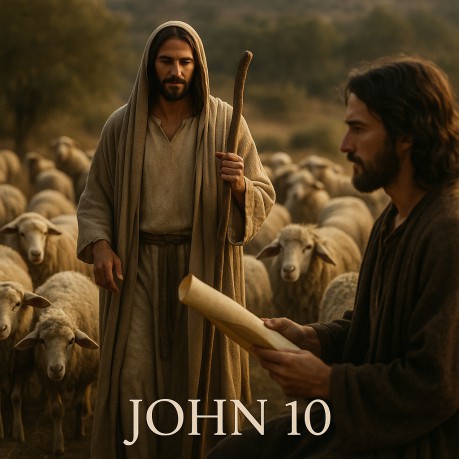
John 10:1-2 † Jesus contrasted false shepherds with
Himself, the true shepherd. False leaders exploited God's people,
while He entered by rightful authority. John 10:3-5 † The intimate relationship between shepherd
and sheep reflected Christ's personal care. Unlike thieves, He calls
His sheep by name. John 10:6-9 † Christ is not only the Shepherd but also the
Door, the exclusive way to salvation and life. John 10:10 † False leaders devour the flock, but Jesus
provides abundant life. John 10:11-13 † The good shepherd sacrifices himself, unlike
hirelings who flee in danger. Jesus foresaw His own death for His
sheep. John 10:14-16 † The intimacy between Christ and His people
mirrors His unity with the Father. "Other sheep" referred
to Gentiles, now one flock with Jews in Him. John 10:17-18 † Jesus' death was voluntary, not forced. His
resurrection was by divine authority. John 10:19-21 † Division followed His teaching. Miracles
supported His authority, but unbelief persisted. John 10:22-24 † The Feast of Dedication (Hanukkah) celebrated
the temple's rededication under the Maccabees. Jesus was asked
directly about His messianic identity. John 10:25-28 † The issue was unbelief, not lack of clarity.
His works testified, but only His sheep believed. Eternal security
rests in His hand. John 10:29-30 † Jesus declared unity with the Father. Divine
authority secured His flock. John 10:31-33 † They understood His claim: equality with God.
Blasphemy charges arose, showing His words were not ambiguous. John 10:34-36 † Jesus cited Psalm 82:6, where judges were
called "gods" as representatives of God. If that applied to
them, how much more to the One sanctified and sent. John 10:37-39 † Works validated His unity with the Father.
Unbelief was willful rejection. John 10:40-42 † Away from hostile Jerusalem, many believed,
affirming John's testimony about Christ. How it applies to us today † Christ is both the Shepherd and the Door;
salvation is found in Him alone. † This is the fulfilled perspective we proclaim at
Fulfilled Prophecies † Source Index
By Dan MainesJohn 10
"Truly, truly I say to you,
the one who does not enter by the door into the fold of the sheep,
but climbs up some other way, he is a thief and a robber. But the one
who enters by the door is a shepherd of the sheep."
†
Josephus (Wars 4.3.2) records corrupt leaders who acted as thieves
over the people, aligning with Christ's charge.
"To him the doorkeeper
opens, and the sheep listen to his voice, and he calls his own sheep
by name and leads them out. When he puts all his own sheep outside,
he goes ahead of them, and the sheep follow him because they know his
voice. However, a stranger they simply will not follow, but will flee
from him, because they do not know the voice of strangers."
† The Dead Sea Scrolls (CD
13.7-9) speak of leaders misleading God's flock, contrasting with the
true Shepherd.
Jesus told them this figure of
speech, but they did not understand what the things that He was
saying to them meant. So Jesus said to them again, "Truly, truly
I say to you, I am the door of the sheep. All those who came before
Me are thieves and robbers, but the sheep did not listen to them. I
am the door; if anyone enters through Me, he will be saved, and will
go in and out and find pasture."
"The thief comes only to
steal and kill and destroy; I came so that they would have life, and
have it abundantly."
"I am the good shepherd;
the good shepherd lays down His life for the sheep. He who is a hired
hand, and not a shepherd, who is not the owner of the sheep, sees the
wolf coming, and leaves the sheep and flees—and the wolf snatches
them and scatters the flock. He flees because he is a hired hand and
does not care about the sheep."
† Chrysostom highlighted the
uniqueness of a shepherd who dies willingly for his flock.
"I am the good shepherd,
and I know My own, and My own know Me, just as the Father knows Me
and I know the Father; and I lay down My life for the sheep. And I
have other sheep, which are not of this fold; I must bring them also,
and they will listen to My voice; and they will become one flock,
with one shepherd."
†
Ignatius of Antioch emphasized the unity of the flock under one
shepherd as the church's foundation.
"For this reason the
Father loves Me, because I lay down My life so that I may take it
back. No one has taken it away from Me, but I lay it down on My own,
and I have authority to lay it down, and I have authority to take it
back. This commandment I received from My Father."
Dissension occurred again
among the Jews because of these words. Many of them were saying, "He
has a demon and is insane. Why do you listen to Him?" Others
were saying, "These are not the words of one who is
demon-possessed. A demon cannot open the eyes of those who are blind,
can he?"
At that time the Feast of the
Dedication took place in Jerusalem; it was winter, and Jesus was
walking in the temple area, in the portico of Solomon. The Jews then
surrounded Him and began saying to Him, "How long will You keep
us in suspense? If You are the Christ, tell us plainly."
†
Josephus (Antiquities 12.7.7) describes this feast, confirming its
observance.
Jesus answered them, "I
told you, and you do not believe; the works that I do in My Father's
name, these testify of Me. But you do not believe, because you are
not of My sheep. My sheep listen to My voice, and I know them, and
they follow Me; and I give them eternal life, and they will never
perish; and no one will snatch them out of My hand."
"My Father, who has given
them to Me, is greater than all; and no one is able to snatch them
out of the Father's hand. I and the Father are one."
† Irenaeus cited
this verse as proof of Christ's full deity and unity with the Father.
The Jews picked up stones
again to stone Him. Jesus replied to them, "I showed you many
good works from the Father; for which of them are you stoning Me?"
The Jews answered Him, "We are not stoning You for a good work,
but for blasphemy; and because You, being a man, make Yourself out to
be God."
Jesus answered them, "Has
it not been written in your Law: ‘I said, you are gods'? If he
called them gods, to whom the word of God came—and the Scripture
cannot be nullified—are you saying of Him whom the Father
sanctified and sent into the world, ‘You are blaspheming,' because
I said, ‘I am the Son of God'?"
"If I do not do the works
of My Father, do not believe Me; but if I do them, even though you do
not believe Me, believe the works, so that you may know and
understand that the Father is in Me, and I in the Father."
Therefore they were seeking again to arrest Him, and He eluded their
grasp.
And He went away again beyond
the Jordan, to the place where John was first baptizing, and He
stayed there. Many came to Him, and were saying, "While John
performed no sign, yet everything John said about this man was true."
And many believed in Him there.
† The Good
Shepherd laid down His life for the flock, proving His love.
†
True unity is in Christ, bringing Jew and Gentile into one flock.
†
Eternal security rests in the hand of the Son and the Father
together.
† Josephus,
Wars 4.3.2 – corrupt leaders as thieves
†
Dead Sea Scrolls, CD 13.7-9 – corrupt leaders misleading the
flock
† Chrysostom, Homilies on John –
shepherd dying for the flock
† Ignatius of
Antioch – unity of the flock under one shepherd
†
Josephus, Antiquities 12.7.7 – Feast of Dedication
†
Irenaeus, Against Heresies – unity of Son and Father
Share on Facebook
Links