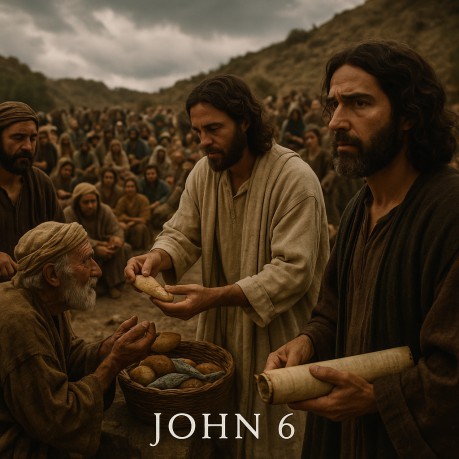
John 6:1-2 † The crowd followed out of fascination with
miracles, not necessarily faith. John notes the Sea of Galilee was
also called Tiberias, after the Roman emperor, showing both Jewish
and Gentile recognition of the location. John 6:3-4 † John connects the feeding with Passover,
hinting at the greater fulfillment of the true bread of life. John 6:5-7 † Philip calculated human impossibility, while
Jesus already purposed divine provision. John 6:8-9 † Barley was the bread of the poor. God uses
the small and insignificant to reveal His glory. John 6:10-11 † The miracle echoed manna in the wilderness.
Jesus gave thanks, showing dependence on the Father, then multiplied
food beyond sufficiency. John 6:12-13 † The abundance pointed to Christ's
inexhaustible provision. Twelve baskets symbolized sufficiency for
Israel and beyond. John 6:14-15 † They misinterpreted Him as a political
deliverer like Moses. Jesus refused worldly kingship, affirming a
spiritual kingdom. John 6:16-21 † Jesus' "It is I" echoes God's
divine name "I AM." His presence calmed their fear and
brought them safely to shore. John 6:22-24 † The people pursued Him not for truth but for
another sign or provision of bread. John 6:25-27 † They sought Him for physical satisfaction,
but He pointed them to eternal life. John 6:28-29 † The true work God requires is faith in
Christ. John 6:30-31 † They demanded another miracle, comparing Him
to Moses. Their unbelief persisted even after the feeding. John 6:32-33 † Jesus shifted their focus from Moses to the
Father, and from manna to Himself, the true bread. John 6:34-35 † Jesus declared Himself the bread of life.
Spiritual hunger is satisfied only in Him. John 6:36-37 † Unbelief persisted despite His signs, but
those drawn by the Father would come to Him. John 6:38-40 † The will of the Father is eternal life
through Christ. Resurrection to life is promised to all believers. John 6:41-44 † Their stumbling was over His claim of
heavenly origin. Faith requires the Father's drawing. John 6:45-47 † Isaiah 54:13 foretold the new covenant
teaching of God. Faith in Christ brings eternal life now. John 6:48-51 † Manna sustained temporarily, but Christ gives
eternal life. His flesh given for the world foreshadows the cross. John 6:52-56 † Jesus spoke spiritually of participation in
His sacrifice. Eating and drinking symbolized faith and union with
Him. John 6:57-59 † The bread of life discourse was delivered
publicly in a synagogue. Eternal life is tied to faith in Christ's
sacrifice. John 6:60-61 † His teaching offended because it demanded
surrender and participation in His sacrifice. John 6:62-65 † Christ clarified: fleshly thinking profits
nothing; only the Spirit brings life. Unbelief revealed lack of
drawing by the Father. John 6:66-69 † Many abandoned Christ when the teaching
became difficult, but Peter confessed truth: Christ alone has eternal
life. John 6:70-71 † Even among the chosen twelve, betrayal was
foreseen. Christ's mission included enduring treachery. How it applies to us today † Christ is the bread of life, offering eternal
satisfaction to all who believe. † This is the fulfilled perspective we proclaim at
Fulfilled Prophecies † Source Index
By Dan MainesJohn 6
After these things Jesus went
away to the other side of the Sea of Galilee (or Tiberias). A large
crowd was following Him, because they were watching the signs which
He was performing on those who were sick.
But Jesus went up on the
mountain, and there He sat with His disciples. Now the Passover, the
feast of the Jews, was near.
So Jesus, after raising His eyes
and seeing that a large crowd was coming to Him, said to Philip,
"Where are we to buy bread so that these people may eat?"
But He was saying this only to test him, for He Himself knew what He
intended to do. Philip answered Him, "Two hundred denarii worth
of bread is not enough for them, for each to receive just a little!"
One of His disciples, Andrew,
Simon Peter's brother, said to Him, "There is a boy here who has
five barley loaves and two fish; but what are these for so many
people?"
Jesus said, "Have the
people recline." Now there was plenty of grass in the place. So
the men reclined, about five thousand in number. Jesus then took the
loaves, and after giving thanks He distributed them to those who were
reclining; likewise also of the fish, as much as they wanted.
And when they had eaten their
fill, He said to His disciples, "Gather up the leftover pieces
so that nothing will be lost." So they gathered them up, and
filled twelve baskets with pieces from the five barley loaves which
were left over by those who had eaten.
Therefore when the people saw
the sign which He had performed, they said, "This is truly the
Prophet who is to come into the world." So Jesus, aware that
they intended to come and take Him by force to make Him king,
withdrew again to the mountain by Himself, alone.
† Josephus (Antiquities
18.1.6) notes many false messianic movements arose seeking political
kingship, unlike Jesus' mission.
Now when evening came, His
disciples went down to the sea, and after getting into a boat, they
started to cross the sea to Capernaum. It had already become dark,
and Jesus had not yet come to them. The sea began to be stirred up
because a strong wind was blowing. Then, after rowing about
twenty-five or thirty stadia, they saw Jesus walking on the sea and
coming near the boat; and they were frightened. But He said to them,
"It is I; do not be afraid." So they were willing to take
Him into the boat, and immediately the boat was at the land to which
they were going.
The next day the crowd that
stood on the other side of the sea saw that there was no other small
boat there except one, and that Jesus had not gotten into the boat
with His disciples, but that His disciples had departed alone. Other
small boats came from Tiberias near the place where they ate the
bread after the Lord had given thanks. So when the crowd saw that
Jesus was not there, nor His disciples, they themselves got into the
small boats and came to Capernaum seeking Jesus.
And when they found Him on the
other side of the sea, they said to Him, "Rabbi, when did You
get here?" Jesus answered them and said, "Truly, truly I
say to you, you seek Me, not because you saw signs, but because you
ate some of the loaves and were filled. Do not work for the food that
perishes, but for the food that lasts for eternal life, which the Son
of Man will give you, for on Him the Father, God, has set His seal."
Therefore they said to Him,
"What are we to do, so that we may accomplish the works of God?"
Jesus answered and said to them, "This is the work of God, that
you believe in Him whom He has sent."
So they said to Him, "What
then are You doing as a sign, so that we may see, and believe You?
What work do You perform? Our fathers ate the manna in the
wilderness; as it is written: ‘He gave them bread out of heaven to
eat.'"
Jesus then said to them,
"Truly, truly I say to you, it is not Moses who has given you
the bread out of heaven, but it is My Father who gives you the true
bread out of heaven. For the bread of God is that which comes down
out of heaven and gives life to the world."
Then they said to Him, "Lord,
always give us this bread." Jesus said to them, "I am the
bread of life; the one who comes to Me will not be hungry, and the
one who believes in Me will never be thirsty."
"But I said to you that
you have indeed seen Me, and yet you do not believe. Everything that
the Father gives Me will come to Me, and the one who comes to Me I
certainly will not cast out."
"For I have come down from
heaven, not to do My own will, but the will of Him who sent Me. And
this is the will of Him who sent Me, that of everything that He has
given Me I will lose nothing, but will raise it up on the last day.
For this is the will of My Father, that everyone who sees the Son and
believes in Him will have eternal life, and I Myself will raise him
up on the last day."
So then the Jews were
complaining about Him, because He said, "I am the bread that
came down out of heaven." And they were saying, "Is this
not Jesus, the son of Joseph, whose father and mother we know? How
does He now say, ‘I have come down out of heaven'?" Jesus
answered and said to them, "Stop complaining among yourselves.
No one can come to Me unless the Father who sent Me draws him; and I
will raise him up on the last day."
"It is written in the
Prophets: ‘And they shall all be taught of God.' Everyone who has
heard and learned from the Father, comes to Me. Not that anyone has
seen the Father, except the One who is from God; He has seen the
Father. Truly, truly I say to you, the one who believes has eternal
life."
"I am the bread of life.
Your fathers ate the manna in the wilderness, and they died. This is
the bread that comes down out of heaven, so that anyone may eat from
it and not die. I am the living bread that came down out of heaven;
if anyone eats from this bread, he will live forever; and the bread
which I will give for the life of the world also is My flesh."
Then the Jews began to argue
with one another, saying, "How can this man give us His flesh to
eat?" So Jesus said to them, "Truly, truly I say to you,
unless you eat the flesh of the Son of Man and drink His blood, you
have no life in yourselves. The one who eats My flesh and drinks My
blood has eternal life, and I will raise him up on the last day. For
My flesh is true food, and My blood is true drink. The one who eats
My flesh and drinks My blood remains in Me, and I in him."
† Ignatius of Antioch (Letter to the
Smyrnaeans 7) emphasized that believers partake of Christ's body and
blood spiritually in the Eucharist.
"Just as the living Father
sent Me, and I live because of the Father, the one who eats Me, he
also will live because of Me. This is the bread that came down out of
heaven—not as the fathers ate and died; the one who eats this bread
will live forever." These things He said in the synagogue as He
taught in Capernaum.
So then many of His disciples,
when they heard this, said, "This statement is very unpleasant;
who can listen to it?" But Jesus, aware that His disciples were
complaining about this, said to them, "Is this offensive to
you?"
"What then if you see the
Son of Man ascending to where He was before? It is the Spirit who
gives life; the flesh provides no benefit; the words that I have
spoken to you are spirit, and are life. But there are some of you who
do not believe." For Jesus knew from the beginning who they were
who did not believe, and who it was who would betray Him. And He was
saying, "For this reason I have told you, that no one can come
to Me unless it has been granted him from the Father."
As a result of this many of His
disciples left, and would no longer walk with Him. So Jesus said to
the twelve, "You do not want to leave also, do you?" Simon
Peter answered Him, "Lord, to whom shall we go? You have words
of eternal life. And we have already believed and have come to know
that You are the Holy One of God."
Jesus answered them, "Did
I Myself not choose you, the twelve? And yet one of you is a devil."
Now He meant Judas, the son of Simon Iscariot; for he, one of the
twelve, was going to betray Him.
† Faith is
the work God requires, not reliance on human effort.
†
Following Jesus means receiving His sacrifice and living by His
Spirit.
† Many turn away at hard teachings,
but true disciples remain, confessing Christ as the Holy One of God.
† Josephus,
Antiquities 18.1.6 – false messianic movements
†
Isaiah 54:13 – all taught by God
† Ignatius
of Antioch, Letter to the Smyrnaeans 7 – eating Christ's flesh and
blood spiritually
† Chrysostom, Homilies on
John – bread of life discourse
† Augustine,
Tractates on John – faith as eating and drinking Christ
Links