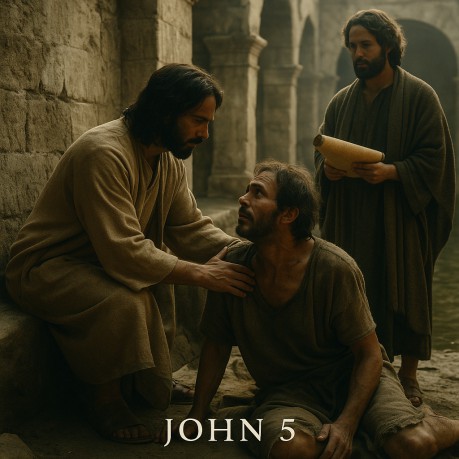
John 5:1-2 † The pool of Bethesda was near the temple,
used for healing traditions. Archaeology confirms a pool with five
porticoes in Jerusalem, validating John's detail. John 5:3-5 † The man's long affliction highlights his
hopelessness. The pool attracted the desperate, but no healing came
until Christ arrived. John 5:6-7 † Jesus asked a penetrating question. The man
thought healing required human help or superstition. Christ revealed
true healing came from Him alone. John 5:8-9 † Christ healed instantly, with authority. His
command defied Jewish Sabbath traditions, creating controversy. John 5:10-12 † Legalism blinded them to the miracle. They
cared more for Sabbath rules than for a healed man. John 5:13-15 † Healing was not merely physical but pointed
to spiritual renewal. Jesus warned of sin's consequences, greater
than sickness. John 5:16-18 † Jesus claimed divine authority. Equality with
God was unmistakable, prompting Jewish leaders to plot His death. John 5:19-20 † The Son perfectly mirrors the Father's works.
Unity of will and power proves divine identity. John 5:21-23 † Jesus declared power over life and judgment,
reserved for God alone. Refusal to honor the Son is rejection of the
Father. John 5:24-25 † Eternal life is present for believers.
Spiritual resurrection was already occurring through Christ's word. John 5:26-27 † Jesus claimed divine self-existence and
judgment authority. "Son of Man" echoed Daniel 7's vision
of authority over all nations. John 5:28-29 † Jesus declared His authority over final
resurrection and judgment. Both righteous and wicked face Him as
Judge. John 5:30 † His judgment is perfect, not self-seeking,
aligned with the Father's will. John 5:31-32 † Jesus appealed to divine testimony, not
self-assertion. John 5:33-35 † John the Baptist was a lamp, but Christ is
the true Light. John 5:36-38 † Miracles and the Father's testimony confirmed
Jesus' mission, but unbelief blinded the leaders. John 5:39-40 † Scripture's purpose is to point to Christ.
Knowing the text without faith in Him brings no life. John 5:41-44 † The leaders sought human praise rather than
God's glory. Pride blinded them to truth. John 5:45-47 † Jesus closed by affirming that Moses
testified of Him. Their rejection of Christ proved unbelief in
Moses. How it applies to us today † Christ has authority to give life and execute
judgment. † This is the fulfilled perspective we proclaim at
Fulfilled Prophecies † Source Index
By Dan MainesJohn 5
After these things there was a
feast of the Jews, and Jesus went up to Jerusalem. Now in Jerusalem,
by the Sheep Gate, there is a pool which in Hebrew is called
Bethesda, having five porticoes.
In these porticoes lay a
multitude of those who were sick, blind, limping, or paralyzed. Now a
man was there who had been ill for thirty-eight years.
Jesus, upon seeing this man lying
there and knowing that he had already been in that condition for a
long time, said to him, "Do you want to get well?" The sick
man answered Him, "Sir, I have no man to put me into the pool
when the water is stirred up; but while I am coming, another steps
down before me."
Jesus said to him, "Get up,
pick up your pallet and walk." Immediately the man became well,
and picked up his pallet and began to walk. Now it was a Sabbath on
that day.
So the Jews were saying to the
man who was cured, "It is a Sabbath, and it is not permissible
for you to carry your pallet." But he answered them, "He
who made me well was the one who said to me, ‘Pick up your pallet
and walk.'" They asked him, "Who is the man who said to
you, ‘Pick it up and walk'?"
†
Josephus (Antiquities 16.2.3) records Jewish disputes about Sabbath
regulations, showing how such traditions became burdensome.
But the man who was healed did
not know who it was, for Jesus had slipped away, since there was a
crowd in that place. Later Jesus found him in the temple and said to
him, "Behold, you have become well; do not sin anymore, so that
nothing worse happens to you." The man went away, and informed
the Jews that it was Jesus who had made him well.
For this reason the Jews were
persecuting Jesus, because He was doing these things on a Sabbath.
But He answered them, "My Father is working until now, and I
Myself am working." For this reason therefore the Jews were
seeking all the more to kill Him, because He not only was breaking
the Sabbath, but also was calling God His own Father, thereby making
Himself equal with God.
†
Philo, though using "Son of God" metaphorically, never
equated a man with God. John shows Jesus uniquely claimed full
equality.
Therefore Jesus answered and
was saying to them, "Truly, truly, I say to you, the Son can do
nothing of Himself, except what He sees the Father doing; for
whatever the Father does, these things the Son also does in the same
way. For the Father loves the Son, and shows Him all things that He
Himself is doing; and the Father will show Him greater works than
these, so that you will be amazed."
"For just as the Father
raises the dead and gives them life, so the Son also gives life to
whom He wishes. For not even the Father judges anyone, but He has
given all judgment to the Son, so that all will honor the Son just as
they honor the Father. The one who does not honor the Son does not
honor the Father who sent Him."
"Truly, truly, I say to
you, the one who hears My word, and believes Him who sent Me, has
eternal life, and does not come into judgment, but has passed out of
death into life. Truly, truly, I say to you, an hour is coming, and
now is, when the dead will hear the voice of the Son of God, and
those who hear will live."
†
Augustine emphasized the present reality of passing from death to
life through Christ.
"For just as the Father
has life in Himself, so He gave to the Son also to have life in
Himself; and He gave Him authority to execute judgment, because He is
the Son of Man."
"Do not be amazed at this;
for a time is coming when all who are in the tombs will hear His
voice, and will come out: those who did the good deeds to a
resurrection of life, those who committed the bad deeds to a
resurrection of judgment."
"I can do nothing on My own.
As I hear, I judge; and My judgment is righteous, because I do not
seek My own will, but the will of Him who sent Me."
"If I alone testify about
Myself, My testimony is not true. There is another who testifies
about Me, and I know that the testimony which He gives about Me is
true."
"You have sent messengers
to John, and he has testified to the truth. But the testimony I
receive is not from man, but I say these things so that you may be
saved. He was the lamp that was burning and shining, and you were
willing to rejoice for a while in his light."
"But the testimony I have
is greater than the testimony of John; for the works which the Father
has given Me to accomplish—the very works that I do—testify about
Me, that the Father has sent Me. And the Father who sent Me, He has
testified about Me. You have neither heard His voice at any time, nor
seen His form. Also you do not have His word remaining in you,
because you do not believe Him whom He sent."
"You examine the
Scriptures because you think that in them you have eternal life; and
it is those very Scriptures that testify about Me; and yet you are
unwilling to come to Me so that you may have life."
†
The Dead Sea Scrolls reveal intense study of Scripture in John's day,
yet without recognition of Christ.
"I do not receive glory
from people; but I know you, that you do not have the love of God in
yourselves. I have come in My Father's name, and you do not receive
Me; if another comes in his own name, you will receive him. How can
you believe, when you accept glory from one another and you do not
seek the glory that is from the one and only God?"
"Do not think that I will
accuse you before the Father; the one who accuses you is Moses, in
whom you have put your hope. For if you believed Moses, you would
believe Me: for he wrote about Me. But if you do not believe his
writings, how will you believe My words?"
† Irenaeus affirmed that all
Scripture, including Moses, pointed to Christ as fulfillment.
† True worshipers follow Scripture
to Christ, not to empty ritual.
† Eternal
life begins now, by hearing and believing the Son.
†
We must seek God's glory rather than human praise.
†
Archaeology – Bethesda pool with five porticoes
†
Josephus, Antiquities 16.2.3 – Jewish Sabbath disputes
†
Philo of Alexandria – Son of God language not equal to deity
†
Augustine, Tractates on John – passing from death to life
†
Daniel 7 – Son of Man vision
† Dead Sea
Scrolls – Scripture study without Christ
†
Irenaeus, Against Heresies – Moses writing of Christ
Links