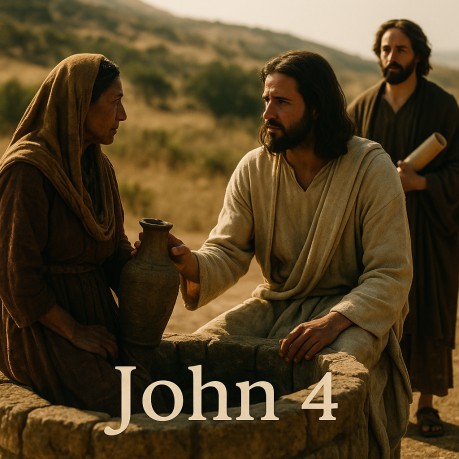
John 4:1-3 † Jesus avoided unnecessary conflict with the
Pharisees, showing wisdom in timing. His disciples performed
baptisms, while His mission centered on preaching the kingdom. John 4:4-6 † Jesus "had to" pass through
Samaria, not geographically but theologically. God's plan was to
reach Samaritans through Him. His humanity is seen in His
weariness. John 4:7-9 † Jews avoided contact with Samaritans. Jesus
broke barriers of ethnicity, gender, and morality. John 4:10 † Living water symbolized the Spirit, eternal
satisfaction, and new life. John 4:11-12 † The woman misunderstood physically what Jesus
spoke spiritually, just as Nicodemus did earlier. John 4:13-14 † Christ offers eternal satisfaction, unlike
earthly sources. His Spirit becomes a fountain within believers. John 4:15 † She still misunderstood, desiring physical
relief rather than spiritual renewal. John 4:16-18 † Jesus revealed her sin and brokenness. His
knowledge was supernatural, convicting yet compassionate. John 4:19-20 † She shifted to theological debate, pointing
to the Mount Gerizim vs. Jerusalem controversy. John 4:21-23 † Jesus transcended both Jewish and Samaritan
disputes. True worship is not about location but Spirit and truth. John 4:24 † God's nature requires worship beyond ritual.
Spirit and truth define the New Covenant. John 4:25-26 † Jesus directly revealed His identity as
Messiah. To an outcast Samaritan woman, He disclosed what He withheld
from Jewish leaders. John 4:27-30 † The woman became a witness. Leaving her
waterpot symbolized leaving behind her old life to proclaim Christ. John 4:31-34 † Jesus taught that true nourishment comes from
obedience to God's mission. John 4:35-38 † The harvest symbolized people ready for the
gospel. The disciples were reaping where prophets and John had sown. John 4:39-42 † Samaritans, despised by Jews, confessed Jesus
as Savior of the world. The gospel broke ethnic barriers. John 4:43-45 † Galileans welcomed Him superficially, driven
by signs, not true faith. John 4:46-47 † The royal official, likely in Herod's
service, came in desperation, showing faith in Jesus' power. John 4:48-50 † Jesus rebuked dependence on signs but
commended faith in His word. True faith rests on Christ's authority,
not outward miracles. John 4:51-54 † The official's faith grew from desperation to
full trust in Christ. His whole household believed, showing the
ripple effect of true faith. How it applies to us today † Christ breaks every barrier of race, gender,
and social status to offer living water. † This is the fulfilled perspective we proclaim at
Fulfilled Prophecies † Source Index
By Dan MainesJohn 4
So then, when the Lord knew that
the Pharisees had heard that He was making and baptizing more
disciples than John (although Jesus Himself was not baptizing;
rather, His disciples were), He left Judea and went away again to
Galilee.
And He had to pass through
Samaria. So He came to a city of Samaria called Sychar, near the
parcel of land that Jacob gave to his son Joseph; and Jacob's well
was there. So Jesus, tired from His journey, was sitting by the well.
It was about the sixth hour.
† Josephus (Antiquities 11.8.6)
records Jewish-Samaritan hostility, making this encounter radical.
A woman of Samaria came to draw
water. Jesus said to her, "Give Me a drink." For His
disciples had gone away to the city to buy food. So the Samaritan
woman said to Him, "How is it that You, though You are a Jew,
are asking me for a drink, though I am a Samaritan woman?" (For
Jews do not associate with Samaritans.)
Jesus answered and said to her,
"If you knew the gift of God, and who it is who is saying to
you, ‘Give Me a drink,' you would have asked Him, and He would have
given you living water."
† The Dead Sea
Scrolls (1QH 8.21) use "living water" imagery for God's
Spirit cleansing His people.
She said to Him, "Sir, You
have no bucket and the well is deep; where then do You get this
living water? You are not greater than our father Jacob, are You, who
gave us the well, and drank of it himself and his sons and his
cattle?"
Jesus answered and said to her,
"Everyone who drinks of this water will be thirsty again; but
the one who drinks of the water that I will give him will never be
thirsty; but the water that I will give him will become in him a
fountain of water springing up to eternal life."
The woman said to Him, "Sir,
give me this water so that I will not be thirsty, nor come all the
way here to draw water."
He said to her, "Go, call
your husband and come here." The woman answered and said to Him,
"I have no husband." Jesus said to her, "You have
correctly said, ‘I have no husband'; for you have had five
husbands, and the one whom you now have is not your husband; this
which you have said is true."
†
Augustine commented that her five husbands symbolized false gods, but
literally it revealed her personal history of shame.
The woman said to Him, "Sir,
I perceive that You are a prophet. Our fathers worshiped on this
mountain, and you Jews say that in Jerusalem is the place where one
must worship."
†
Josephus (Antiquities 18.4.1) notes the Samaritan temple on Mount
Gerizim, destroyed in 128 BC.
Jesus said to her, "Believe
Me, woman, that a time is coming when you will worship the Father
neither on this mountain nor in Jerusalem. You Samaritans worship
what you do not know; we worship what we do know, because salvation
is from the Jews. But a time is coming, and even now has arrived,
when the true worshipers will worship the Father in spirit and truth;
for such people the Father seeks to be His worshipers."
"God is spirit, and those who
worship Him must worship in spirit and truth."
The woman said to Him, "I
know that Messiah is coming (He who is called Christ); when that One
comes, He will declare all things to us." Jesus said to her, "I
am He, the One speaking to you."
And at this point His disciples
came, and they were amazed that He had been speaking with a woman;
yet no one said, "What are You seeking?" or, "Why are
You speaking with her?" So the woman left her waterpot and went
into the city, and said to the people, "Come, see a man who told
me all the things that I have done; this is not the Christ, is He?"
They left the city and were coming to Him.
Meanwhile the disciples were
urging Him, saying, "Rabbi, eat something." But He said to
them, "I have food to eat that you do not know about." So
the disciples were saying to one another, "No one brought Him
anything to eat, did he?" Jesus said to them, "My food is
to do the will of Him who sent Me, and to accomplish His work."
"Do you not say, ‘There
are still four months, and then comes the harvest'? Behold, I tell
you, raise your eyes and observe the fields, that they are white for
harvest. Already the one who reaps is receiving wages and is
gathering fruit for eternal life, so that the one who sows and the
one who reaps may rejoice together. For in this case the saying is
true: ‘One sows and another reaps.' I sent you to reap that for
which you have not labored; others have labored, and you have come
into their labor."
Now from that city many of the
Samaritans believed in Him because of the word of the woman who
testified, "He told me all the things that I have done." So
when the Samaritans came to Jesus, they were asking Him to stay with
them; and He stayed there two days. Many more believed because of His
word; and they were saying to the woman, "It is no longer
because of what you said that we believe, for we have heard for
ourselves and know that this One truly is the Savior of the world."
And after the two days, He
departed from there for Galilee. For Jesus Himself testified that a
prophet has no honor in his own country. So when He came to Galilee,
the Galileans received Him, only because they had seen all the things
that He did in Jerusalem at the feast; for they themselves also went
to the feast.
Therefore He came again to Cana
of Galilee, where He had made the water into wine. And there was a
royal official whose son was sick in Capernaum. When he heard that
Jesus had come from Judea to Galilee, he went to Him and was begging
Him to come down and heal his son; for he was at the point of death.
Then Jesus said to him, "Unless
you people see signs and wonders, you simply will not believe."
The royal official said to Him, "Sir, come down before my child
dies." Jesus said to him, "Go; your son is alive." The
man believed the word that Jesus spoke to him and went home.
And as he was now going down,
his slaves met him, saying that his son was alive. So he inquired of
them the hour when he began to get better. Then they said to him,
"Yesterday at the seventh hour the fever left him." So the
father knew that it was at that hour in which Jesus said to him,
"Your son is alive"; and he himself believed, and his
entire household. This is again a second sign that Jesus performed
when He had come from Judea into Galilee.
†
True worship is in spirit and truth, not confined to places or
rituals.
† Testimony, even from the unlikely,
can bring many to Christ.
† Faith grows from
signs to resting on the authority of Christ's word.
† Josephus,
Antiquities 11.8.6 – Jewish-Samaritan hostility
†
Dead Sea Scrolls, 1QH 8.21 – living water imagery
†
Augustine, Tractates on John – Samaritan woman's spiritual
significance
† Josephus, Antiquities 18.4.1 –
Samaritan temple on Gerizim
† Chrysostom,
Homilies on John – Jesus' mission transcending ritual worship
Links