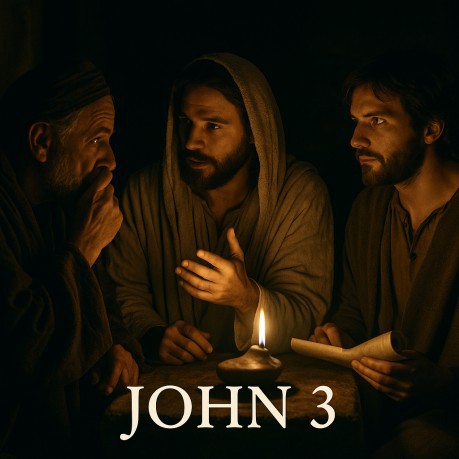
John 3:1-2 † Nicodemus, a Pharisee and member of the
Sanhedrin, approached Jesus secretly. His recognition of Jesus as
teacher fell short of understanding Him as Messiah. John 3:3 † Jesus moved from signs to the necessity of
new birth. "Born again" (or "born from above")
pointed to the Spirit's work, not human effort. John 3:4 † Nicodemus misunderstood, interpreting
physically what Jesus meant spiritually. John 3:5 † "Water and Spirit" recalls Ezekiel
36:25-27, where God promised cleansing and a new heart by His Spirit.
Baptism symbolizes this spiritual renewal. John 3:6-7 † Flesh produces only flesh. Only the Spirit
brings new birth. Jesus demanded spiritual transformation, not mere
lineage or law-keeping. John 3:8 † The Spirit's work is mysterious yet evident.
Like the wind, its source and movement are unseen, but its effects
undeniable. John 3:9-10 † Nicodemus, despite his learning, lacked
spiritual insight. Scripture had foretold new covenant renewal, yet
he missed it. John 3:11-12 † Israel's leaders rejected testimony of the
Messiah. If they stumbled over earthly metaphors, they would not
grasp heavenly truths. John 3:13 † Jesus alone has heavenly authority. He
descended from heaven and reveals the Father perfectly. John 3:14-15 † The bronze serpent in Numbers 21 prefigured
Christ's crucifixion. Looking in faith brings life. John 3:16 † This verse encapsulates the gospel: God's
love, His gift, and salvation through faith. John 3:17-18 † The mission of Christ was salvation, not
condemnation. Judgment falls on unbelief, not on those who embrace
the Son. John 3:19-21 † The division is moral and spiritual: those
who love darkness reject Christ, those who love truth come into the
Light. John 3:22-24 † Both Jesus' disciples and John were
baptizing, showing continuity of preparation and fulfillment. John 3:25-27 † John reaffirmed that all ministry is a gift
from God. Popularity was not his concern; faithfulness was. John 3:28-30 † John likened himself to the friend of the
groom. Christ is the true bridegroom of God's people. John's role was
preparation, not competition. John 3:31-33 † Christ's authority comes from heaven. To
believe Him is to affirm God's truth. John 3:34-36 † The Spirit's fullness rests upon Christ.
Faith in the Son brings eternal life, while rejection brings wrath. How it applies to us today † New birth is essential: no one enters the
kingdom without being born of the Spirit. † This is the fulfilled perspective we proclaim at
Fulfilled Prophecies † Source Index
By Dan MainesJohn 3
Now there was a man of the
Pharisees, named Nicodemus, a ruler of the Jews; this man came to
Jesus at night and said to Him, "Rabbi, we know that You have
come from God as a teacher; for no one can do these signs that You do
unless God is with him."
†
Josephus (Antiquities 14.9.3) describes the Sanhedrin's authority,
confirming Nicodemus' standing.
Jesus responded and said to him,
"Truly, truly, I say to you, unless someone is born again he
cannot see the kingdom of God."
Nicodemus said to Him, "How
can a man be born when he is old? He cannot enter his mother's womb a
second time and be born, can he?"
Jesus answered, "Truly, truly,
I say to you, unless someone is born of water and the Spirit, he
cannot enter the kingdom of God."
"That which has been born of
the flesh is flesh, and that which has been born of the Spirit is
spirit. Do not be amazed that I said to you, ‘You must be born
again.'"
"The wind blows where it
wishes, and you hear its sound, but do not know where it is coming
from and where it is going; so is everyone who has been born of the
Spirit."
Nicodemus responded and said to
Him, "How can these things be?" Jesus answered and said to
him, "You are the teacher of Israel, and yet you do not
understand these things?"
"Truly, truly, I say to
you, we speak of what we know, and testify of what we have seen, and
you people do not accept our testimony. If I told you earthly things
and you do not believe, how will you believe if I tell you heavenly
things?"
"No one has ascended into
heaven, except He who descended from heaven: the Son of Man."
†
Early church father Origen affirmed that Christ is the only true
revealer of heavenly mysteries.
"And just as Moses lifted
up the serpent in the wilderness, so must the Son of Man be lifted
up, so that everyone who believes will have eternal life in Him."
"For God so loved the world,
that He gave His only Son, so that everyone who believes in Him will
not perish, but have eternal life."
†
Augustine declared this the "summary of the gospel."
"For God did not send the
Son into the world to judge the world, but so that the world might be
saved through Him. The one who believes in Him is not judged; the one
who does not believe has been judged already, because he has not
believed in the name of the only Son of God."
"And this is the judgment,
that the Light has come into the world, and people loved the darkness
rather than the Light; for their deeds were evil. For everyone who
does evil hates the Light, and does not come to the Light, so that
his deeds will not be exposed. But the one who practices the truth
comes to the Light, so that his deeds will be revealed as having been
performed in God."
After these things Jesus and
His disciples came into the land of Judea; and there He was spending
time with them and baptizing. Now John also was baptizing in Aenon
near Salim, because there was much water there; and people were
coming and being baptized. For John had not yet been thrown into
prison.
Then a matter of dispute
developed on the part of John's disciples with a Jew about
purification. And they came to John and said to him, "Rabbi, He
who was with you beyond the Jordan, to whom you have testified,
behold, He is baptizing and all the people are coming to Him."
John replied, "A person can receive not even one thing unless it
has been given to him from heaven."
"You yourselves are
witnesses that I said, ‘I am not the Christ,' but, ‘I have been
sent ahead of Him.' He who has the bride is the groom; but the friend
of the groom, who stands and listens to him, rejoices greatly because
of the groom's voice. So this joy of mine has been made full. He must
increase, but I must decrease."
† The Dead Sea
Scrolls also use bride imagery for God's covenant, which John applies
here to Christ.
"He who comes from above
is above all; the one who is only from the earth is of the earth, and
speaks of the earth. He who comes from heaven is above all. What He
has seen and heard, of this He testifies; and no one accepts His
testimony. The one who has accepted His testimony has certified that
God is true."
"For He whom God sent
speaks the words of God; for He does not give the Spirit sparingly.
The Father loves the Son and has entrusted all things to His hand.
The one who believes in the Son has eternal life; but the one who
does not obey the Son will not see life, but the wrath of God remains
on him."
†
Christ crucified, lifted up like the serpent, is the only way of
salvation.
† God's love is universal, but
salvation is for those who believe.
† Like
John, we must decrease so that Christ may increase in our lives.
† Josephus,
Antiquities 14.9.3 – Sanhedrin authority
†
Ezekiel 36:25-27 – cleansing and Spirit renewal
†
Origen, Commentary on John – Christ as revealer of heaven
†
Numbers 21:8-9 – serpent lifted up
†
Augustine, Homilies on John – John 3:16 as gospel summary
†
Dead Sea Scrolls – covenant bride imagery
†
Chrysostom, Homilies on John – John's humility and decrease
Links