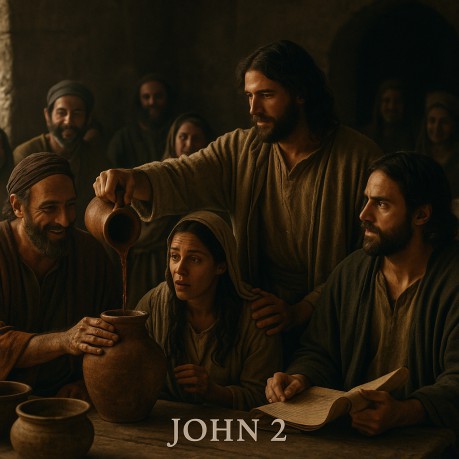
John 2:1-2 † John records the first public sign of Jesus'
ministry at a wedding. The setting reflects joy, covenant, and
fellowship. His mother's presence highlights the personal nature of
this moment. John 2:3-4 † Running out of wine symbolized shame in
Jewish culture. Jesus' reply was not disrespectful but clarified that
His miracles would follow God's appointed hour, not human demand. John 2:5-7 † The six stone jars, used for purification,
symbolized the insufficiency of the old order. Jesus filled them to
the brim, signifying abundance and completion. John 2:8-10 † The transformation of water into wine pointed
to the New Covenant, superior to the old. The best was saved until
the appearing of Christ. John 2:11 † The miracle revealed Jesus' glory and
strengthened the faith of His disciples. This was not mere provision,
but a sign pointing to His messianic role. John 2:12 † Capernaum became the center of His Galilean
ministry. His family and disciples traveled with Him, highlighting
the growing circle around Christ. John 2:13-14 † The cleansing of the temple is placed early
in John, while the Synoptics place it near the end. John highlights
Jesus' authority at the start of His ministry. John 2:15-16 † Jesus' zeal revealed His messianic mission to
cleanse God's dwelling. The temple was being turned into a
marketplace rather than a house of prayer. John 2:17 † This fulfilled Psalm 69:9, a prophecy of the
Messiah's zeal for God's holiness. John 2:18-19 † The leaders demanded a sign, but Jesus
pointed to His death and resurrection as the ultimate sign of His
authority. John 2:20-21 † The physical temple, renovated under Herod
for decades, was not the true temple. Christ's body was the dwelling
place of God, soon to be destroyed and raised again. John 2:22 † The resurrection validated His words. Faith
in Scripture and in Christ's testimony came together in fulfillment. John 2:23-25 † Many believed superficially, attracted by
signs, but Jesus saw the heart. True faith goes beyond wonder to
trust in His person. How it applies to us today † Christ transforms emptiness into abundance,
as seen at Cana. † This is the fulfilled perspective we proclaim at
Fulfilled Prophecies † Source Index
By Dan MainesJohn 2
On the third day there was a
wedding in Cana of Galilee, and the mother of Jesus was there; and
both Jesus and His disciples were invited to the wedding.
When the wine ran out, the mother
of Jesus said to Him, "They have no wine." And Jesus said
to her, "What business do you have with Me, woman? My hour has
not yet come."
†
Chrysostom noted that "woman" was a respectful form of
address in Greek, not derogatory.
His mother said to the servants,
"Whatever He tells you, do it." Now there were six stone
waterpots standing there for the Jewish custom of purification,
containing two or three measures each. Jesus said to them, "Fill
the waterpots with water." So they filled them up to the brim.
And He said to them, "Draw
some out now and take it to the headwaiter." And they took it to
him. Now when the headwaiter tasted the water which had become wine,
and did not know where it came from (but the servants who had drawn
the water knew), the headwaiter called the groom, and said to him,
"Every man serves the good wine first, and when the guests are
drunk, then he serves the poorer wine; but you have kept the good
wine until now."
† Irenaeus (Against
Heresies 3.11.5) saw this miracle as a sign of Christ bringing new
creation.
This beginning of His signs Jesus
did in Cana of Galilee, and revealed His glory; and His disciples
believed in Him.
After this He went down to
Capernaum, He and His mother, His brothers, and His disciples; and
they stayed there a few days.
The Passover of the Jews was
near, and Jesus went up to Jerusalem. And within the temple grounds
He found those who were selling oxen, sheep, and doves, and the money
changers seated at their tables.
†
Josephus (Wars 6.9.3) noted the vast commerce connected with the
temple, showing how it became corrupted by profit.
And He made a whip of cords,
and drove them all out of the temple, with the sheep and the oxen;
and He poured out the coins of the money changers and overturned
their tables; and to those who were selling the doves He said, "Take
these things away from here; stop making My Father's house a place of
business!"
His disciples remembered that it
was written: "Zeal for Your house will consume me."
The Jews then said to Him,
"What sign do You show us as your authority for doing these
things?" Jesus answered them, "Destroy this temple, and in
three days I will raise it up."
The Jews then said, "It
took forty-six years to build this temple, and yet You will raise it
up in three days?" But He was speaking about the temple of His
body.
†
Josephus (Antiquities 15.11.1) records Herod's long temple
renovation, confirming the forty-six years.
So, when He was raised from the
dead, His disciples remembered that He said this; and they believed
the Scripture and the word which Jesus had spoken.
Now when He was in Jerusalem at
the Passover, during the feast many believed in His name, as they
observed His signs which He was doing. But Jesus, on His part, was
not entrusting Himself to them, because He knew all people, and
because He did not need anyone to testify about mankind, for He
Himself knew what was in mankind.
† Augustine observed
that Jesus did not commit Himself to those with shallow belief,
showing His divine knowledge of hearts.
† He cleanses our hearts as
His temple, driving out hypocrisy and corruption.
†
True faith rests not on signs alone, but on Christ Himself, the risen
Lord.
† The resurrection is the ultimate sign
proving His authority and glory.
†
Chrysostom, Homilies on John – "woman" as respectful
address
† Irenaeus, Against Heresies 3.11.5 –
Cana as new creation
† Josephus, Wars 6.9.3 –
temple commerce and corruption
† Josephus,
Antiquities 15.11.1 – Herod's forty-six-year temple renovation
†
Augustine, Tractates on John – superficial belief and Christ's
knowledge of hearts
Links