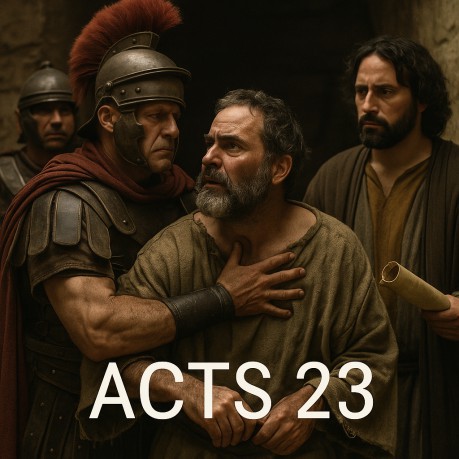
Acts 23:1-2 † Paul declared his clear conscience, showing
that in Christ he was blameless. Ananias' order reflected corruption
and hostility toward the gospel. Acts 23:3 † Paul's rebuke echoed Jesus' words about
whitewashed tombs (Matthew 23:27). Ananias represented hypocrisy,
claiming to uphold the Law while violating it. Acts 23:4-5 † Paul quoted Exodus 22:28, showing his respect
for God's law even while confronting injustice. His humility tempered
his sharp rebuke. Acts 23:6 † Paul wisely shifted the focus to the
resurrection, a dividing line between Sadducees and Pharisees. His
defense became a testimony to the core of the gospel. Acts 23:7-9 † Paul's defense turned his accusers against
one another. Some Pharisees even defended him. Acts 23:10-11 † Christ Himself comforted Paul, assuring him
that his mission was not ending in Jerusalem but continuing to Rome. Acts 23:12-15 † The plot revealed the depth of hatred against
Paul. Even religious leaders were willing to align with murder. Acts 23:16-22 † God providentially used Paul's nephew to
expose the plot. Even in danger, God preserved His servant for the
mission. Acts 23:23-24 † The massive escort showed Rome's recognition
of the seriousness of the threat. Paul was protected by the very
empire he was accused of opposing. Acts 23:25-30 † Lysias' letter confirmed Paul's innocence of
any crime against Rome. His case was religious, not political. Acts 23:31-35 † Paul was now under Roman protection in
Caesarea, awaiting trial before Felix. God's plan was moving him
closer to Rome. How it applies to us today † God's servants may face corruption and false
accusations, but His providence preserves His mission. † This is the fulfilled perspective we proclaim at
Fulfilled Prophecies † Source Index
By Dan MainesActs 23
Now looking intently at the
Council, Paul said, "Brothers, I have lived my life with an
entirely good conscience before God up to this day." But the
high priest Ananias commanded those standing beside him to strike him
on the mouth.
† Josephus
(Antiquities 20.9.2) describes Ananias as greedy and violent,
confirming Luke's depiction.
Then Paul said to him, "God
is going to strike you, you whitewashed wall! Do you sit to judge me
according to the Law, and yet in violation of the Law you order me to
be struck?"
But those present said, "Are
you insulting God's high priest?" And Paul said, "I was not
aware, brothers, that he is high priest; for it is written: ‘You
shall not speak evil of a ruler of your people.'"
But Paul, perceiving that one
group were Sadducees and the other Pharisees, began crying out in the
Council, "Brothers, I am a Pharisee, a son of Pharisees; I am on
trial for the hope and resurrection of the dead!"
†
Josephus (Antiquities 18.1.4) records the Sadducees' denial of
resurrection, while Pharisees affirmed it.
When he said this, a dissension
occurred between the Pharisees and Sadducees, and the assembly was
divided. For the Sadducees say that there is no resurrection, nor an
angel, nor a spirit, but the Pharisees acknowledge them all. And a
great uproar occurred; and some of the scribes of the Pharisaic party
stood up and started arguing strenuously, saying, "We find
nothing wrong with this man; suppose a spirit or an angel has spoken
to him?"
And when a great dissension
occurred, the commander was afraid that Paul would be torn to pieces
by them, and ordered the soldiers to go down and take him away from
them by force, and bring him into the barracks. But on the following
night, the Lord stood near him and said, "Be courageous! For as
you have testified to the truth about Me in Jerusalem, so you must
testify in Rome also."
When it was day, the Jews
formed a conspiracy and put themselves under an oath, saying that
they would neither eat nor drink until they had killed Paul. There
were more than forty who formed this plot. They came to the chief
priests and the elders and said, "We have put ourselves under a
curse to taste nothing until we have killed Paul. Now therefore, you,
with the Council, notify the commander to bring him down to you, as
though you were going to investigate his case more thoroughly; and
we, for our part, are ready to kill him before he comes near."
†
The Mishnah (Nedarim 3.1) records the seriousness of oaths, making
their vow even more striking in its corruption.
But the son of Paul's sister
heard about their ambush, and he came and entered the barracks and
told Paul. Paul called one of the centurions to himself and said,
"Lead this young man to the commander, for he has something to
report to him." So he took him and led him to the commander and
said, "Paul the prisoner called me to him and asked me to lead
this young man to you since he has something to tell you." The
commander took him by the hand and stepping aside, began to inquire
of him privately, "What is it that you have to report to me?"
And he said, "The Jews have agreed to ask you to bring Paul down
tomorrow to the Council, as though they were going to inquire
somewhat more thoroughly about him. So do not listen to them, for
more than forty of them are in hiding to ambush him, and these men
have put themselves under an oath not to eat or drink until they have
killed him; and now they are ready and waiting for assurance from
you." So the commander let the young man go, instructing him,
"Tell no one that you have notified me of these things."
And he called to himself two
of the centurions and said, "Get two hundred soldiers ready by
the third hour of the night to proceed to Caesarea, with seventy
horsemen, and two hundred spearmen." They were also to provide
mounts for Paul and put him on them, and bring him safely to Felix
the governor.
And he wrote a letter with the
following content:
"Claudius Lysias, to the most excellent
governor Felix: Greetings. When this man was seized by the Jews and
was about to be killed by them, I came up to them with the troops and
rescued him, after learning that he was a Roman. And wanting to
ascertain the basis for the charges they were bringing against him, I
brought him down to their Council; and I found that he was being
accused regarding questions in their Law, but he was not charged with
anything deserving death or imprisonment. When I was informed that
there would be a plot against the man, I sent him to you at once,
also instructing his accusers to bring charges against him before
you."
So the soldiers, in accordance
with their orders, took Paul and brought him by night to Antipatris.
But on the next day they let the horsemen go on with him, and they
returned to the barracks. When these horsemen had come to Caesarea
and delivered the letter to the governor, they also presented Paul to
him. Now Felix, after reading the letter, asked what province he was
from; and when he learned that he was from Cilicia, he said, "I
will give you a hearing when your accusers arrive as well,"
giving orders for Paul to be kept in Herod's Praetorium.
†
Christ's resurrection is the dividing truth that exposes both faith
and unbelief.
† Believers must remain
courageous, knowing that Christ stands with them in trials.
†
God can use earthly powers, even corrupt ones, to protect His people
and advance His kingdom.
† Josephus,
Antiquities 20.9.2 – High priest Ananias' corruption
†
Josephus, Antiquities 18.1.4 – Sadducees' denial of resurrection
†
Mishnah, Nedarim 3.1 – Seriousness of vows and oaths
†
Roman historical records – Claudius Lysias and Roman procedure
Links