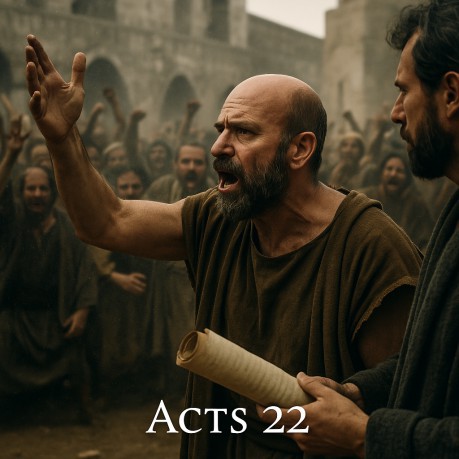
Acts 22:1-2 † Paul addressed them with respect, calling
them brothers and fathers. Speaking Hebrew gained their attention and
showed his identification with Israel. Acts 22:3 † Paul established his credentials as a
faithful Jew. Gamaliel was a leading Pharisee teacher, respected even
in rabbinic tradition. Acts 22:4-5 † Paul confessed his past as a persecutor of
the church, showing his zeal once blinded him. His testimony was
verifiable through the council. Acts 22:6-8 † Paul's conversion was centered on an
encounter with the risen Christ. Persecuting the church was
persecuting Christ Himself. Acts 22:9-11 † Paul's blindness symbolized his former
spiritual blindness. His commissioning was divinely appointed. Acts 22:12-13 † Ananias was respected among Jews, validating
Paul's testimony. His healing of Paul showed God's grace. Acts 22:14-16 † Paul's commission was to testify to all
people. Baptism marked his cleansing and entry into Christ. Acts 22:17-18 † Paul was warned early that his mission would
face rejection in Jerusalem. This matched the prophets who were
rejected in their own city. Acts 22:19-20 † Paul again confessed his past, connecting
himself to Stephen's martyrdom. His conversion was a testimony of
grace. Acts 22:21 † The mission to the Gentiles was God's
command. This statement became the trigger for renewed Jewish
outrage. Acts 22:22-23 † The mention of Gentiles enraged them,
revealing their hardened exclusivism. Acts 22:24-25 † Paul wisely used his Roman citizenship to
avoid illegal torture. Roman law protected its citizens. Acts 22:26-29 † Paul's citizenship again provided protection.
His status gave him legal standing in Rome's world. Acts 22:30 † Paul's case was now to be heard by the
Sanhedrin. God's plan moved forward toward Rome. How it applies to us today † Testimony is powerful. Paul shared his story,
showing how God's grace transforms the worst sinner. † This is the fulfilled perspective we proclaim at
Fulfilled Prophecies † Source Index
By Dan MainesActs 22
"Brothers and fathers, hear
my defense which I now offer to you." And when they heard that
he was addressing them in the Hebrew dialect, they became even more
quiet; and he said,
"I am a Jew, born in Tarsus
of Cilicia, but brought up in this city, educated at the feet of
Gamaliel according to the strictness of the law of our fathers, being
zealous for God just as you all are today."
† The Mishnah (Avot
1.16) highlights Gamaliel's prominence, confirming Paul's education
under him.
"I persecuted this Way to
the death, binding and putting both men and women into prisons, as
also the high priest and all the Council of the elders can testify.
From them I also received letters to the brothers, and started off
for Damascus in order to bring even those who were there to Jerusalem
as prisoners to be punished."
"But it happened that as I
was on my way, approaching Damascus around noontime, a very bright
light suddenly flashed from heaven all around me, and I fell to the
ground and heard a voice saying to me, ‘Saul, Saul, why are you
persecuting Me?' And I answered, ‘Who are You, Lord?' And He said
to me, ‘I am Jesus the Nazarene, whom you are persecuting.'"
"And those who were with
me saw the light, but did not understand the voice of the One who was
speaking to me. And I said, ‘What shall I do, Lord?' And the Lord
said to me, ‘Get up and go on into Damascus, and there you will be
told of everything that has been appointed for you to do.' But since
I could not see because of the brightness of that light, I was led by
the hand by those who were with me and came into Damascus."
"Now a certain Ananias, a
man who was devout by the standard of the Law, and well spoken of by
all the Jews who lived there, came to me, and standing nearby he said
to me, ‘Brother Saul, receive your sight!' And at that very moment
I looked up at him."
"And he said, ‘The God
of our fathers has appointed you to know His will and to see the
Righteous One, and to hear a message from His mouth. For you will be
a witness for Him to all people of what you have seen and heard. Now
why do you delay? Get up and be baptized, and wash away your sins by
calling on His name.'"
"It happened when I
returned to Jerusalem and was praying in the temple, that I fell into
a trance, and I saw Him saying to me, ‘Hurry, and leave Jerusalem
quickly, because they will not accept your testimony about Me.'"
"And I said, ‘Lord,
they themselves understand that in one synagogue after another I used
to imprison and beat those who believed in You. And when the blood of
Your witness Stephen was being shed, I also was standing nearby and
approving, and I was taking care of the cloaks of those who were
killing him.'"
"And He said to me, ‘Go!
For I will send you far away to the Gentiles.'"
They listened to him up to
this statement, and then they raised their voices and said, "Away
with such a man from the earth, for he should not be allowed to
live!" And as they were shouting and throwing off their cloaks
and tossing dust into the air,
†
Josephus (Wars 2.17.2) describes similar crowd outbursts in
Jerusalem, confirming Luke's accuracy.
the commander ordered that he
be brought into the barracks, saying that he was to be interrogated
by flogging so that he would find out the reason why they were
shouting against him that way. But when they stretched him out with
straps, Paul said to the centurion who was standing by, "Is it
lawful for you to flog a man who is a Roman and uncondemned?"
†
Cicero (Against Verres 2.5.66) affirms that it was unlawful to bind
or flog an uncondemned Roman citizen.
When the centurion heard this,
he went to the commander and told him, saying, "What are you
about to do? For this man is a Roman." The commander came and
said to him, "Tell me, are you a Roman?" And he said,
"Yes." The commander answered, "I acquired this
citizenship for a large sum of money." And Paul said, "But
I was actually born a citizen." Therefore, those who were about
to interrogate him immediately backed away from him; and the
commander also was afraid when he found out that he was a Roman, and
because he had put him in chains.
Now on the next day, wanting to
know for certain why Paul had been accused by the Jews, he released
him and ordered the chief priests and all the Council to assemble,
and he brought Paul down and placed him before them.
†
Believers must be ready to confess Christ, even when misunderstood or
persecuted.
† God uses both spiritual
authority and earthly citizenship to advance His purposes.
†
The mission to the nations is central, and opposition to it reveals
hardened hearts.
† Mishnah,
Avot 1.16 – Gamaliel's prominence as a teacher
†
Josephus, Wars 2.17.2 – Crowd outbursts in Jerusalem
†
Cicero, Against Verres 2.5.66 – Illegality of flogging a Roman
citizen
† Early church writings – Dionysius
and early leaders citing Paul's testimony
Links