Acts 20:1-3 † Paul's ministry was marked by both
encouragement and opposition. Jewish plots repeatedly forced changes
in his plans, but God still directed his journey. Acts 20:4-6 † Luke reenters with the "we"
sections, showing he was present as an eyewitness. Paul's team
represented multiple regions, symbolizing the unity of Jew and
Gentile in the mission. Acts 20:7-9 † The early church gathered on the first day of
the week, marking the shift from Sabbath to the Lord's Day. The story
of Eutychus shows both human weakness and God's power. Acts 20:10-12 † God used Paul to restore Eutychus, confirming
His power and comforting the believers. The breaking of bread again
emphasized fellowship and remembrance of Christ. Acts 20:13-16 † Paul's urgency to reach Jerusalem showed his
dedication to God's timing. His travels show the precision of Luke's
eyewitness account. Acts 20:17-21 † Paul reminded the Ephesian elders of his
faithful ministry, marked by humility, tears, and trials. His
preaching was consistent: repentance and faith. Acts 20:22-24 † Paul's life was dedicated to completing the
mission Christ gave him. His courage reflected Christ's own example
of facing Jerusalem with resolve. Acts 20:25-27 † Paul declared his innocence because he had
faithfully proclaimed God's whole counsel. This reflected Ezekiel's
watchman principle. Acts 20:28-30 † Paul warned of false teachers, both external
and internal. The church must be vigilant. Acts 20:31-32 † Paul commended them to God and His word,
showing reliance on divine grace rather than himself. Acts 20:33-35 † Paul set an example of selflessness and hard
work. The quote from Jesus, though not recorded in the Gospels, was
preserved in apostolic tradition. Acts 20:36-38 † The farewell at Miletus was filled with love
and sorrow. Paul's bond with the elders showed the depth of Christian
fellowship. How it applies to us today † Ministry requires humility, perseverance, and
boldness in declaring the whole counsel of God. † This is the fulfilled perspective we proclaim at
Fulfilled Prophecies † Source Index
By Dan MainesActs 20
After the uproar had ceased,
Paul sent for the disciples, and when he had encouraged them and said
farewell, he left to go to Macedonia. When he had gone through those
regions and had given them much encouragement, he came to Greece. And
he spent three months there. When a plot was formed against him by
the Jews as he was about to set sail for Syria, he decided to return
through Macedonia.
†
Josephus (Antiquities 20.2.3) mentions similar Jewish plots against
those seen as opposing their traditions.
And he was accompanied by
Sopater of Berea, Aristarchus and Secundus of the Thessalonians,
Gaius of Derbe, Timothy, and Tychicus and Trophimus of Asia. Now
these had gone on ahead and were waiting for us at Troas. We sailed
from Philippi after the days of Unleavened Bread, and reached them at
Troas within five days; and we stayed there for seven days.
On the first day of the week,
when we were gathered together to break bread, Paul began talking to
them, intending to leave the next day, and he prolonged his message
until midnight. Now there were many lamps in the upstairs room where
we were gathered. And there was a young man named Eutychus sitting on
the windowsill, sinking into a deep sleep; and as Paul kept on
talking, he was overcome by sleep and fell down from the third floor,
and was picked up dead.
But Paul went down and fell
upon him, and after embracing him, he said, "Do not be troubled,
for he is still alive." When Paul had gone back up and had
broken the bread and eaten, he talked with them a long while until
daybreak, and then left. They took the boy alive, and were greatly
comforted.
But we went on ahead to the
ship and set sail for Assos, intending from there to take Paul on
board; for so he had arranged it, intending himself to go by land.
And when he met us at Assos, we took him on board and came to
Mitylene. Sailing from there, we arrived the following day opposite
Chios, and the next day we crossed over to Samos; and the day after
that we came to Miletus. For Paul had decided to sail past Ephesus so
that he would not have to spend time in Asia, for he was hurrying, if
possible, to be in Jerusalem on the day of Pentecost.
From Miletus he sent word to
Ephesus and called to himself the elders of the church. And when they
came to him, he said to them, "You yourselves know, from the
first day that I set foot in Asia, how I was with you the whole time,
serving the Lord with all humility and with tears and trials which
came upon me through plots of the Jews; how I did not shrink from
declaring to you anything that was beneficial, and teaching you
publicly and from house to house, solemnly testifying to both Jews
and Greeks of repentance toward God and faith in our Lord Jesus
Christ."
"And now, behold, bound
by the Spirit, I am on my way to Jerusalem, not knowing what will
happen to me there, except that the Holy Spirit solemnly testifies to
me in every city, saying that chains and afflictions await me. But I
do not consider my life of any account as dear to myself, so that I
may finish my course and the ministry which I received from the Lord
Jesus, to testify solemnly of the gospel of God's grace."
"And now, behold, I know
that all of you, among whom I went about preaching the kingdom, will
no longer see my face. Therefore, I testify to you this day that I am
innocent of the blood of all people. For I did not shrink from
declaring to you the whole purpose of God."
"Be on guard for
yourselves and for all the flock, among which the Holy Spirit has
made you overseers, to shepherd the church of God which He purchased
with His own blood. I know that after my departure savage wolves will
come in among you, not sparing the flock; and from among your own
selves men will arise, speaking perverse things to draw away the
disciples after them."
†
The Dead Sea Scrolls (CD 20.14-15) warned of false shepherds, a theme
fulfilled in Paul's charge to the elders.
"Therefore, be on the
alert, remembering that night and day for a period of three years I
did not cease to admonish each one with tears. And now I entrust you
to God and to the word of His grace, which is able to build you up
and to give you the inheritance among all those who are sanctified."
"I have coveted no one's
silver or gold or clothes. You yourselves know that these hands
served my own needs and the men who were with me. In everything I
showed you that by working hard in this way you must help the weak,
and remember the words of the Lord Jesus, that He Himself said, ‘It
is more blessed to give than to receive.'"
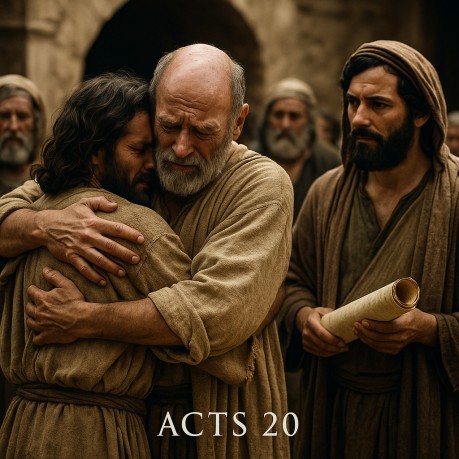
When he had said these things,
he knelt down and prayed with them all. And they all began to weep
aloud and embraced Paul, and repeatedly kissed him, grieving
especially over the word which he had spoken, that they would not see
his face again. And they were accompanying him to the ship.
†
Believers must be alert against false teaching and protect the flock
of God.
† Selfless service and generosity
reflect Christ's teaching and Paul's example.
†
True fellowship is marked by love, prayer, and shared tears.
† Josephus,
Antiquities 20.2.3 – Jewish plots and opposition
†
Ezekiel 33:4-6 – Watchman imagery applied by Paul
†
Dead Sea Scrolls, CD 20.14-15 – Warnings of false shepherds
†
Delphi and Ephesian inscriptions – Archaeological confirmations of
Paul's journeys
Links