Acts 16:1-2 † Timothy became Paul's closest companion in
ministry. His mixed heritage symbolized the union of Jew and Gentile
in Christ. Acts 16:3 † Paul circumcised Timothy not for salvation,
but to remove stumbling blocks for Jewish evangelism. This act
contrasted with his refusal to circumcise Titus (Galatians 2:3),
showing flexibility for the sake of the gospel. Acts 16:4-5 † The decisions of the Jerusalem Council (Acts
15) were confirmed and spread, promoting unity and growth. Acts 16:6-8 † The Spirit directed the mission, closing some
doors and opening others. The gospel's spread was under divine
control, not human strategy. Acts 16:9-10 † The Macedonian vision marked the gospel's
entry into Europe. Notice the "we" section begins here,
showing Luke's presence as eyewitness. Acts 16:11-12 † Philippi was a Roman colony, full of retired
soldiers and Roman culture. This gave the church a strategic base. Acts 16:13-15 † Lydia became the first convert in Europe. Her
heart was opened by the Lord, showing salvation is God's work. Acts 16:16-18 † The spirit of divination literally means
"python spirit," tied to the oracle of Delphi. Paul's
command in Jesus'name showed Christ's authority over demonic
powers. Acts 16:19-21 † Economic loss fueled opposition. Their
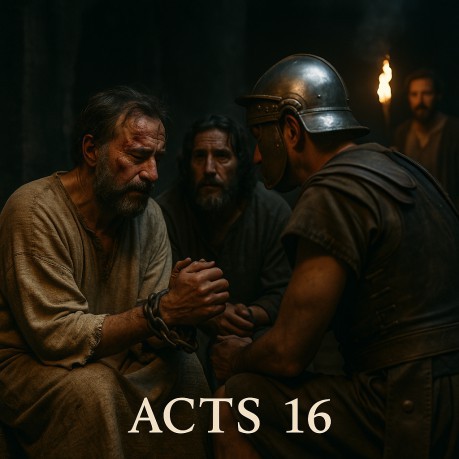
accusation framed Paul and Silas as disturbers of Roman order. Acts 16:22-24 † Paul and Silas were publicly humiliated,
beaten, and imprisoned unjustly. Roman law normally protected
citizens, but prejudice led to abuse. Acts 16:25-26 † Their worship in suffering became a
testimony. God shook the prison with His power, setting captives
free. Acts 16:27-30 † The jailer's despair turned to salvation.
Roman guards were liable with their lives for escaped prisoners,
explaining his desperation. Acts 16:31-34 † Salvation came by faith in Christ, not works.
Baptism marked his immediate inclusion in the covenant. His joy
showed true transformation. Acts 16:35-37 † Paul asserted his Roman citizenship to
protect the gospel's integrity. The authorities had violated Roman
law. Acts 16:38-40 † The magistrates' fear confirmed the
seriousness of their unlawful actions. Paul and Silas encouraged the
believers before departing, leaving a strong witness. How it applies to us today † God directs the mission, opening doors and
closing others. † This is the fulfilled perspective we proclaim at
Fulfilled Prophecies † Source Index
By Dan MainesActs 16
Now Paul also came to Derbe and
to Lystra. And a disciple was there named Timothy, the son of a
Jewish woman who was a believer, but his father was a Greek, and he
was well spoken of by the brothers and sisters who were in Lystra and
Iconium.
† The Mishnah (Kiddushin 3.12)
records debates over mixed marriages, showing why Timothy's parentage
was significant in Jewish eyes.
Paul wanted this man to leave with
him, and he took him and circumcised him because of the Jews who were
in those parts, for they all knew that his father was a Greek.
Now while they were passing
through the cities, they were delivering the ordinances which had
been determined by the apostles and elders in Jerusalem, for them to
follow. So the churches were being strengthened in the faith, and
were increasing in number daily.
They passed through the Phrygian
and Galatian region, after being forbidden by the Holy Spirit to
speak the word in Asia, and after they came to Mysia, they were
trying to go into Bithynia, and the Spirit of Jesus did not allow
them. And passing by Mysia, they went down to Troas.
And a vision appeared to Paul
in the night: a man of Macedonia was standing and pleading with him,
and saying, "Come over to Macedonia and help us." When he
had seen the vision, we immediately sought to leave for Macedonia,
concluding that God had called us to preach the gospel to them.
So after setting sail from
Troas, we ran a straight course to Samothrace, and on the following
day to Neapolis, and from there to Philippi, which is a leading city
of the district of Macedonia, a Roman colony; and we were spending
some days in this city.
†
Roman inscriptions confirm Philippi's colonial status, aligning Acts
with archaeology.
And on the Sabbath day we went
outside the gate to a riverside, where we were thinking that there
was a place of prayer; and we sat down and began speaking to the
women who had assembled. A woman named Lydia, from the city of
Thyatira, a seller of purple fabrics, a worshiper of God, was
listening; and the Lord opened her heart to respond to the things
spoken by Paul. Now when she and her household had been baptized, she
urged us, saying, "If you have judged me to be faithful to the
Lord, come into my house and stay." And she prevailed upon us.
†
Purple fabric was a luxury trade item, linking Lydia to wealth and
influence.
It happened that as we were
going to the place of prayer, a slave woman who had a spirit of
divination met us, who was bringing great profit to her masters by
fortune-telling. She followed Paul and us, and cried out, saying,
"These men are bond-servants of the Most High God, who are
proclaiming to you a way of salvation." Now she continued doing
this for many days. But Paul was greatly annoyed, and he turned and
said to the spirit, "I command you in the name of Jesus Christ
to come out of her!" And it came out at that very moment.
† Plutarch (Moralia, The Oracles at
Delphi) explains the cultural connection to pythonic prophecy.
But when her masters saw that
their hope of profit had been suddenly lost, they seized Paul and
Silas and dragged them into the marketplace before the authorities,
and when they had brought them to the chief magistrates, they said,
"These men, Jews as they are, are causing our city trouble, and
they are proclaiming customs that are not lawful for us to accept or
to practice, since we are Romans."
The crowd joined in an attack
against them, and the chief magistrates tore their robes off them and
proceeded to order them to be beaten with rods. When they had struck
them with many blows, they threw them into prison, commanding the
jailer to guard them securely; and he, having received such a
command, threw them into the inner prison and fastened their feet in
the stocks.
†
Cicero (Against Verres 2.5.162) speaks of the illegality of beating
Roman citizens, which makes this episode significant.
Now about midnight Paul and
Silas were praying and singing hymns of praise to God, and the
prisoners were listening to them; and suddenly there was a great
earthquake, so that the foundations of the prison were shaken, and
immediately all the doors were opened, and everyone's chains were
unfastened.
When the jailer awoke and saw
the prison doors opened, he drew his sword and was about to kill
himself, thinking that the prisoners had escaped. But Paul called out
with a loud voice, saying, "Do not harm yourself, for we are all
here!" And the jailer asked for lights and rushed in, and
trembling with fear, he fell down before Paul and Silas; and after he
brought them out, he said, "Sirs, what must I do to be saved?"
They said, "Believe in
the Lord Jesus, and you will be saved, you and your household."
And they spoke the word of God to him together with all who were in
his house. And he took them that very hour of the night and washed
their wounds, and immediately he was baptized, he and all his
household. And he brought them into his house and set food before
them, and was overjoyed, since he had become a believer in God
together with his whole household.
Now when day came, the chief
magistrates sent their officers, saying, "Release those men."
But Paul said to them, "After beating us in public without due
process, men who are Romans, they have thrown us into prison, and now
they are releasing us secretly? No indeed! On the contrary, let them
come in person and lead us out."
The officers reported these
words to the chief magistrates. And they became fearful when they
heard that they were Romans, and they came and pleaded with them; and
when they had brought them out, they kept begging them to leave the
city. They left the prison and entered the house of Lydia, and when
they saw the brothers and sisters, they encouraged them and departed.
† True salvation is by faith,
demonstrated in immediate obedience and joy.
†
Believers must stand firm in trials, using every opportunity to
glorify Christ.
† Our worship and
perseverance in suffering can become the strongest testimony to the
world.
† Mishnah,
Kiddushin 3.12 – Mixed marriages in Jewish law
†
Roman inscriptions – Philippi as a Roman colony
†
Plutarch, Moralia, The Oracles at Delphi – Python spirit
connection
† Cicero, Against Verres 2.5.162 –
Illegality of beating Roman citizens
Links