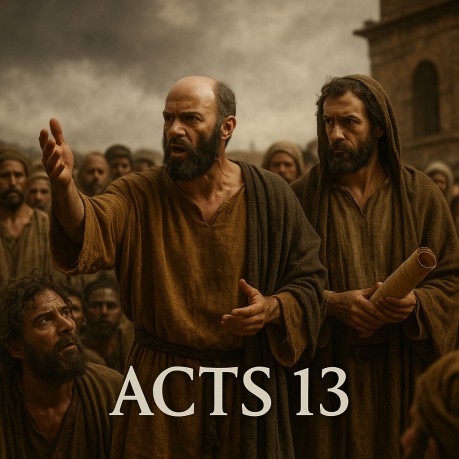
Acts 13:1-3 † Antioch was now the center of missionary
activity. The Spirit Himself set apart Barnabas and Saul for the
Gentile mission. Acts 13:4-5 † Their mission began in Cyprus, Barnabas'
homeland (Acts 4:36). The gospel spread first to Jews, then to
Gentiles. Acts 13:6-8 † Opposition arose immediately through Elymas.
Spiritual deception resisted the gospel, but the proconsul was
seeking truth. Acts 13:9-11 † This is the first time Saul is called Paul.
Elymas was struck with blindness, just as Saul had been earlier. The
parallel showed God's judgment on falsehood and confirmation of the
gospel's truth. Acts 13:12 † The miracle confirmed the message. Sergius
Paulus' conversion showed the gospel's reach into Roman authority. Acts 13:13 † John Mark's departure would later become a
source of division (Acts 15:37-39). It also showed the difficulty of
missionary work. Acts 13:14-16 † Paul began his first recorded sermon by
addressing both Jews and Gentile God-fearers. This inclusive audience
mirrored Cornelius' household. Acts 13:17-22 † Paul rehearsed Israel's history to show God's
sovereignty in choosing leaders. David became the central figure of
promise, leading to Christ. Acts 13:23-25 † John the Baptist pointed beyond himself to
Christ. The promise to David was fulfilled in Jesus. Acts 13:26-29 † Paul highlighted Israel's guilt in rejecting
Christ, yet emphasized fulfillment of prophecy. Acts 13:30-33 † The resurrection fulfilled Scripture and
confirmed Jesus as God's Son. Psalm 2 was applied directly to
Christ's enthronement. Acts 13:34-37 † Unlike David, Jesus did not see corruption.
His resurrection proved Him greater than all previous kings. Acts 13:38-39 † Paul declared justification by faith, not by
the Law. The Law could never bring true freedom. Acts 13:40-41 † Quoting Habakkuk 1:5, Paul warned them not to
reject God's work in Christ. Acts 13:42-43 † The gospel drew a strong response. Many Jews
and God-fearers embraced the message. Acts 13:44-46 † Jealousy fueled opposition. Paul and Barnabas
boldly declared the Gentile mission, fulfilling Isaiah's prophecy. Acts 13:47-49 † Quoting Isaiah 49:6, Paul and Barnabas
revealed the mission was always to include Gentiles. The Gentiles
rejoiced at their inclusion. Acts 13:50-52 † Opposition could not quench the Spirit's joy.
The gospel advanced despite persecution. How it applies to us today † God's plan of salvation through Christ was
foretold in Israel's history and fulfilled in Jesus. † This is the fulfilled perspective we proclaim at
Fulfilled Prophecies † Source Index
By Dan MainesActs 13
Now there were prophets and
teachers at Antioch, in the church that was there: Barnabas, Simeon
who was called Niger, Lucius of Cyrene, Manaen who had been brought
up with Herod the tetrarch, and Saul. While they were serving the
Lord and fasting, the Holy Spirit said, "Set Barnabas and Saul
apart for Me for the work to which I have called them." Then,
when they had fasted, prayed, and laid their hands on them, they sent
them away.
† Eusebius (Ecclesiastical
History 3.1) identifies Antioch as the first great Gentile church,
confirming its importance.
So, being sent out by the Holy
Spirit, they went down to Seleucia and from there they sailed to
Cyprus. When they arrived in Salamis, they began to proclaim the word
of God in the synagogues of the Jews; and they also had John as their
assistant.
When they had gone through the
whole island as far as Paphos, they found a magician, a Jewish false
prophet whose name was Bar-Jesus, who was with the proconsul, Sergius
Paulus, an intelligent man. This man summoned Barnabas and Saul and
sought to hear the word of God. But Elymas the magician (for so his
name is translated) was opposing them, seeking to turn the proconsul
away from the faith.
† Roman records confirm
Sergius Paulus as a historical figure, aligning Acts with
archaeology.
But Saul, who was also known as
Paul, filled with the Holy Spirit, stared at him, and said, "You
who are full of all deceit and fraud, you son of the devil, you enemy
of all righteousness, will you not stop making crooked the straight
ways of the Lord? Now, behold, the hand of the Lord is upon you, and
you will be blind and not see the sun for a time." And
immediately a mist and darkness fell upon him, and he went about
seeking those who would lead him by the hand.
Then the proconsul believed when
he saw what had happened, being amazed at the teaching of the Lord.
Now Paul and his companions put
out to sea from Paphos and came to Perga in Pamphylia; but John left
them and returned to Jerusalem.
But going on from Perga, they
arrived at Pisidian Antioch, and on the Sabbath day they went into
the synagogue and sat down. After the reading of the Law and the
Prophets, the synagogue officials sent word to them, saying,
"Brothers, if you have any word of exhortation for the people,
say it." Paul stood up, and motioning with his hand said, "Men
of Israel, and you who fear God, listen."
"The God of this people
Israel chose our fathers and made the people great during their stay
in the land of Egypt, and with an uplifted arm He led them out from
it. For a period of about forty years He put up with them in the
wilderness. When He had destroyed seven nations in the land of
Canaan, He distributed their land as an inheritance-all of which took
about 450 years. After these things He gave them judges until Samuel
the prophet. Then they asked for a king, and God gave them Saul the
son of Kish, a man of the tribe of Benjamin, for forty years. After
He had removed him, He raised up David to be their king, concerning
whom He also testified and said, ‘I have found David, the son of
Jesse, a man after My heart, who will do all My will.'"
† Josephus
(Antiquities 6.5.6) also recounts Saul's kingship and replacement by
David.
"From the descendants of
this man, according to promise, God has brought to Israel a Savior,
Jesus, after John had proclaimed, before His coming, a baptism of
repentance to all the people of Israel. And while John was completing
his course, he kept saying, ‘What do you suppose that I am? I am
not He. But behold, one is coming after me the sandals of whose feet
I am not worthy to untie.'"
"Brothers, sons of
Abraham's family, and those among you who fear God, to us the message
of this salvation has been sent. For those who live in Jerusalem, and
their rulers, recognizing neither Him nor the declarations of the
prophets which are read every Sabbath, fulfilled these by condemning
Him. And though they found no grounds for putting Him to death, they
asked Pilate that He be executed. When they had carried out
everything that was written concerning Him, they took Him down from
the cross and laid Him in a tomb."
†
Tacitus (Annals 15.44) affirms Christ's execution under Pilate.
"But God raised Him from
the dead; and for many days He appeared to those who came up with Him
from Galilee to Jerusalem, the very ones who are now His witnesses to
the people. And we preach to you the good news of the promise made to
the fathers, that God has fulfilled this promise to our children in
that He raised up Jesus, as it is also written in the second Psalm:
‘You are My Son; today I have fathered You.'"
"As for the fact that He
raised Him from the dead, never again to return to decay, He has
spoken in this way: ‘I will give you the holy and faithful mercies
of David.' Therefore, He also says in another Psalm: ‘You will not
allow Your Holy One to undergo decay.' For David, after he had served
God's purpose in his own generation, fell asleep, and was buried with
his fathers and underwent decay; but He whom God raised did not
undergo decay."
"Therefore let it be
known to you, brothers, that through Him forgiveness of sins is
proclaimed to you, and through Him everyone who believes is freed
from all things, from which you could not be freed through the Law of
Moses."
"Therefore, see that the
thing spoken of in the Prophets does not come upon you: ‘Look, you
scoffers, and be astonished, and perish; for I am accomplishing a
work in your days, a work which you will never believe, though
someone should describe it to you.'"
As Paul and Barnabas were
going out, the people repeatedly begged to have these things spoken
to them the next Sabbath. Now when the meeting of the synagogue had
broken up, many of the Jews and of the God-fearing proselytes
followed Paul and Barnabas, who were speaking to them and urging them
to continue in the grace of God.
The next Sabbath nearly all
the city assembled to hear the word of the Lord. But when the Jews
saw the crowds, they were filled with jealousy and began
contradicting the things said by Paul, and they were slandering him.
Both Paul and Barnabas spoke out boldly and said, "It was
necessary that the word of God be spoken to you first; since you
repudiate it and consider yourselves unworthy of eternal life,
behold, we are turning to the Gentiles."
"For so the Lord has
commanded us: ‘I have appointed You as a light to the Gentiles,
that You may bring salvation to the end of the earth.' When the
Gentiles heard this, they began rejoicing and glorifying the word of
the Lord; and all who had been appointed to eternal life believed.
And the word of the Lord was being spread through the whole region."
But the Jews incited the
devout women of prominence and the leading men of the city, and
instigated a persecution against Paul and Barnabas, and drove them
out of their region. But they shook off the dust from their feet in
protest against them and went to Iconium. And the disciples were
continually filled with joy and with the Holy Spirit.
†
The gospel is for Jew and Gentile alike, breaking all barriers.
†
Rejection by some does not stop the spread of the word. God's mission
continues unhindered.
† Eusebius,
Ecclesiastical History 3.1 – Antioch as the Gentile mission
center
† Roman records – Confirmation of
Sergius Paulus as proconsul
† Josephus,
Antiquities 6.5.6 – Saul and David's kingship
†
Tacitus, Annals 15.44 – Christ's execution under Pilate
†
Psalm 2 – Applied to Christ's resurrection and enthronement
†
Isaiah 49:6 – Light to the Gentiles
Share on Facebook
Links