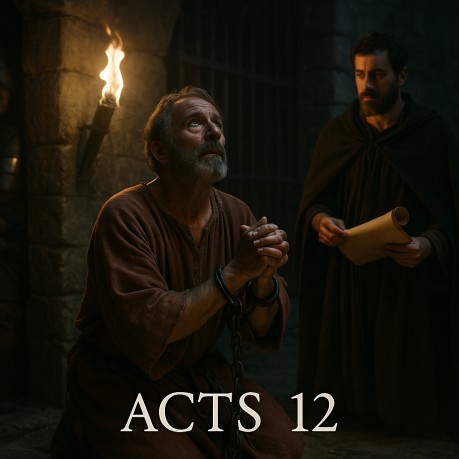
Acts 12:1-2 † This Herod was Herod Agrippa I, grandson of
Herod the Great. His execution of James marked the first apostolic
martyrdom. Acts 12:3-4 † Agrippa sought favor with the Jewish leaders
by persecuting Christians. Peter's arrest during Passover echoed
Jesus' own arrest at the same feast. Acts 12:5 † The church responded with prayer, showing
reliance on God rather than force. Acts 12:6-7 † God intervened at the last moment. Peter's
calm sleep showed trust in God's sovereignty. Acts 12:8-10 † The iron gate opened of its own accord,
showing God's power over Roman might. Peter thought it was a vision
until he was outside. Acts 12:11 † Peter acknowledged God's deliverance, not
chance or human intervention. Acts 12:12-15 † The church prayed but struggled to believe
their prayer was answered. Their reaction shows God's power exceeded
their expectations. Acts 12:16-17 † Peter testified of God's deliverance and
instructed that the news be shared. He then went into hiding to avoid
further danger. Acts 12:18-19 † Roman law required guards to suffer the
penalty of escaped prisoners (compare Acts 16:27). The execution of
the soldiers reflected Roman severity. Acts 12:20-22 † Herod Agrippa received divine honors.
Josephus (Antiquities 19.8.2) describes the same scene, noting his
robe was made of silver and shone brilliantly in the sun, causing the
people to hail him as a god. Acts 12:23 † Divine judgment fell swiftly on Agrippa.
Josephus corroborates this event, stating Agrippa was seized with
violent stomach pains and died five days later. Acts 12:24-25 † Despite Herod's opposition, the word of God
grew. The transition now turns to Barnabas, Saul, and John Mark,
setting the stage for missionary expansion. How it applies to us today † God's sovereignty over rulers is absolute.
Herod opposed the church, but God struck him down. † This is the fulfilled perspective we proclaim at
Fulfilled Prophecies † Source Index
By Dan MainesActs 12
Now about that time Herod the
king laid hands on some who belonged to the church, to do them harm.
And he had James the brother of John executed with a sword.
† Josephus (Antiquities 19.7.2)
confirms Agrippa's reign and his harshness toward those seen as
threats.
When he saw that it pleased the
Jews, he proceeded to arrest Peter also. Now it was during the days
of Unleavened Bread. When he had arrested him, he also put him in
prison, handing him over to four squads of soldiers to guard him,
intending after the Passover to bring him before the people.
†
Josephus records Agrippa's zeal for Jewish customs (Antiquities
19.7.3).
So Peter was kept in the prison,
but prayer for him was being made to God intensely by the church.
On the very night when Herod was
about to bring him forward, Peter was sleeping between two soldiers,
bound with two chains, and guards in front of the door were watching
over the prison. And behold, an angel of the Lord suddenly stood near
him, and a light shone in the cell; and he struck Peter's side and
woke him, saying, "Get up quickly." And his chains fell off
his hands.
†
The Dead Sea Scrolls (1QM 13.10) describe angels as God's agents of
deliverance, reflecting Jewish expectation of angelic intervention.
And the angel said to him, "Put
on your belt and strap on your sandals." And he did so. And he
said to him, "Wrap your cloak around you and follow me."
And he went out and continued to follow, and yet he did not know that
what was being done by the angel was real, but thought he was seeing
a vision. Now when they had passed the first and second guard, they
came to the iron gate that leads into the city, which opened for them
by itself; and they went out and went along one street, and
immediately the angel departed from him.
When Peter came to himself, he
said, "Now I truly understand that the Lord has sent His angel,
and rescued me from the hand of Herod and from all that the Jewish
people expected."
And when he realized this, he
went to the house of Mary, the mother of John who was called Mark,
where many were gathered together and were praying. When he knocked
at the door of the gate, a slave woman named Rhoda came to answer.
When she recognized Peter's voice, because of her joy she did not
open the gate, but ran in and announced that Peter was standing in
front of the gate. They said to her, "You are out of your mind!"
But she kept insisting that it was so. They said, "It is his
angel."
But Peter continued knocking;
and when they had opened the door, they saw him and were amazed. But
motioning to them with his hand to be silent, he described to them
how the Lord had led him out of the prison. And he said, "Report
these things to James and the brothers." Then he left and went
to another place.
Now when day came, there was
no small disturbance among the soldiers over what had become of
Peter. And when Herod had looked for him and had not found him, he
examined the guards and ordered that they be led away to execution.
Then he went down from Judea to Caesarea and was spending time there.
Now he was very angry with the
people of Tyre and Sidon; and with one mind they came to him, and
having won over Blastus the king's chamberlain, they were pleading
for peace, because their country was supported with food from the
king's country. On an appointed day, after putting on his royal
apparel, Herod took his seat on the rostrum and began delivering an
address to them. The people repeatedly cried out, "The voice of
a god and not of a man!"
And immediately an angel of the
Lord struck him because he did not give God the glory, and he was
eaten by worms and died.
But the word of the Lord
continued to grow and to be multiplied. And Barnabas and Saul
returned when they had fulfilled their mission to Jerusalem, taking
along with them John, who was also called Mark.
†
The church must rely on prayer in persecution, even when answers seem
impossible.
† God can open any gate and
deliver His people, reminding us not to fear man's power.
†
The kingdom of God multiplies despite opposition, because its growth
depends on God, not men.
† Josephus,
Antiquities 19.7.2 – Agrippa's reign and severity
†
Josephus, Antiquities 19.7.3 – Agrippa's zeal for Jewish customs
†
Dead Sea Scrolls, 1QM 13.10 – Angels as agents of deliverance
†
Josephus, Antiquities 19.8.2 – Agrippa's silver robe and
deification
† Josephus, Antiquities 19.8.2 –
Agrippa's death by sudden illness
Links