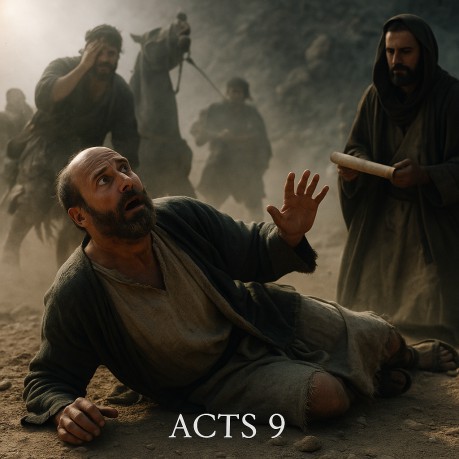
Acts 9:1-2 † Saul's zeal for the Law drove him to
persecute the followers of Christ. The term "the Way"
signified the distinct path of the new covenant. Acts 9:3-4 † Saul's encounter with Christ was direct and
supernatural. Jesus identified Himself with His body, the church, to
persecute them was to persecute Him. Acts 9:5-6 † Saul's question revealed his blindness. The
Lord revealed Himself clearly: Jesus, the crucified and risen
Messiah. His command showed Saul's calling was divinely appointed. Acts 9:7-9 † Saul's blindness symbolized his spiritual
condition. Three days of darkness prepared him for new sight in
Christ. Acts 9:10-12 † God prepared both Saul and Ananias. Straight
Street is a well-known road in Damascus, confirming the historical
setting. Acts 9:13-16 † Saul, the persecutor, was chosen to become
the chief apostle to the Gentiles. His mission was not comfort, but
suffering for Christ's name. Acts 9:17-19 † Saul's healing and baptism marked his
transformation. His blindness was lifted, both physically and
spiritually. Baptism signified his covenant entrance into Christ. Acts 9:20-22 † Saul's immediate preaching testified to the
radical change. The persecutor became preacher. His knowledge of
Scripture enabled him to prove Jesus was the Christ. Acts 9:23-25 † Saul faced persecution early. Deliverance
through a wall basket highlights God's providence. Acts 9:26-27 † Barnabas played a crucial role in affirming
Saul's genuine conversion. His testimony opened fellowship with the
apostles. Acts 9:28-30 † Saul's ministry immediately met with
opposition. Like Stephen, he debated Hellenistic Jews, and like
Stephen, they sought his death. Acts 9:31 † After Saul's departure, the church
experienced peace and growth. Persecution scattered the church, but
also strengthened it. Acts 9:32-35 † Peter's healing of Aeneas echoed Jesus'
miracles. The result was mass conversion in the region. Acts 9:36-39 † Tabitha (Dorcas) was remembered for her works
of charity. Her death grieved the widows she served, demonstrating
the fruit of her discipleship. Acts 9:40-42 † Peter raised Tabitha from the dead, imitating
Christ's raising of Jairus' daughter (Mark 5:41). Such miracles
confirmed Christ's power at work in His apostles. Acts 9:43 † Peter's stay with a tanner, considered
unclean by Jewish standards, shows God's preparing him for the
Gentile mission in Acts 10. How it applies to us today † Saul's conversion shows no one is beyond
God's grace. The persecutor became preacher. † This is the fulfilled perspective we proclaim at
Fulfilled Prophecies † Source Index
By Dan MainesActs 9
Now Saul, still breathing threats
and murder against the disciples of the Lord, went to the high
priest, and asked for letters from him to the synagogues in Damascus,
so that if he found any belonging to the Way, whether men or women,
he might bring them bound to Jerusalem.
†
Josephus (Wars 2.17.4) records the authority of high priests to send
orders, fitting Saul's commission.
Now as he was traveling, it
happened that he was approaching Damascus, and suddenly a light from
heaven flashed around him; and he fell to the ground and heard a
voice saying to him, "Saul, Saul, why are you persecuting Me?"
And he said, "Who are You,
Lord?" And He said, "I am Jesus whom you are persecuting.
But get up and enter the city, and it will be told to you what you
must do."
The men who traveled with him
stood speechless, hearing the voice but seeing no one. Saul got up
from the ground, and though his eyes were open, he could see nothing;
and leading him by the hand, they brought him into Damascus. And for
three days he was without sight, and neither ate nor drank.
Now there was a disciple in
Damascus named Ananias; and the Lord said to him in a vision,
"Ananias." And he said, "Here I am, Lord." And
the Lord said to him, "Get up and go to the street called
Straight, and inquire at the house of Judas for a man from Tarsus
named Saul; for he is praying, and he has seen in a vision a man
named Ananias coming in and laying his hands on him, so that he might
regain his sight."
But Ananias answered, "Lord,
I have heard from many people about this man, how much harm he did to
Your saints in Jerusalem; and here he has authority from the chief
priests to arrest all who call on Your name." But the Lord said
to him, "Go, for he is a chosen instrument of Mine, to bear My
name before the Gentiles and kings, as well as the sons of Israel;
for I will show him how much he must suffer in behalf of My name."
So Ananias departed and entered
the house, and after laying his hands on him said, "Brother
Saul, the Lord Jesus, who appeared to you on the road by which you
were coming, has sent me so that you may regain your sight, and be
filled with the Holy Spirit." And immediately something like
fish scales fell from his eyes, and he regained his sight, and he got
up and was baptized; and he took food and was strengthened.
Now for several days he was
with the disciples who were in Damascus, and immediately he began to
proclaim Jesus in the synagogues, saying, "He is the Son of
God." All those hearing him continued to be amazed, and were
saying, "Is this not the one who in Jerusalem destroyed those
who called on this name, and had come here for the purpose of
bringing them bound before the chief priests?" But Saul kept
increasing in strength and confounding Jews who lived in Damascus by
proving that this Jesus is the Christ.
When many days had elapsed, the
Jews plotted together to do away with him, but their plot became
known to Saul. And they also watched the gates day and night so that
they might put him to death; but his disciples took him at night and
let him down through an opening in the wall, lowering him in a large
basket.
†
Josephus (Wars 2.19.2) mentions city walls with guarded gates,
matching this description.
When he came to Jerusalem, he
tried repeatedly to associate with the disciples; and yet they were
all afraid of him, as they did not believe that he was a disciple.
But Barnabas took hold of him and brought him to the apostles, and
described to them how he had seen the Lord on the road, and that He
had talked to him, and how he had spoken out boldly in the name of
Jesus at Damascus.
And he was with them, moving
about freely in Jerusalem, speaking out boldly in the name of the
Lord. And he was talking and debating with the Hellenistic Jews; but
they were attempting to put him to death. Now when the brothers
learned of it, they brought him down to Caesarea and sent him away to
Tarsus.
So the church throughout Judea,
Galilee, and Samaria enjoyed peace, as it was being built up; and as
it continued in the fear of the Lord and in the comfort of the Holy
Spirit, it kept increasing.
Now as Peter was traveling
through all those regions, he also came down to the saints who lived
at Lydda. There he found a man named Aeneas who had been bedridden
for eight years, because he was paralyzed. Peter said to him,
"Aeneas, Jesus Christ heals you; get up and make your own bed."
Immediately he got up. And all who lived in Lydda and Sharon saw him,
and they turned to the Lord.
Now in Joppa there was a
disciple named Tabitha (which translated in Greek is called Dorcas);
this woman was full of deeds of kindness and charity which she
continually did. And it happened at that time that she became sick
and died; and when they had washed her body, they laid it in an
upstairs room. Since Lydda was near Joppa, the disciples, having
heard that Peter was there, sent two men to him, urging him, "Do
not delay in coming to us." So Peter got ready and went with
them. When he arrived, they brought him into the room upstairs; and
all the widows stood beside him, weeping and showing all the tunics
and garments that Dorcas used to make while she was with them.
But Peter sent them all out and
knelt down and prayed, and turning to the body, he said, "Tabitha,
arise." And she opened her eyes, and when she saw Peter, she sat
up. And he gave her his hand and raised her up; and calling all the
saints and widows, he presented her alive. It became known all over
Joppa, and many believed in the Lord.
And Peter stayed in Joppa many
days with a tanner named Simon.
†
The gospel breaks barriers of fear, persecution, and cultural
prejudice.
† God equips His people through
suffering and miraculous works for the advance of the kingdom.
†
Like Tabitha, believers today can leave a lasting legacy of service
and kindness.
† Josephus,
Wars 2.17.4 – Authority of high priests to send letters
†
Josephus, Wars 2.19.2 – City walls and guarded gates
†
Philo, On Abraham – Divine calling and obedience as foundation of
faith
† Mishnah, Sanhedrin 9.6 – Penalties
for heretics
† Eusebius, Ecclesiastical
History 2.1 – Spread of gospel and early conversions
Links