Acts 8:1 † Saul consented to Stephen's death, marking
the beginning of widespread persecution. The scattering of believers
fulfilled Jesus' words in Acts 1:8, extending the gospel to Judea and
Samaria. Acts 8:2-3 † Saul's zeal for the Law drove him to violent
persecution. His later conversion would display God's transforming
grace. Acts 8:4 † Persecution could not silence the gospel.
Scattering became a means of spreading the word. Acts 8:5-8 † Philip, one of the seven, preached in
Samaria, fulfilling Jesus' commission to reach Samaritans. Signs
confirmed his message, bringing joy. Acts 8:9-11 † Simon Magus represents counterfeit power. His
sorcery deceived many, but it was no match for the gospel. Acts 8:12-13 † The gospel overcame sorcery. Even Simon
professed belief, though his heart would soon be tested. Acts 8:14-17 † The apostles confirmed the Samaritan
believers by laying on hands. This demonstrated unity of Jew and
Samaritan in one Spirit. Acts 8:18-21 † Simon sought to buy spiritual authority. This
sin, later called "simony," revealed his corruption. Acts 8:22-24 † Peter called Simon to repentance, showing
that even grave sin could be forgiven if truly repented of. Simon's
reply reveals fear but not clear repentance. Acts 8:25 † The mission expanded further. The apostles
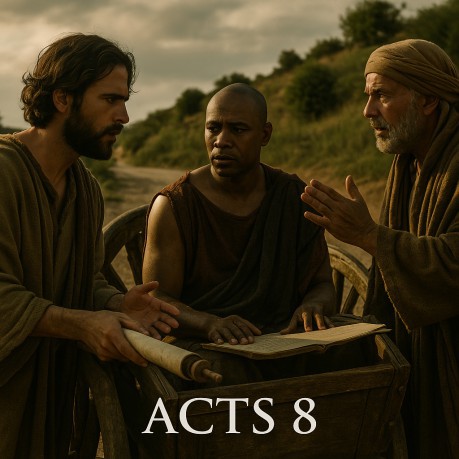
embraced the Samaritans, breaking long-standing barriers. Acts 8:26-28 † God orchestrated an encounter with an
Ethiopian eunuch, showing the gospel's reach to Gentiles and
outcasts. Acts 8:29-31 † The eunuch needed guidance to understand
Scripture, highlighting the necessity of Spirit-filled
interpretation. Acts 8:32-33 † The eunuch read Isaiah 53, the prophecy of
the suffering servant. This passage perfectly pointed to Christ's
crucifixion. Acts 8:34-35 † Philip showed the Old Testament found
fulfillment in Jesus. Christ is the suffering servant of Isaiah 53. Acts 8:36-38 † The eunuch's baptism showed immediate
response to faith. Nothing prevented his inclusion in Christ. The
excluded was now welcomed. Acts 8:39-40 † Philip's Spirit-led ministry continued. The
eunuch returned to Ethiopia rejoicing, symbolizing the spread of the
gospel to the nations. How it applies to us today † Persecution spreads the gospel rather than
stopping it. † This is the fulfilled perspective we proclaim at
Fulfilled Prophecies † Source Index
By Dan MainesActs 8
Now Saul approved of putting him to
death. And on that day a great persecution began against the church
in Jerusalem, and they were all scattered throughout the regions of
Judea and Samaria, except for the apostles.
† Josephus (Wars 2.13.3) describes
unrest in Judea at this time, providing historical backdrop to the
turbulence.
Some devout men buried Stephen,
and mourned loudly for him. But Saul began ravaging the church,
entering house after house; and he would drag away men and women and
put them in prison.
† The Mishnah (Sanhedrin 9.6) records
harsh penalties for those considered heretics. Saul acted in line
with Pharisaic zeal, though wrongly.
Therefore, those who had been
scattered went through places preaching the word.
Philip went down to the city of
Samaria and began proclaiming the Christ to them. The crowds were
paying attention with one mind to what was being said by Philip, as
they heard and saw the signs which he was performing. For in the case
of many who had unclean spirits, they were coming out of them
shouting with a loud voice; and many who had been paralyzed or limped
on crutches were healed. So there was much rejoicing in that city.
†
Josephus (Antiquities 11.8.6) records hostility between Jews and
Samaritans, highlighting the radical nature of this outreach.
Now a man named Simon had
previously been practicing magic in the city and astonishing the
people of Samaria, claiming to be someone great; and all the people,
from small to great, were paying attention to him, saying, "This
man is the Power of God that is called Great." And they were
paying attention to him because for a long time he had astounded them
with his magic arts.
†
Irenaeus (Against Heresies 1.23.1) identifies Simon as the father of
Gnosticism, showing his enduring influence.
But when they believed Philip
as he was proclaiming the good news about the kingdom of God and the
name of Jesus Christ, both men and women were being baptized. Now
even Simon himself believed; and after being baptized, he continued
on with Philip, and as he observed signs and great miracles taking
place, he was repeatedly amazed.
Now when the apostles in
Jerusalem heard that Samaria had received the word of God, they sent
them Peter and John, who came down and prayed for them that they
would receive the Holy Spirit. (For He had not yet fallen upon any of
them; they had simply been baptized in the name of the Lord Jesus.)
Then they began laying their hands on them, and they were receiving
the Holy Spirit.
Now when Simon saw that the
Spirit was given through the laying on of the apostles' hands, he
offered them money, saying, "Give this authority to me as well,
so that everyone on whom I lay my hands may receive the Holy Spirit."
But Peter said to him, "May your silver perish with you, because
you thought you could acquire the gift of God with money! You have no
part or share in this matter, for your heart is not right before
God."
†
Cyprian of Carthage (On the Lapsed 6) condemned this as the root of
church corruption.
"Therefore repent of this
wickedness of yours, and pray to the Lord that, if possible, the
intention of your heart will be forgiven you. For I see that you are
in the gall of bitterness and in the bondage of unrighteousness."
But Simon answered and said, "Pray to the Lord for me
yourselves, so that nothing of what you have said may come upon me."
So, after solemnly testifying and
speaking the word of the Lord, they started back to Jerusalem, and
were preaching the gospel to many villages of the Samaritans.
But an angel of the Lord spoke
to Philip, saying, "Get ready and go south to the road that
descends from Jerusalem to Gaza." (This is a desert road.) So he
got ready and went; and there was an Ethiopian eunuch, a court
official of Candace, queen of the Ethiopians, who was in charge of
all her treasure; and he had come to Jerusalem to worship, and he was
returning and sitting in his chariot, and was reading Isaiah the
prophet.
† The Law excluded eunuchs
(Deuteronomy 23:1), but Isaiah 56:4-5 promised a place for them in
God's covenant. Fulfillment arrives here.
Then the Spirit said to Philip,
"Go up and join this chariot." Philip ran up and heard him
reading Isaiah the prophet, and said, "Do you understand what
you are reading?" And he said, "Well, how could I, unless
someone guides me?" And he invited Philip to come up and sit
with him.
Now the passage of Scripture
which he was reading was this: "He was led like a sheep to
slaughter; and like a lamb that is silent before its shearer, so He
does not open His mouth. In humiliation His justice was taken away;
who will describe His generation? For His life is taken away from the
earth."
The eunuch answered Philip and
said, "Please tell me, of whom does the prophet say this? Of
himself, or of someone else?" Then Philip opened his mouth, and
beginning from this Scripture he preached Jesus to him.
As they went along the road
they came to some water; and the eunuch said, "Look! Water! What
prevents me from being baptized?" And he ordered that the
chariot stop; and they both went down into the water, Philip as well
as the eunuch, and he baptized him.
When they came up out of the
water, the Spirit of the Lord snatched Philip away; and the eunuch no
longer saw him, but went on his way rejoicing. But Philip found
himself at Azotus, and as he passed through he kept preaching the
gospel to all the cities, until he came to Caesarea.
† Eusebius
(Ecclesiastical History 2.1) claimed this eunuch became the first
fruits of Christianity in Ethiopia.
† The gospel breaks barriers:
Jew, Samaritan, Gentile, and outcast are all included in Christ.
†
The Spirit guides believers to those seeking truth in Scripture.
†
Baptism is the covenant sign of inclusion, open to all who believe.
† Josephus,
Wars 2.13.3 – Turmoil in Judea
† Mishnah,
Sanhedrin 9.6 – Penalties for heretics
†
Josephus, Antiquities 11.8.6 – Hostility of Jews and Samaritans
†
Irenaeus, Against Heresies 1.23.1 – Simon Magus as father of
Gnosticism
† Cyprian, On the Lapsed 6 –
Condemnation of simony
† Deuteronomy 23:1 –
Eunuchs excluded from the assembly
† Isaiah
56:4-5 – Eunuchs welcomed in God's covenant
†
Isaiah 53:7-8 – The suffering servant prophecy
†
Eusebius, Ecclesiastical History 2.1 – Christianity in Ethiopia
Links