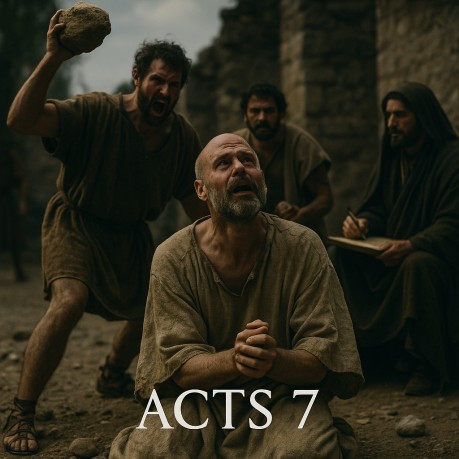
Acts 7:1 † Stephen was placed on trial before the
Sanhedrin, accused of blasphemy against Moses, the Law, and the
temple. His defense would be the longest recorded speech in Acts,
rehearsing Israel's history to show their continual rejection of
God's messengers. Acts 7:2-3 † Stephen begins with Abraham, the father of
faith, showing God's covenant began before the temple or Law
existed. Acts 7:4-5 † Abraham never received the land physically,
yet the promise was fulfilled through his seed, Christ (Galatians
3:16). Acts 7:6-7 † Stephen reminds them of Israel's sojourn and
deliverance, showing God's pattern of salvation through judgment. Acts 7:8 † The covenant sign pointed forward to Christ,
not to nationalistic pride. Acts 7:9-10 † Joseph's rejection by his brothers prefigures
Christ's rejection by Israel. God exalted Joseph just as He exalted
Jesus. Acts 7:11-16 † Israel's story was marked by exile and
return. Stephen highlights God's providence even in hardship. Acts 7:17-19 † This Pharaoh's cruelty anticipates Herod's
massacre of infants in Matthew 2. Israel's leaders repeatedly opposed
God's deliverers. Acts 7:20-22 † Moses, like Christ, was preserved from death
in infancy. Both were prepared for their mission by God's
providence. Acts 7:23-29 † Moses was rejected as ruler and deliverer,
foreshadowing Christ's rejection by Israel. Acts 7:30-34 † God's presence was not confined to the
temple. He appeared to Moses in the wilderness. Stephen emphasizes
God's freedom to reveal Himself anywhere. Acts 7:35-37 † Stephen directly applies Moses' prophecy
(Deuteronomy 18:15) to Jesus. Just as Israel rejected Moses, so they
rejected Christ. Acts 7:38-41 † Israel's idolatry at Sinai revealed their
continual rebellion. Stephen compares their past rejection of Moses
to their present rejection of Christ. Acts 7:42-43 † Stephen quotes Amos 5:25-27, reminding them
of Israel's idolatry that led to exile. Their history was marked by
rebellion. Acts 7:44-47 † The tabernacle and temple were never
ultimate. They were temporary symbols pointing to Christ. Acts 7:48-50 † Quoting Isaiah 66:1-2, Stephen shows God
cannot be confined to a building. This directly challenges the
Sanhedrin's temple obsession. Acts 7:51-53 † Stephen indicts them for resisting the Spirit
and killing the prophets, culminating in the betrayal of Christ. Acts 7:54-56 † Stephen's vision confirms Daniel 7:13-14,
where the Son of Man receives kingdom authority. Jesus was enthroned,
not awaiting a future reign. Acts 7:57-60 † Stephen became the first Christian martyr.
His prayer echoed Jesus on the cross (Luke 23:34, 46). How it applies to us today † God's presence is not confined to buildings
but revealed through His people in Christ. † This is the fulfilled perspective we proclaim at
Fulfilled Prophecies † Source Index
By Dan MainesActs 7
Now the high priest said, "Are
these things so?"
And Stephen said, "Hear me,
brothers and fathers! The God of glory appeared to our father Abraham
when he was in Mesopotamia, before he lived in Haran, and said to
him, ‘Leave your country and your relatives, and come to the land
which I will show you.'"
† Philo (On Abraham 70) speaks of
Abraham as the model of obedience by leaving Mesopotamia.
"Then he left the land of
the Chaldeans and settled in Haran. From there, after his father
died, God had him move to this country in which you are now living.
But He gave him no inheritance in it, not even a foot of ground, and
yet, even when he had no child, He promised that He would give it to
him as a possession, and to his descendants after him."
† Josephus (Antiquities 1.7.1)
confirms Abraham's migration to Canaan by God's command.
"But God spoke to this
effect, that his descendants would be strangers in a foreign land,
and that they would enslave and mistreat them for four hundred years.
‘And whatever nation to which they are enslaved I Myself will
judge,' said God, ‘and after that they will come out and serve Me
in this place.'"
"And He gave him the covenant
of circumcision; and so Abraham fathered Isaac, and circumcised him
on the eighth day; and Isaac fathered Jacob, and Jacob the twelve
patriarchs."
† The Mishnah
(Shabbat 19.6) emphasizes circumcision as a defining mark, but
Stephen points beyond it.
"The patriarchs became
jealous of Joseph, and sold him into Egypt. Yet God was with him, and
rescued him from all his afflictions, and granted him favor and
wisdom in the sight of Pharaoh, king of Egypt, and he made him
governor over Egypt and his entire household."
† Philo (On Joseph 39) praises
Joseph's wisdom, paralleling Stephen's description.
"Now a famine came over
all Egypt and Canaan, and great affliction with it, and our fathers
could find no food. But when Jacob heard that there was grain in
Egypt, he sent our fathers there the first time. And during the
second visit, Joseph made himself known to his brothers, and Joseph's
family was revealed to Pharaoh. Then Joseph sent word and invited his
father Jacob and all his relatives to come to him, seventy-five
people in all. And Jacob went down to Egypt, and he and our fathers
died there; and they were brought back from there to Shechem and laid
in the tomb which Abraham had purchased for a sum of money from the
sons of Hamor in Shechem."
"But as the time of the
promise which God had assured to Abraham was approaching, the people
increased and multiplied in Egypt, until another king arose over
Egypt who did not know Joseph. It was he who took shrewd advantage of
our nation and mistreated our fathers, in order that they would
expose their infants, and they would not survive."
"It was at this time that
Moses was born; and he was beautiful in the sight of God, and he was
nurtured for three months in his father's home. And after he had been
put outside, Pharaoh's daughter took him away and nurtured him as her
own son. Moses was educated in all the wisdom of the Egyptians, and
he was proficient in speaking and action."
† Josephus (Antiquities 2.9.7)
affirms Moses' reputation for wisdom and eloquence even among the
Egyptians.
"But when he was
approaching the age of forty, it entered his mind to visit his
brothers, the sons of Israel. And when he saw one of them being
treated unjustly, he defended him and took revenge for the oppressed
man by striking and killing the Egyptian. And he thought that his
brothers understood that God was granting them deliverance through
him; but they did not understand. And on the following day he
appeared to them as they were fighting together, and he tried to
reconcile them in peace, saying, ‘Men, you are brothers, why are
you injuring one another?' But the one who was injuring his neighbor
pushed him away, saying, ‘Who made you a ruler and judge over us?
You do not intend to kill me as you killed the Egyptian yesterday, do
you?' At this remark, Moses fled and became a stranger in the land of
Midian, where he fathered two sons."
"Now after forty years had
passed, an angel appeared to him in the wilderness of Mount Sinai, in
the flame of a burning thorn bush. When Moses saw it, he was amazed
at the sight; but as he approached to look more closely, the voice of
the Lord came: ‘I am the God of your fathers, the God of Abraham,
Isaac, and Jacob.' Moses shook with fear and did not dare to look
closely. But the Lord said to him, ‘Remove your sandals from your
feet, for the place on which you are standing is holy ground. I have
certainly seen the oppression of My people in Egypt, and have heard
their groans, and I have come down to rescue them; and now come, I
will send you to Egypt.'"
†
The Dead Sea Scrolls (1QH 4.33-35) describe God's presence in
unexpected places, confirming Stephen's point.
"This Moses whom they
disowned, saying, ‘Who made you a ruler and a judge?' is the one
whom God sent to be both a ruler and a deliverer with the help of the
angel who appeared to him in the thorn bush. This man led them out,
performing wonders and signs in the land of Egypt and in the Red Sea,
and in the wilderness for forty years. This is the Moses who said to
the sons of Israel, ‘God will raise up for you a Prophet like me
from your countrymen.'"
"This is the one who was
in the assembly in the wilderness with the angel who spoke to him at
length on Mount Sinai, and with our fathers; and he received living
oracles to pass on to you. Our fathers were unwilling to be obedient
to him; on the contrary they rejected him and turned back to Egypt in
their hearts, saying to Aaron, ‘Make us a god who will go before
us; for this Moses who led us out of the land of Egypt—we do not
know what happened to him.' At that time they made a calf and brought
a sacrifice to the idol, and were rejoicing in the works of their
hands."
"But God turned away and
delivered them up to serve the heavenly lights; as it is written in
the book of the prophets: ‘You did not offer Me victims and
sacrifices for forty years in the wilderness, did you, house of
Israel? You also took along the tabernacle of Moloch and the star of
the god Rompha, the images which you made to worship. I also will
deport you beyond Babylon.'"
"Our fathers had the
tabernacle of testimony in the wilderness, just as He who spoke to
Moses directed him to make it according to the pattern which he had
seen. And our fathers, after receiving it in succession, brought it
in with Joshua when they disposed of the nations that God drove out
from our fathers, until the time of David. David found favor in God's
sight, and asked that he might find a dwelling place for the house of
Jacob. But it was Solomon who built a house for Him."
"However, the Most High
does not dwell in houses made by human hands; as the prophet says:
‘Heaven is My throne, and the earth is the footstool of My feet;
what kind of house will you build for Me?' says the Lord, ‘Or what
place is there for My rest? Was it not My hand that made all these
things?'"
"You men who are
stiff-necked and uncircumcised in heart and ears are always resisting
the Holy Spirit; as your fathers did, you do also. Which one of the
prophets did your fathers not persecute? They killed those who had
previously announced the coming of the Righteous One, whose betrayers
and murderers you have now become; you who received the Law as
ordained by angels, and yet did not keep it."
†
The Mishnah (Sanhedrin 10.1) declares all Israel has a share in the
age to come except those who deny the Law. Stephen reverses this,
declaring that those who rejected Christ forfeited covenant
blessings.
Now when they heard this, they
were infuriated, and they began gnashing their teeth at him. But he,
being full of the Holy Spirit, looked intently into heaven and saw
the glory of God, and Jesus standing at the right hand of God; and he
said, "Behold, I see the heavens opened and the Son of Man
standing at the right hand of God!"
But they shouted with loud
voices, and covered their ears and rushed at him with one mind. When
they had driven him out of the city, they began stoning him; and the
witnesses laid their cloaks at the feet of a young man named Saul.
They went on stoning Stephen as he called on the Lord and said, "Lord
Jesus, receive my spirit!" Then he fell on his knees and cried
out with a loud voice, "Lord, do not hold this sin against
them!" Having said this, he fell asleep.
†
Early writers (Tertullian, Apology 50) saw Stephen's martyrdom as the
seed of the church, inspiring boldness in others.
†
The history of Israel's rejection warns us not to resist the
Spirit.
† Stephen's bold witness and
forgiving spirit remain a model for the church under persecution.
†
Christ reigns now at God's right hand, confirming fulfillment of
Daniel 7.
† Philo, On
Abraham 70 – Abraham's obedience
†
Josephus, Antiquities 1.7.1 – Abraham's migration
†
Mishnah, Shabbat 19.6 – Circumcision as covenant sign
†
Philo, On Joseph 39 – Joseph's wisdom
†
Josephus, Antiquities 2.9.7 – Moses' wisdom and reputation
†
Dead Sea Scrolls, 1QH 4.33-35 – God's presence in unexpected
places
† Deuteronomy 18:15 – Prophet like
Moses
† Amos 5:25-27 – Idolatry leads to
exile
† Isaiah 66:1-2 – God not confined to
temples
† Mishnah, Sanhedrin 10.1 –
Israel's covenant assumptions
† Daniel
7:13-14 – Son of Man enthroned
†
Tertullian, Apology 50 – Stephen's martyrdom as seed of the church
Links