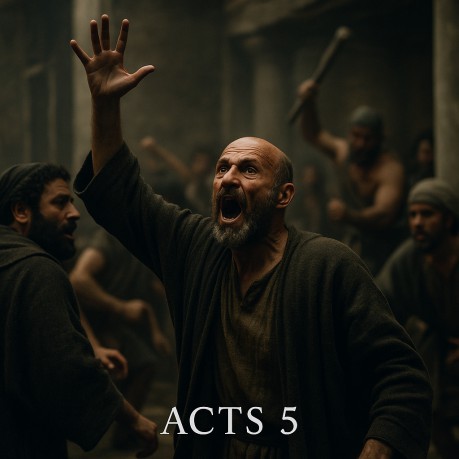
Acts 5:1-2 † The issue was not withholding money, but
lying to the Spirit. Hypocrisy threatened the integrity of the
covenant community. Acts 5:3-4 † Peter makes clear that Ananias lied to God,
not man. The Spirit is God, and deceit against Him brings judgment. † The Dead Sea Scrolls (1QS 5.20-22) emphasized
honesty and integrity in the covenant community. Early Christians
demanded even greater truthfulness. Acts 5:5-6 † Divine judgment fell instantly, instilling
fear. The holiness of the new covenant body was established. Acts 5:7-10 † Both husband and wife perished for their
deceit. Their hypocrisy tested the Spirit. This demonstrates the
seriousness of covenant integrity. Acts 5:11 † Fear of God spread widely. The early church
was marked by reverence and holiness. Acts 5:12-16 † Miracles confirmed apostolic authority. The
church grew rapidly. Even Peter's shadow was viewed as powerful,
emphasizing God's presence with His people. † Eusebius (Ecclesiastical History 2.3)
described this as the church's early demonstration of divine power. Acts 5:17-18 † Jealousy drove the Sadducees to persecute.
They feared losing authority as the gospel spread. Acts 5:19-21 † God overruled earthly rulers. The apostles
were freed by an angel to continue proclaiming Christ. Acts 5:22-26 † The rulers were powerless to stop the gospel.
The apostles boldly preached in the temple after miraculous release. Acts 5:27-29 † The apostles again affirm obedience to God
above men. They directly accused the leaders of guilt in Christ's
death. Acts 5:30-32 † The message is consistent: Jesus was
crucified, raised, exalted, and now reigns. Repentance and
forgiveness are offered to Israel through Him. Acts 5:33-39 † Gamaliel counseled restraint. He compared
Jesus' movement to failed revolts, yet warned that if it was from
God, it could not be stopped. † Josephus (Antiquities 20.5.1-2) records
Theudas and Judas of Galilee as examples of failed leaders,
confirming Gamaliel's historical accuracy. Acts 5:40-42 † The apostles rejoiced in suffering for
Christ. Opposition only strengthened their resolve. Daily, they
proclaimed Jesus as Messiah in both public and private settings. How it applies to us today † Integrity in the covenant community is vital.
Hypocrisy must not be tolerated. † God's power cannot be restrained by earthly
rulers. His word advances despite opposition. † Obedience to God must take precedence over
man's commands. † Suffering for Christ is a privilege, and bold
witness is our calling. † This is the fulfilled perspective we proclaim at
Fulfilled Prophecies † Source Index
By Dan MainesActs 5
But a man named Ananias, with his
wife Sapphira, sold a piece of property, and kept back some of the
proceeds for himself, with his wife's full knowledge, and bringing a
portion of it, he laid it at the apostles' feet.
But Peter said, "Ananias,
why has Satan filled your heart to lie to the Holy Spirit and to keep
back some of the proceeds of the land? While it remained unsold, did
it not remain your own? And after it was sold, was it not under your
control? Why is it that you have conceived this deed in your heart?
You have not lied to men, but to God."
And as he heard these words,
Ananias collapsed and died; and great fear came over all who heard
about it. The young men got up and covered him up, and after carrying
him out, they buried him.
Now an interval of about three
hours elapsed, and his wife came in, not knowing what had happened.
And Peter responded to her, "Tell me whether you sold the land
for this price?" And she said, "Yes, for that price."
Then Peter said to her, "Why is it that you have agreed together
to put the Spirit of the Lord to the test? Behold, the feet of those
who have buried your husband are at the door, and they will carry you
out as well." And immediately she collapsed at his feet and
died, and the young men came in and found her dead; and they carried
her out and buried her beside her husband.
And great fear came over the whole
church, and over all who heard about these things.
At the hands of the apostles
many signs and wonders were taking place among the people; and they
were all together in Solomon's portico. But none of the rest dared to
associate with them; however, the people held them in high esteem.
And increasingly believers in the Lord, large numbers of men and
women, were being added to their number, to such an extent that they
even carried the sick out into the streets and laid them on cots and
pallets, so that when Peter came by, at least his shadow might fall
on any of them. The people from the cities in the vicinity of
Jerusalem were coming together as well, bringing people who were sick
or tormented with unclean spirits, and they were all being healed.
But the high priest stood up,
and all his associates (that is, the sect of the Sadducees), and they
were filled with jealousy. They laid hands on the apostles and put
them in a public prison.
But during the night an angel
of the Lord opened the gates of the prison, and leading them out, he
said, "Go, stand and speak to the people in the temple area the
whole message of this Life." Upon hearing this, they entered
into the temple area about daybreak and began to teach.
But the officers who came did
not find them in the prison; and they returned and reported, saying,
"We found the prison locked quite securely and the guards
standing at the doors; but when we opened them, we found no one
inside." Now when the captain of the temple guard and the chief
priests heard these words, they were greatly perplexed about them as
to what would come of this. But someone came and reported to them,
"The men whom you put in prison are standing in the temple and
teaching the people!" Then the captain went along with the
officers and proceeded to bring them back without violence (for they
were afraid of the people), that they might not be stoned.
When they had brought them,
they had them stand before the Council. The high priest interrogated
them, saying, "We gave you strict orders not to continue
teaching in this name, and yet, you have filled Jerusalem with your
teaching and intend to bring this Man's blood upon us." But
Peter and the apostles answered, "We must obey God rather than
men."
"The God of our fathers
raised up Jesus, whom you put to death by hanging Him on a cross. He
is the one whom God exalted to His right hand as a Prince and a
Savior, to grant repentance to Israel, and forgiveness of sins. And
we are witnesses of these things; and so is the Holy Spirit, whom God
has given to those who obey Him."
But when they heard this, they
became infuriated and nearly decided to execute them. But a Pharisee
named Gamaliel, a teacher of the Law, respected by all the people,
stood up in the Council and gave orders to put the men outside for a
short time. And he said to them, "Men of Israel, be careful as
to what you are about to do with these men. For, some time ago
Theudas appeared, claiming to be somebody, and a group of about four
hundred men joined him. But he was killed, and all who followed him
were dispersed and came to nothing. After this man, Judas of Galilee
appeared in the days of the census and drew away some people after
him; he also perished, and all those who followed him were scattered.
And so in the present case, I say to you, stay away from these men
and leave them alone, for if the source of this plan or action is
men, it will be overthrown; but if the source is God, you will not be
able to overthrow them; or else you may even be found fighting
against God."
They followed his advice, and
after calling the apostles in, they flogged them and ordered them not
to speak in the name of Jesus, and then released them. So they went
on their way from the presence of the Council, rejoicing that they
had been considered worthy to suffer shame for His name. And every
day, in the temple and from house to house, they did not stop
teaching and preaching the good news of Jesus as the Christ.
† Dead Sea
Scrolls, 1QS 5.20-22 – Integrity and truthfulness in the covenant
†
Eusebius, Ecclesiastical History 2.3 – Apostolic miracles and
growth
† Josephus, Antiquities 20.5.1-2 –
Theudas and Judas of Galilee
† Psalm 2 –
Rulers opposing the Lord and His Messiah
Links