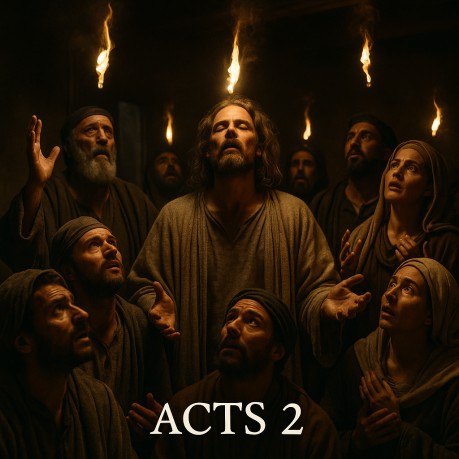
Acts 2:1 † Pentecost, fifty days after Passover, was a
Jewish feast celebrating firstfruits and the giving of the Law at
Sinai. Here, it marks the giving of the Spirit, the firstfruits of
the New Covenant. † Josephus (Antiquities 3.10.6) notes the
significance of Pentecost among Jewish feasts. God chose this moment
to begin the church's witness. Acts 2:2-4 † Wind and fire recall Sinai (Exodus 19:18).
This signals a new covenantal Sinai, with the Spirit writing the Law
on hearts instead of stone. † Philo described Sinai as filled with fiery
voices (On the Decalogue 46). Luke shows the Spirit now fulfills this
typology. Acts 2:5-8 † Jews of the diaspora from every nation heard
the gospel in their own language. This reverses the curse of Babel
(Genesis 11), uniting nations in Christ. † The Mishnah (Pesahim 9:3) confirms that Jews
came from far nations for pilgrimage feasts, showing the wide
audience present. Acts 2:9-11 † The list of nations emphasizes the
universality of the gospel. The Spirit transcends borders, fulfilling
Isaiah 2:2-3 that all nations would flow to the mountain of the Lord. Acts 2:12-13 † Some mocked, accusing the apostles of
drunkenness. Yet this only highlights the miraculous nature of what
occurred. Acts 2:14-16 † Peter refutes mockery and declares
fulfillment of Joel 2:28-32. Pentecost was not random-it was prophecy
realized. Acts 2:17-21 † Joel's prophecy is applied directly to
Pentecost. The last days refer to the end of the Old Covenant age,
not the physical cosmos. † Josephus (Wars 6.5.3) described cosmic signs
during Jerusalem's fall, confirming Joel's imagery. Acts 2:22-24 † Peter boldly accuses them of crucifying
Christ, but declares God raised Him, fulfilling His plan. † Tacitus (Annals 15.44) confirms Christ's
execution under Pontius Pilate. Acts 2:25-28 † Psalm 16 is applied to Christ. David's words
pointed beyond himself to the Messiah who would not see corruption. Acts 2:29-32 † David's tomb remained, but Christ's was
empty. The apostles were eyewitnesses of His resurrection. Acts 2:33-36 † Psalm 110:1 is fulfilled in Christ's
enthronement. Jesus now reigns as Lord and Messiah. † Chrysostom emphasized this verse as proof
Christ's kingship was not future but present from His ascension. Acts 2:37-39 † Repentance, baptism, and reception of the
Spirit were the proper response. The promise extended to Jews, their
children, and those far off (Gentiles). Acts 2:40-41 † Peter links salvation to deliverance from
"this perverse generation," confirming fulfillment in their
time. About three thousand respond in faith and baptism. Acts 2:42-47 † The early church's devotion included
teaching, fellowship, breaking of bread, prayer, sharing of
possessions, and worship. The Lord continually added to their number. † Eusebius (Ecclesiastical History 2.1)
confirms the unity, charity, and rapid growth of the early Jerusalem
church. How it applies to us today † Pentecost shows the Spirit fulfills God's
promises, empowering His people to witness. † The gospel is for all nations, reversing
Babel and uniting the world in Christ. † The kingdom is present reality. Christ reigns
now at God's right hand. † Our call is the same: repentance, baptism,
Spirit-filled living, unity, prayer, and love. † This is the fulfilled perspective we proclaim at
Fulfilled Prophecies † Source Index
By Dan MainesActs 2
When the day of Pentecost had come,
they were all together in one place.
And suddenly a noise like a
violent rushing wind came from heaven, and it filled the whole house
where they were sitting. And tongues that looked like fire appeared
to them, distributing themselves, and a tongue rested on each one of
them. And they were all filled with the Holy Spirit and began to
speak with different tongues, as the Spirit was giving them the
ability to speak out.
Now there were Jews residing in
Jerusalem, devout men from every nation under heaven. And when this
sound occurred, the crowd came together, and they were bewildered
because each one of them was hearing them speak in his own language.
They were amazed and astonished, saying, "Why, are not all these
who are speaking Galileans? And how is it that we each hear them in
our own language to which we were born?"
Parthians, Medes, Elamites, and
residents of Mesopotamia, Judea and Cappadocia, Pontus and Asia,
Phrygia and Pamphylia, Egypt and the parts of Libya around Cyrene,
and visitors from Rome, both Jews and proselytes, Cretans and
Arabs-we hear them speaking in our own tongues of the mighty deeds of
God.
And they all continued in
amazement and great perplexity, saying to one another, "What
does this mean?" But others were jeering and saying, "They
are full of sweet wine!"
But Peter, taking his stand
with the other eleven, raised his voice and declared to them: "Men
of Judea and all you who live in Jerusalem, know this and pay
attention to my words. For these people are not drunk, as you assume,
since it is only the third hour of the day; but this is what has been
spoken through the prophet Joel."
"And it shall be in the
last days, God says, that I will pour out My Spirit on all mankind;
and your sons and your daughters will prophesy, and your young men
will see visions, and your old men will have dreams; and even on My
male and female servants I will pour out My Spirit in those days, and
they will prophesy. And I will display wonders in the sky above and
signs on the earth below, blood, fire, and vapor of smoke. The sun
will be turned into darkness, and the moon into blood, before the
great and glorious day of the Lord comes. And it shall be that
everyone who calls on the name of the Lord will be saved."
"Men of Israel, listen to
these words: Jesus the Nazarene, a Man attested to you by God with
miracles and wonders and signs which God performed through Him in
your midst, just as you yourselves know-this Man, delivered over by
the predetermined plan and foreknowledge of God, you nailed to a
cross by the hands of godless men and put Him to death. But God
raised Him from the dead, putting an end to the agony of death, since
it was impossible for Him to be held in its power."
"For David says of Him, ‘I
saw the Lord continually before me, because He is at my right hand,
so that I will not be shaken. Therefore my heart was glad and my
tongue was overjoyed; moreover my flesh also will live in hope; for
You will not abandon my soul to Hades, nor will You allow Your Holy
One to undergo decay. You have made known to me the ways of life; You
will make me full of gladness with Your presence.'"
"Brothers, I may
confidently say to you regarding the patriarch David that he both
died and was buried, and his tomb is with us to this day. So because
he was a prophet and knew that God had sworn to him with an oath to
seat one of his descendants on his throne, he looked ahead and spoke
of the resurrection of the Christ, that He was neither abandoned to
Hades, nor did His flesh suffer decay. It is this Jesus whom God
raised up, a fact to which we are all witnesses."
"Therefore, since He has
been exalted at the right hand of God, and has received the promise
of the Holy Spirit from the Father, He has poured out this which you
both see and hear. For it was not David who ascended into heaven, but
he himself says: ‘The Lord said to my Lord, "Sit at My right
hand, until I make Your enemies a footstool for Your feet."'
Therefore let all the house of Israel know for certain that God has
made Him both Lord and Christ-this Jesus whom you crucified."
Now when they heard this, they
were pierced to the heart, and said to Peter and the rest of the
apostles, "Brothers, what are we to do?" Peter said to
them, "Repent, and each of you be baptized in the name of Jesus
Christ for the forgiveness of your sins; and you will receive the
gift of the Holy Spirit. For the promise is for you and your children
and for all who are far away, as many as the Lord our God will call
to Himself."
And with many other words he
solemnly testified and kept on urging them, saying, "Be saved
from this perverse generation!" So then, those who had received
his word were baptized; and that day there were added about three
thousand souls.
They were continually devoting
themselves to the apostles' teaching and to fellowship, to the
breaking of bread and to prayer. Everyone kept feeling a sense of
awe; and many wonders and signs were taking place through the
apostles. And all the believers were together and had all things in
common; and they would sell their property and possessions and share
them with all, to the extent that anyone had need. Day by day
continuing with one mind in the temple, and breaking bread from house
to house, they were taking their meals together with gladness and
sincerity of heart, praising God and having favor with all the
people. And the Lord was adding to their number day by day those who
were being saved.
† Josephus,
Antiquities 3.10.6 – Feast of Pentecost
†
Philo, On the Decalogue 46 – Fiery voices at Sinai
†
Mishnah, Pesahim 9:3 – Pilgrims from distant nations
†
Isaiah 2:2-3 – All nations flow to the mountain of the Lord
†
Joel 2:28-32 – Outpouring of the Spirit in the last days
†
Josephus, Wars 6.5.3 – Signs and wonders during Jerusalem's fall
†
Tacitus, Annals 15.44 – Execution of Christ
†
Psalm 16:8-11 – Holy One not seeing corruption
†
Psalm 110:1 – Lord at God's right hand
†
Chrysostom, Homilies on Acts – Christ reigning from ascension
†
Eusebius, Ecclesiastical History 2.1 – Unity and growth of early
church
Links