Acts 1:1-2 † Luke reminds Theophilus that Acts continues
from his first account (the Gospel of Luke). The focus is what Jesus
began to do, now continued through His Spirit in the apostles. † Early church tradition (Irenaeus, Against
Heresies 3.14.1) affirms Luke as the faithful companion of Paul and
historian of the church. Acts 1:3 † The resurrection was verified by many proofs.
For forty days, Jesus spoke about the kingdom of God, not a far-off
earthly empire, but the New Covenant reign. † Josephus records false messiahs around this
time, but none produced evidence like the risen Christ. Acts 1:4-5 † The promise of the Spirit is central. John's
baptism pointed to Christ's greater baptism in the Spirit. Pentecost
would fulfill this promise. Acts 1:6 † The disciples still misunderstood, expecting
a political restoration. Jesus would reveal the kingdom's true nature
was spiritual, covenantal, and fulfilled in their generation. Acts 1:7-8 † The kingdom's restoration was not tied to
earthly timetables. The apostles' mission was Spirit-empowered
witness, beginning in Jerusalem and expanding outward. † This corresponds to Isaiah 49:6, "I will
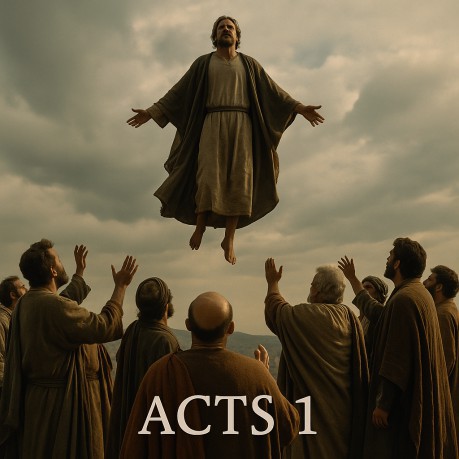
also make You a light of the nations." Acts 1:9 † The ascension is described with cloud
imagery, recalling Daniel 7:13 where the Son of Man comes to the
Ancient of Days in glory. This is not a departure to a far-off
heaven, but an enthronement scene. † Chrysostom taught that Christ's ascension was
His exaltation to kingship, fulfilling Psalm 110:1. Acts 1:10-11 † The angels assure them Jesus will return in
the same covenantal manner He ascended - in the clouds, in glory, in
judgment against Jerusalem within that generation (Matthew 24:30). † Josephus (Wars 6.5.3) records eyewitnesses
seeing armies in the clouds in AD 66, a fulfillment of Christ's
coming in judgment. Acts 1:12-14 † The apostles obeyed, returning to Jerusalem.
They gathered in unity, devoting themselves to prayer. Mary and
Jesus' brothers were present, showing the inclusiveness of the new
covenant community. † Eusebius (Ecclesiastical History 2.1) records
the early devotion of the Jerusalem church in unity and prayer. Acts 1:15-17 † Peter interprets Judas' betrayal as
fulfillment of Scripture. The Spirit had foretold even this tragedy. Acts 1:18-19 † Judas' death was seen as divine judgment.
Matthew records his hanging, Luke records the gruesome fall. Together
they testify to the horror of betraying Christ. Acts 1:20 † Peter applies Psalm 69:25 and 109:8 to Judas,
showing God's word ordained both his judgment and replacement. Acts 1:21-22 † The qualifications for apostleship were
eyewitness knowledge of Jesus' ministry and resurrection. Apostolic
authority was grounded in direct witness. Acts 1:23-26 † The replacement of Judas is Spirit-led.
Casting lots was a biblical method of discerning God's will (Proverbs
16:33). Matthias joins the eleven, restoring the number twelve to
symbolize the renewed Israel. How it applies to us today † The kingdom is not political restoration, but
the reign of Christ through the Spirit. † The ascension is Christ's enthronement. He
reigns now, fulfilling Daniel 7 and Psalm 110. † The Spirit empowers the church to witness to
all nations, fulfilling God's covenant promises. † Judas' fate reminds us of the seriousness of
covenant betrayal, but Matthias' appointment shows God's faithfulness
to restore. † This is the fulfilled perspective we proclaim at
Fulfilled Prophecies † Source Index
By Dan MainesActs 1
The first account I composed,
Theophilus, about all that Jesus began to do and teach, until the day
when He was taken up to heaven, after He had given orders by the Holy
Spirit to the apostles whom He had chosen.
To these He also presented Himself
alive after His suffering, by many convincing proofs, appearing to
them over a period of forty days and speaking of things regarding the
kingdom of God.
Gathering them together, He
commanded them not to leave Jerusalem, but to wait for what the
Father had promised, "Which," He said, "you heard of
from Me; for John baptized with water, but you will be baptized with
the Holy Spirit not many days from now."
So, when they had come together,
they began asking Him, saying, "Lord, is it at this time that
You are restoring the kingdom to Israel?"
But He said to them, "It is
not for you to know periods of time or appointed times which the
Father has set by His own authority; but you will receive power when
the Holy Spirit has come upon you; and you shall be My witnesses both
in Jerusalem, and in all Judea, and Samaria, and as far as the
remotest part of the earth."
And after He had said these things,
He was lifted up while they were watching, and a cloud took Him up
out of their sight.
And as they were gazing
intently into the sky while He was going, behold, two men in white
clothing stood beside them, and they said, "Men of Galilee, why
do you stand looking into the sky? This Jesus, who has been taken up
from you into heaven, will come in the same way as you have watched
Him go into heaven."
Then they returned to Jerusalem
from the mountain called Olivet, which is near Jerusalem, a Sabbath
day's journey away. When they had entered the city, they went up to
the upstairs room where they were staying; that is, Peter, John,
James, Andrew, Philip, Thomas, Bartholomew, Matthew, James the son of
Alphaeus, Simon the Zealot, and Judas the son of James. All these
were continually devoting themselves with one mind to prayer, along
with the women, and Mary the mother of Jesus, and with His brothers.
At this time Peter stood up
among the brothers and sisters (a group of about 120 people was there
together), and said, "Brothers, the Scripture had to be
fulfilled, which the Holy Spirit foretold by the mouth of David
concerning Judas, who became a guide to those who arrested Jesus. For
he was counted among us and received his share in this ministry."
(Now this man acquired a field
with the price of his wickedness, and falling headlong, he burst open
in the middle and all his intestines gushed out. And it became known
to all who lived in Jerusalem, so that in their own language that
field was called Hakeldama, that is, Field of Blood.)
"For it is written in the
book of Psalms: ‘May his residence be made desolate, and may there
be none living in it'; and, ‘May another take his office.'"
Therefore it is necessary that
of the men who have accompanied us all the time that the Lord Jesus
went in and out among us - beginning with the baptism of John until
the day that He was taken up from us - one of these must become a
witness with us of His resurrection.
So they put forward two men,
Joseph called Barsabbas (who was also called Justus), and Matthias.
And they prayed and said, "You, Lord, who know the hearts of all
people, show which one of these two You have chosen to occupy this
ministry and apostleship from which Judas turned aside to go to his
own place." And they drew lots for them, and the lot fell to
Matthias; and he was added to the eleven apostles.
† Irenaeus,
Against Heresies 3.14.1 – Luke as historian of the church
†
Josephus, Antiquities 20.5 – False messiahs in Israel
†
Isaiah 49:6 – Light to the nations
† Daniel
7:13 – Son of Man coming to the Ancient of Days
†
Psalm 110:1 – Christ seated at God's right hand
†
Chrysostom, Homilies on Acts – Ascension as exaltation
†
Josephus, Wars 6.5.3 – Armies seen in the clouds
†
Eusebius, Ecclesiastical History 2.1 – Unity of early church in
prayer
† Psalm 69:25; 109:8 – Judas'
desolation and replacement
† Proverbs 16:33 –
Casting lots reveals God's choice
Links