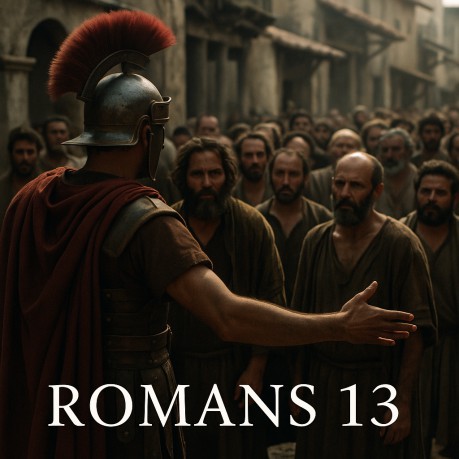
Romans 13:1 † Paul instructs submission to governing
authorities. This would have been shocking, since Rome was often
hostile to Christians. Yet God establishes authority to maintain
order. † Josephus (Antiquities 18.1.1) wrote that
Rome's rule over Judea was seen as divinely permitted, even if
resented. Paul affirms God's sovereignty over rulers. Romans 13:2 † To resist lawful authority is to resist God's
ordinance. In Paul's context, rebellion against Rome often led to
death. † The Jewish revolt of AD 66-70 fulfilled
Paul's warning. Josephus records that resistance to Rome brought
severe judgment and destruction. Romans 13:3-4 † Authorities serve as instruments of God's
justice. Rome bore the sword to punish lawlessness. † Tacitus (Histories 4.74) described Roman
justice as harsh but effective in restraining disorder. Paul calls
Christians to peaceable conduct. Romans 13:5 † Submission is not merely pragmatic, to avoid
wrath, but rooted in conscience before God. Romans 13:6-7 † Paying taxes is framed as obedience to God.
Christians were not to join Jewish tax revolts. † The Mishnah (Nedarim 3:4) records Jewish
resistance to Roman taxes. Paul instead urges submission. Romans 13:8 † The only debt believers should carry is love.
Love fulfills the Law. † Jesus said the Law hangs on love of God and
neighbor (Matthew 22:37-40). Paul applies this covenant truth. Romans 13:9 † Paul cites the commandments, showing they are
all summed up in love. The Law's purpose is fulfilled in Christ
through love. Romans 13:10 † Love, not Torah observance, is the true
covenant fulfillment. Romans 13:11 † Paul stresses urgency. Salvation was near in
their generation. This points to the approaching fulfillment in AD
70. † The Dead Sea Scrolls (1QS 9.26) urged
vigilance, awaiting God's visitation. Paul affirms that the time had
come. Romans 13:12 † The night of the old covenant was passing.
The day of Christ's fulfilled kingdom was near. Believers must live
as children of light. Romans 13:13 † Conduct must reflect covenant light. Paul
warns against indulgence and division that marked the old order. Romans 13:14 † To put on Christ is to live fully in His
covenant life. The flesh is denied; Christ is embraced. How it applies to us today † God ordains governing authorities. Our duty
is respectful submission, unless obedience to them contradicts
obedience to God. † Love fulfills the Law. Our calling is to live
in Christlike love, not legalistic obligation. † The urgency of Paul's generation reminds us
to live watchfully, knowing Christ has fulfilled His promises and His
kingdom is present. † Putting on Christ is the essence of Christian
life. He is our light, our armor, and our covenant identity. † This is the fulfilled perspective we proclaim at
Fulfilled Prophecies † Source Index
By Dan MainesRomans 13
Every person is to be subject to
the governing authorities. For there is no authority except from God,
and those which exist are established by God.
Therefore the one who resists
authority has opposed the ordinance of God; and they who have opposed
will receive condemnation upon themselves.
For rulers are not a cause of
fear for good behavior, but for evil. Do you want to have no fear of
authority? Do what is good and you will have praise from the same;
for it is a servant of God to you for good. But if you do what is
evil, be afraid; for it does not bear the sword for nothing; for it
is a servant of God, an avenger who brings wrath on the one who
practices evil.
Therefore it is necessary to be
in subjection, not only because of wrath, but also for the sake of
conscience.
For because of this you also
pay taxes, for rulers are servants of God, devoting themselves to
this very thing. Pay to all what is due them: tax to whom tax is due;
custom to whom custom; respect to whom respect; honor to whom honor.
Owe nothing to anyone except to
love one another; for the one who loves his neighbor has fulfilled
the Law.
For this, "You shall not
commit adultery, You shall not murder, You shall not steal, You shall
not covet," and if there is any other commandment, it is summed
up in this saying: "You shall love your neighbor as yourself."
Love does no wrong to a
neighbor; therefore love is the fulfillment of the Law.
Do this, knowing the time, that
it is already the hour for you to awaken from sleep; for now
salvation is nearer to us than when we first believed.
The night is almost gone, and
the day is near. Therefore let's rid ourselves of the deeds of
darkness and put on the armor of light.
Let's behave properly as in the
day, not in carousing and drunkenness, not in sexual promiscuity and
debauchery, not in strife and jealousy.
But put on the Lord Jesus
Christ, and make no provision for the flesh in regard to its lusts.
† Josephus,
Antiquities 18.1.1 – Roman rule over Judea seen as divinely
permitted
† Josephus, Wars 2.17.2 – Revolt
against Rome brings destruction
† Tacitus,
Histories 4.74 – Roman justice restraining disorder
†
Mishnah, Nedarim 3:4 – Jewish resistance to taxes
†
Matthew 22:37-40 – Love as fulfillment of the Law
†
Dead Sea Scrolls, 1QS 9.26 – Vigilance for God's visitation
Links