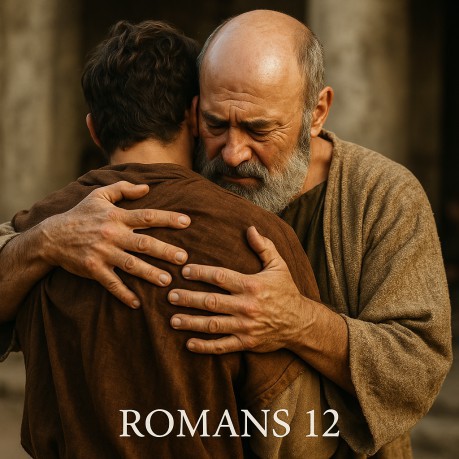
Romans 12:1 † Paul shifts from doctrine to practice. In
light of God's mercies, believers are called to present themselves as
living sacrifices. † This contrasts with Old Covenant animal
sacrifices. Now, covenant service is offering our entire lives to
God. † Philo spoke of the soul as a sacrifice of
reason. Paul grounds true sacrifice in Christ and Spirit-filled
obedience. Romans 12:2 † Transformation is inward, by renewing of the
mind. The old covenant age was passing; believers were called not to
conform to its patterns. † Josephus describes how zealots conformed to
violence and corruption before Jerusalem's fall. Paul calls believers
to the opposite: transformation through Christ. Romans 12:3 † Humility is commanded. Faith is measured by
God's gift, not human pride. Romans 12:4-5 † The body metaphor shows unity in diversity.
Each believer has a role, yet all belong to one body. † Clement of Rome used this imagery in 1
Clement 37, urging unity in the church. Romans 12:6-8 † The Spirit distributes gifts for service.
Each is to use their gift faithfully and joyfully. † The Didache (ch. 11-13) speaks of proper use
of spiritual gifts in the early church. Paul emphasizes humility and
grace in their exercise. Romans 12:9 † True love is without pretense. Holiness
demands rejecting evil and embracing good. Romans 12:10-11 † The Christian community must excel in love,
honor, and service, modeling a new covenant family. Romans 12:12-13 † Paul emphasizes endurance, prayer,
generosity, and hospitality, critical virtues for the persecuted
church. Romans 12:14 † Echoing Jesus in Matthew 5:44, Paul calls for
blessing in the face of persecution. † Tacitus (Annals 15.44) described Roman
cruelty to Christians, yet their response of blessing shocked the
empire. Romans 12:15-16 † Christian empathy and humility mark the
community. They reject arrogance and embrace unity. Romans 12:17-18 † Retribution belongs to God. Believers are to
pursue peace wherever possible. Romans 12:19 † Quoting Deuteronomy 32:35, Paul teaches that
vengeance belongs to God. The destruction of Jerusalem in AD 70 was
God's vengeance on covenant breakers. Romans 12:20-21 † Quoting Proverbs 25:21-22, Paul instructs
believers to respond to enemies with kindness, leaving judgment to
God. How it applies to us today † Our lives are living sacrifices, holy and
acceptable to God. Worship is not confined to ritual but encompasses
daily obedience. † Transformation is the ongoing renewal of the
mind. We must resist conformity to worldly patterns. † Humility, service, and love remain the marks
of Christ's body. † Vengeance belongs to God. We are called to
overcome evil with good, trusting Him to judge rightly. † This is the fulfilled perspective we proclaim at
Fulfilled Prophecies † Source Index
By Dan MainesRomans 12
Therefore I urge you, brothers
and sisters, by the mercies of God, to present your bodies as a
living and holy sacrifice, acceptable to God, which is your spiritual
service of worship.
And do not be conformed to this
world, but be transformed by the renewing of your mind, so that you
may prove what the will of God is, that which is good and acceptable
and perfect.
For through the grace given to
me I say to everyone among you not to think more highly of himself
than he ought to think, but to think so as to have sound judgment, as
God has allotted to each a measure of faith.
For just as we have many parts
in one body and all the body's parts do not have the same function,
so we, who are many, are one body in Christ, and individually parts
of one another.
However, since we have gifts
that differ according to the grace given to us, each of us is to use
them properly: if prophecy, in proportion to one's faith; if service,
in the act of serving; or the one who teaches, in the act of
teaching; or the one who exhorts, in the work of exhortation; the one
who gives, with generosity; the one who is in leadership, with
diligence; the one who shows mercy, with cheerfulness.
Love must be free of hypocrisy.
Detest what is evil; cling to what is good.
Be devoted to one another in
brotherly love; give preference to one another in honor, not lagging
behind in diligence, fervent in spirit, serving the Lord.
rejoicing in hope,
persevering in tribulation, devoted to prayer, contributing to the
needs of the saints, practicing hospitality.
Bless those who persecute you;
bless and do not curse.
Rejoice with those who
rejoice, and weep with those who weep. Be of the same mind toward one
another; do not be haughty in mind, but associate with the lowly. Do
not be wise in your own estimation.
Never repay evil for evil to
anyone. Respect what is right in the sight of all people. If
possible, so far as it depends on you, be at peace with all people.
Never take your own revenge,
beloved, but leave room for the wrath of God, for it is written:
"Vengeance is Mine, I will repay," says the Lord.
"But if your enemy is
hungry, feed him, if he is thirsty, give him a drink; for in so doing
you will heap burning coals on his head." Do not be overcome by
evil, but overcome evil with good.
† Philo, On
the Special Laws – Sacrifice of reason
†
Josephus, Wars 6.5.4 – Zealots' corruption before Jerusalem's
fall
† Clement of Rome, 1 Clement 37 –
Unity in the body
† Didache, chapters 11-13 –
Early church teaching on gifts
† Tacitus,
Annals 15.44 – Persecution of Christians
†
Deuteronomy 32:35 – Vengeance belongs to God
†
Proverbs 25:21-22 – Feeding enemies heaps burning coals
Links