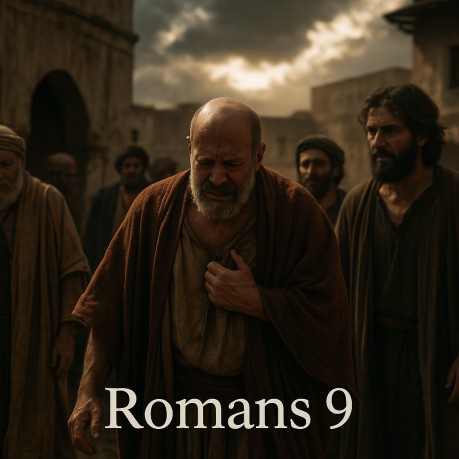
Romans 9:1-2 † Paul opens with a solemn statement,
expressing deep grief for Israel. Though privileged, many of his
kinsmen had rejected Christ. † Jeremiah also wept over Israel's disobedience
(Jeremiah 9:1). Paul continues this prophetic lament for covenant
unfaithfulness. Romans 9:3 † Paul's love for Israel is profound. He even
declares he would accept being cut off for their sake. This echoes
Moses in Exodus 32:32, who offered himself for Israel. † Josephus describes the zeal of Jews for their
nation in Wars 2.17.10. Paul's zeal is spiritual, rooted in Christ. Romans 9:4-5 † Israel had unique privileges: adoption,
glory, covenants, Law, worship, promises, patriarchs, and even
Christ's lineage. Yet privilege without faith led to judgment. † The Dead Sea Scrolls (CD 3.12-15) remind us
that Israel often relied on privilege without obedience. Paul insists
Christ is the true goal of all these blessings. Romans 9:6 † God's word did not fail. True Israel is
defined not by flesh but by promise. † Hosea 1:10 foretold that those not called
God's people would be called His people. Paul applies this to the
nations and believing remnant of Israel. Romans 9:7-9 † Covenant descent is not through flesh but
promise. Isaac, not Ishmael, was the child of promise. So also,
Christ fulfills the covenant promise. † Philo noted that Isaac symbolized divine
promise. Paul applies this to Christ as the seed. Romans 9:10-13 † God's election is demonstrated in Jacob over
Esau. Choice was not based on works but on God's purpose. † Malachi 1:2-3 shows this was national, not
individual. Israel was chosen for covenant purpose, while Edom was
rejected. Romans 9:14-15 † God's sovereignty is defended. His mercy is
His to grant. Exodus 33:19 showed this truth during Israel's
rebellion with the golden calf. Romans 9:16 † Covenant blessing is not earned by will or
effort. It depends solely on God's mercy. Romans 9:17-18 † Pharaoh is used as an example. God raised him
to display His power. Hardening was God's judicial act, confirming
Pharaoh's rebellion. † Josephus (Antiquities 2.14.3) recounts
Pharaoh's stubbornness, which Paul ties directly to God's sovereign
purpose. Romans 9:19-21 † Paul rebukes human arrogance in questioning
God. The potter and clay image from Jeremiah 18 shows God's right to
shape nations for His purpose. Romans 9:22-24 † God's patience with unbelieving Israel
demonstrated His glory when He revealed mercy to Jew and Gentile
alike. The objects of wrath were covenant breakers, culminating in AD
70. Romans 9:25-26 † Hosea foretold covenant expansion. What
applied to Israel's restoration also pointed to the nations'
inclusion. Romans 9:27-29 † Isaiah predicted judgment and remnant
salvation. Though Israel was numerous, only a remnant was preserved. † Josephus (Wars 6.9.4) described Israel's near
total destruction, sparing only a remnant. Paul interprets this as
Isaiah's prophecy fulfilled. Romans 9:30-32 † Gentiles attained righteousness by faith,
while Israel stumbled by seeking it through works. Christ was the
stumbling stone. Romans 9:33 † Isaiah 28:16 is applied to Christ. Those who
believed were secure. Those who rejected Him stumbled into
destruction. How it applies to us today † Covenant privilege without faith is
worthless. Like Israel, churches today cannot rely on heritage or
ritual. † God's promises never fail. True Israel is
defined by faith, not flesh. † God's mercy and sovereignty assure us that
His purpose will stand. Our trust is not in human will but in His
calling. † The remnant principle applies today. God
always preserves a faithful people, even when many reject Him. † This is the fulfilled perspective we proclaim at
Fulfilled Prophecies † Source Index
By Dan MainesRomans 9
I am telling the truth in
Christ, I am not lying; my conscience testifies with me in the Holy
Spirit, that I have great sorrow and unceasing grief in my heart.
For I could wish that I myself
were accursed, separated from Christ for the sake of my countrymen,
my kinsmen according to the flesh,
who are Israelites, to whom
belongs the adoption as sons and daughters, the glory, the covenants,
the giving of the Law, the temple service, and the promises, whose
are the fathers, and from whom is the Christ according to the flesh,
who is over all, God blessed forever. Amen.
But it is not as though the word
of God has failed. For they are not all Israel who are descended from
Israel.
nor are they all children
because they are Abraham's descendants, but: "through Isaac your
descendants shall be named." That is, it is not the children of
the flesh who are children of God, but the children of the promise
are regarded as descendants. For this is the word of promise: "At
this time I will come, and Sarah will have a son."
And not only that, but there
was also Rebekah, when she had conceived twins by one man, our father
Isaac; for though the twins were not yet born and had not done
anything good or bad, so that God's purpose according to His choice
would stand, not because of works but because of Him who calls, it
was said to her, "The older will serve the younger." Just
as it is written: "Jacob I have loved, but Esau I have hated."
What shall we say then? There
is no injustice with God, is there? Far from it! For He says to
Moses, "I will have mercy on whomever I have mercy, and I will
show compassion to whomever I show compassion."
So then, it does not depend on
the person who wants it nor the one who runs, but on God who has
mercy.
For the Scripture says to
Pharaoh, "For this very reason I raised you up, in order to
demonstrate My power in you, and in order that My name might be
proclaimed throughout the earth." So then He has mercy on whom
He desires, and He hardens whom He desires.
You will say to me then, "Why
does He still find fault? For who has resisted His will?" On the
contrary, who are you, you foolish person, who answers back to God?
The thing molded will not say to the molder, "Why did you make
me like this," will it? Or does the potter not have a right over
the clay, to make from the same lump one object for honorable use and
another for common use?
What if God, although willing
to demonstrate His wrath and to make His power known, endured with
great patience objects of wrath prepared for destruction? And He did
so to make known the riches of His glory upon objects of mercy, which
He prepared beforehand for glory, namely us, whom He also called, not
only from among Jews, but also from among Gentiles.
As He also says in Hosea: "I
will call those who were not My people, 'My people,' and her who was
not beloved, 'beloved.' And it shall be that in the place where it
was said to them, 'you are not My people,' there they shall be called
sons of the living God."
Isaiah cries out concerning
Israel, "Though the number of the sons of Israel may be like the
sand of the sea, only the remnant will be saved; for the Lord will
execute His word on the earth, thoroughly and quickly." And just
as Isaiah foretold: "If the Lord of armies had not left us
descendants, we would have become like Sodom, and would have been
like Gomorrah."
What shall we say then? That
Gentiles, who did not pursue righteousness, attained righteousness,
but the righteousness that is by faith; however, Israel, pursuing a
law of righteousness, did not arrive at that law. Why? Because they
did not pursue it by faith, but as though they could by works. They
stumbled over the stumbling stone.
just as it is written: "Behold,
I am laying in Zion a stone of stumbling and a rock of offense, and
the one who believes in Him will not be put to shame."
† Jeremiah
9:1 – Prophet weeping over Israel
† Exodus
32:32 – Moses offering himself for Israel
†
Josephus, Wars 2.17.10 – Jewish zeal for the nation
†
Dead Sea Scrolls, CD 3.12-15 – Israel's false reliance on
privilege
† Hosea 1:10 – Not My people
called My people
† Philo, On Abraham –
Isaac as the child of promise
† Malachi 1:2-3
– Jacob loved, Esau hated
† Josephus,
Antiquities 2.14.3 – Pharaoh's stubbornness
†
Jeremiah 18 – Potter and clay imagery
†
Josephus, Wars 6.9.4 – Israel's destruction, sparing a remnant
†
Isaiah 28:16 – Stone of stumbling in Zion
Links