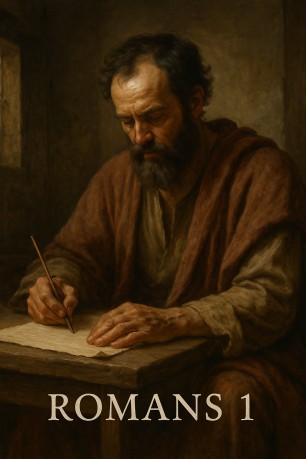
Romans 1:1 † Paul begins by declaring his role as a
bond-servant. In covenantal language this means total submission to
God's will. The term recalls Exodus 14:31 where Israel believed in
the Lord and in His servant Moses. Just as Moses was the covenant
mediator of the Old Covenant, Paul presents himself as a servant of
the New. † Being "set apart" recalls Jeremiah
1:5, where God set apart the prophet before birth. Paul's calling is
rooted in prophetic tradition, but here it is fulfilled in
proclaiming the gospel of God already established through Christ. † Philo of Alexandria called Moses the supreme
"servant of God," a title of honor. Paul applies the same
title to himself, showing the shift of covenant authority into
Christ's apostles. Romans 1:2 † Paul roots the gospel in prophecy. This shows
continuity, not novelty. The gospel wasn't invented in Paul's time
but promised in texts like Isaiah 53 and Jeremiah 31:31-34. † The Dead Sea Scrolls (4QFlorilegium)
demonstrate how Jews of the first century expected imminent
fulfillment of promises in their own day. Paul reveals that the true
fulfillment is not in political deliverance but in Christ Himself. † This verse alone refutes futurism. The
promises were already fulfilled when Paul wrote, not waiting for a
distant future age. Romans 1:3-4 † Jesus fulfills the Davidic covenant of 2
Samuel 7. According to the flesh He was heir to David's throne.
According to the Spirit of holiness He is Son of God with power. † The resurrection vindicated His claim to
kingship. Psalm 2:7, "You are My Son, today I have begotten
You," is fulfilled in the resurrection (Acts 13:33). † Josephus (Wars 6.5.4) notes Jewish
expectation of a ruler from Judea. Paul declares Jesus is that ruler,
revealed not by conquest but by resurrection. Romans 1:5 † Paul's apostleship is rooted in grace. His
mission was to extend the gospel beyond Israel to the nations,
fulfilling Genesis 12:3 where Abraham's seed would bless all families
of the earth. † "Obedience of faith" contrasts with
"works of law." Faith is the covenant marker in Christ.
This obedience is covenant trust, not Torah observance. † Irenaeus (Against Heresies 3.13.1) points to
Paul as the apostle who broke down the wall between Jew and Gentile,
uniting them into one covenant family. Romans 1:6-7 † Gentile believers are called "saints."
This term, once reserved for Israel, is now applied to the nations.
This fulfills Daniel 7:27 where "the saints of the Most High"
receive the kingdom. † Tacitus (Annals 15.44) confirms that
Christians in Rome formed a distinct community, even under
persecution. Paul's greeting of grace and peace was covenant
encouragement for their trials. Romans 1:8 † Their faith was known worldwide, showing the
rapid spread of the gospel in the first century. Jesus said the
gospel would be preached to all nations before the end came (Matthew
24:14). Paul affirms it was already happening. † The Mishnah (Avot 1:2) claimed the world
rests on Torah, worship, and kindness. Paul shifts this foundation to
faith in Christ, which was already shaking the Roman world. Romans 1:9-10 † Paul served God "in his spirit,"
pointing to New Covenant worship not bound to temple or sacrifices.
John 4:24 echoes this: those who worship must worship in spirit and
truth. † His unceasing prayers show the unity of the
body across distances. The Roman believers could be confident that
they were not forgotten. Romans 1:11-12 † Spiritual gifts were temporary provisions for
the early church to establish it before the end of the age (1
Corinthians 13:8-10). Paul desired to strengthen them with these
gifts. † Mutual encouragement shows the reciprocity of
the body of Christ. Paul wasn't above needing their faith. † Clement of Rome (1 Clement 42) testifies that
the apostles, empowered by the Spirit, established churches by gifts
and preaching. Romans 1:13 † Paul sought "fruit" among them,
meaning the conversion of more Gentiles. This ties directly to Jesus'
parable of the vineyard (Matthew 21:43): the kingdom would be taken
from unfruitful Israel and given to a people producing fruit. Romans 1:14-15 † The gospel was not bound by culture,
intellect, or social standing. From the elite philosophers to the
unlearned, Paul's mission was universal. † This fulfills Isaiah 45:22, "Turn to Me
and be saved, all the ends of the earth." Romans 1:16-17 † The gospel is God's power. Not Rome's armies,
not the temple's rituals, but the gospel. † "To the Jew first" reflects
covenant priority. Israel received the promises, but they now extend
equally to the nations. Isaiah 49:6 foretold that the Servant would
be a light to the nations. † The righteousness of God means His covenant
faithfulness revealed in Christ. It is not man's righteousness but
God's gift. † Josephus shows that Jews of his time equated
righteousness with Torah observance. Paul redefines righteousness as
faith in Christ. † Futurists delay righteousness to a future
age, but Paul says it is already revealed. The righteous live by
faith now. Romans 1:18 † Wrath was already being revealed in Paul's
day. It pointed to the judgment coming upon Israel and the nations
culminating in AD 70. † Josephus (Wars 6.9.3) describes the horrors
of Jerusalem's fall, confirming this wrath in history. Romans 1:19-20 † Creation reveals God's attributes. Both Jew
and Gentile were accountable. Psalm 19:1 affirms, "The heavens
are telling of the glory of God." † Futurists claim the world waits for greater
revelation, but Paul says creation already leaves all without excuse. Romans 1:21-23 † Idolatry is the rejection of God for
creation. Israel often fell into this (Psalm 106:20). † Philo (On the Decalogue 52) condemned
idolatry as the ultimate folly. Paul echoes this cultural critique. Romans 1:24-25 † "God gave them up" reflects
covenant judgment. As in Hosea 4:17, "Ephraim is joined to
idols, let him alone." Romans 1:26-27 † Paul uses sexual immorality as an example of
covenant corruption. It shows how rebellion against God distorts even
the most basic human relationships. Romans 1:28-31 † This catalog of sins matches Jewish critiques
of paganism (Wisdom of Solomon 14:22-31). Yet Paul applies it equally
to Israel, showing universal guilt. Romans 1:32 † Knowing God's ordinances but rejecting them
results in judgment. This applied to Israel with the law and to
Gentiles with conscience. † Tacitus (Histories 1.2) lamented Rome's moral
decay, showing that even pagans recognized the corruption Paul
described. How it applies to us today † We must not be ashamed of the gospel. It
remains God's power for salvation, not future speculation or man's
effort. † God's righteousness has already been revealed
in Christ. We live in it now by faith, not waiting for a future age. † Idolatry and moral decay surround us today as
they did in the first century. Paul's warning is timeless: rejecting
God leads to corruption, while faith in Christ restores
righteousness. † Just as the Roman church was a light in a
hostile empire, so must our faith be visible today, proclaimed by how
we live as Christ's covenant people. † This is the fulfilled perspective we proclaim at
Fulfilled Prophecies † Source Index
By Dan MainesRomans 1
Paul, a bond-servant of Christ
Jesus, called as an apostle, set apart for the gospel of God,
which He promised beforehand
through His prophets in the holy Scriptures,
concerning His Son, who was
born of a descendant of David according to the flesh, who was
declared the Son of God with power by the resurrection from the dead,
according to the Spirit of holiness, Jesus Christ our Lord,
through whom we have received
grace and apostleship to bring about the obedience of faith among all
the Gentiles in behalf of His name,
among whom you also are the
called of Jesus Christ; to all who are beloved of God in Rome, called
as saints: Grace to you and peace from God our Father and the Lord
Jesus Christ.
First, I thank my God through
Jesus Christ for you all, because your faith is being proclaimed
throughout the world.
For God, whom I serve in my
spirit in the preaching of the gospel of His Son, is my witness as to
how without ceasing I make mention of you, always in my prayers
requesting, if perhaps now at last by the will of God I may succeed
in coming to you.
For I long to see you so that
I may impart some spiritual gift to you, that you may be established;
that is, that I may be encouraged together with you while among you,
each of us by the other's faith, both yours and mine.
I do not want you to be unaware,
brothers and sisters, that often I have planned to come to you (and
have been prevented so far) so that I may obtain some fruit among you
also, just as among the rest of the Gentiles.
I am under obligation both to
Greeks and to the uncultured, both to the wise and to the foolish.
So, for my part I am eager to preach the gospel to you also who are
in Rome.
For I am not ashamed of the
gospel, for it is the power of God for salvation to everyone who
believes, to the Jew first and also to the Greek. For in it the
righteousness of God is revealed from faith to faith; as it is
written: "But the righteous one will live by faith."
For the wrath of God is revealed
from heaven against all ungodliness and unrighteousness of people who
suppress the truth in unrighteousness,
because that which is known
about God is evident within them; for God made it evident to them.
For since the creation of the world His invisible attributes, that
is, His eternal power and divine nature, have been clearly perceived,
being understood by what has been made, so that they are without
excuse.
For even though they knew
God, they did not honor Him as God or give thanks, but they became
futile in their reasonings, and their senseless hearts were darkened.
Claiming to be wise, they became fools, and they exchanged the glory
of the incorruptible God for an image in the form of corruptible
mankind, of birds, four-footed animals, and crawling creatures.
Therefore God gave them up to
vile impurity in the lusts of their hearts, so that their bodies
would be dishonored among them. For they exchanged the truth of God
for falsehood, and worshiped and served the creature rather than the
Creator, who is blessed forever. Amen.
For this reason God gave them
over to degrading passions; for their women exchanged natural
relations for that which is contrary to nature, and likewise the men
too abandoned natural relations with women and burned in their desire
toward one another, males with males committing shameful acts and
receiving in their own persons the due penalty of their error.
And just as they did not see
fit to acknowledge God, God gave them up to a depraved mind, to do
those things that are not proper, people having been filled with all
unrighteousness, wickedness, greed, and evil; full of envy, murder,
strife, deceit, and malice; they are gossips, slanderers, haters of
God, insolent, arrogant, boastful, inventors of evil, disobedient to
parents, without understanding, untrustworthy, unfeeling, and
unmerciful.
and although they know the
ordinance of God, that those who practice such things are worthy of
death, they not only do the same, but also approve of those who
practice them.
† Philo, On
the Life of Moses 1.29 – Moses as servant of God
†
Dead Sea Scrolls, 4QFlorilegium – Messianic expectations in the
first century
† Josephus, Wars of the Jews
6.5.4 – Expectation of a ruler from Judea
†
Irenaeus, Against Heresies 3.13.1 – Unity of Jew and Gentile in
Christ
† Tacitus, Annals 15.44 – Roman
persecution of Christians under Nero
†
Mishnah, Avot 1:2 – World upheld by Torah, worship, and kindness
†
Clement of Rome, 1 Clement 42 – Apostles empowered by the Spirit
established churches
† Josephus, Wars of the
Jews 6.9.3 – Wrath on Jerusalem in AD 70
†
Philo, On the Decalogue 52 – Critique of idolatry
†
Wisdom of Solomon 14:22-31 – Pagan corruption and immorality
†
Tacitus, Histories 1.2 – Corruption and moral decline in Rome
Links