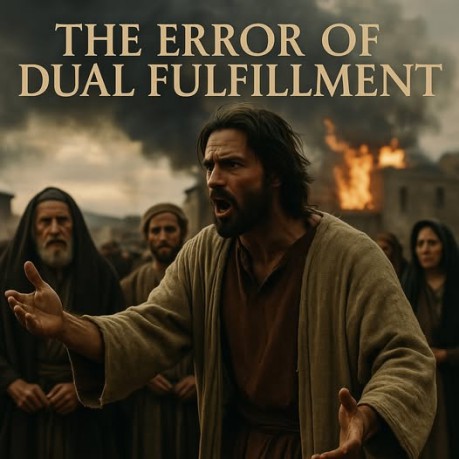
The
Error of Dual Fulfillment When people
defend the idea of dual fulfillment, they are not upholding the
words of Christ, they are undermining them. Dual fulfillment is
really just a way to escape the force of the time statements that
Jesus and the apostles declared with absolute clarity. Over and
over, they said that all prophecy would be fulfilled in that
generation. Matthew 24:34 - Truly
I say to you, this generation will not pass away until all these
things take place. † These are not
vague statements. They are direct, pointed, and bound to the
first-century context. To then claim that prophecies had a
first-century fulfillment and also a future fulfillment thousands of
years later is to make Christ's words meaningless. † Notice the
inconsistency: Partial preterists criticize dispensationalists for
stretching the time texts, yet they themselves fall into the same
error by appealing to so-called dual fulfillment. Scripture never
teaches that God's word comes in repeated cycles separated by
millennia. That is the invention of men, not the testimony of the
Spirit. † The phrase "this
generation" in Matthew always refers to the people then alive,
compare Matthew 11:16, 12:41-42, 23:36, 24:34. Luke 21:22 fixes the
timing by saying all things written would be fulfilled when
Jerusalem was surrounded. Nearness words like "soon," "at
hand," and "about to" are never stretched across
thousands of years. They were urgent for that audience. The Shadow and the Substance The law and the prophets were not
meant to stretch on forever, being fulfilled and then re-fulfilled
again and again. They were shadows pointing to Christ. When He came,
He fulfilled them completely. Luke 24:44 - Now He
said to them, These are My words which I spoke to you while I was
still with you, that all the things that are written about Me in the
Law of Moses and the Prophets and the Psalms must be
fulfilled. † A shadow does not
reappear once the reality has arrived. No one waits for shadows to
return after the substance has taken its rightful place. To argue
for dual fulfillment is to argue for shadows to rise again after the
cross. That is confusion and error. † Colossians
2:16-17 calls Israel's calendar a shadow, with Christ as the
substance. Hebrews 10:1 repeats that the law is a shadow, not the
form. Hebrews 8:13 says the Old Covenant was becoming obsolete and
about to vanish, and Hebrews 9:26 says Christ appeared at the
consummation of the ages to put away sin. Shadows serve once, then
vanish when the substance arrives. The Danger of Confusion † This is why dual
fulfillment causes so much confusion in the church. It allows
endless speculation. It gives people an excuse to look at the
newspaper instead of the scriptures. It undermines the plain words
of Christ and opens the door to every kind of future telling,
prediction, and failed prophecy. † But when we
accept that Jesus meant exactly what He said, that these things
would happen in that generation, the confusion disappears. We no
longer need to stretch the text, invent theories, or divide
fulfillment into two phases. Christ spoke plainly, and His words
were true. † The prophets used
sun, moon, stars, and cloud-riding as covenant judgment language:
Isaiah 13:10 against Babylon, Ezekiel 32:7-8 against Egypt, Amos 8:9
against Israel, Isaiah 19:1 with the Lord riding on a swift cloud to
judge Egypt. Jesus applied the same imagery to His own generation.
Luke 21:22 anchors it: all things written would be fulfilled in
those days. † Josephus himself
recorded that Jerusalem was surrounded by armies, exactly as Christ
warned. He described famine so severe that mothers ate their own
children, fulfilling the covenant curses of Deuteronomy 28. This was
not a shadow of a future event, it was the real judgment Christ
declared would fall on that generation. † Tacitus confirmed
that signs appeared in the heavens before the fall. Armies and
chariots were seen in the clouds, a vivid picture of the Son of Man
coming on the clouds in power and glory. These were the signs Jesus
said His generation would see. † Eusebius later
wrote that Christians remembered Christ's warning and fled to Pella
when they saw the city surrounded. This proves the early church did
not expect a second fulfillment. They knew the words of Christ were
true and complete in their own day. † Suetonius also
recorded omens and portents in the skies before the fall, seen as
warnings of divine judgment. These secular witnesses confirm what
the apostles and prophets declared. † Clement of
Alexandria taught that the destruction of Jerusalem was a divine
judgment, and pointed to the church's preservation as proof of God's
fulfilled word. † Tertullian
affirmed that the fall of Jerusalem was the fulfillment of prophecy
and that the church now lived in the age of Christ's kingdom. † Philo of
Alexandria described the corruption of the priesthood and the moral
decay of the Jewish leadership leading into the first century,
setting the stage for covenant judgment. † The Qumran
community, in their writings, also spoke of imminent judgment and
covenant curses, showing that even among the sects of Judaism there
was an expectation of an approaching end. † Every attempt to
stretch these texts into the future must ignore the inspired time
markers. The apostles said "the Judge is standing right at the
door" (James 5:9) and "the time is near" (Revelation
1:3). These words are not elastic, they were urgent for them. No Such Thing as Dual
Fulfillment That’s the key point: Scripture
never teaches "dual fulfillment" as a doctrine. The idea
of a prophecy having a primary fulfillment in the first century and
then a second, larger fulfillment thousands of years later is not in
the Bible at all, it is an invention of later interpreters to get
around the plain time statements. † Sometimes there
are types and shadows (like Israel as a type of Christ, or the
exodus as a type of redemption), but those are not "dual
fulfillments." A type ends in the antitype. Once Christ
fulfills it, it does not repeat. † Jesus Himself
said that "all things written" would be fulfilled in His
generation (Luke 21:22; Matthew 24:34). That leaves no room for a
second round thousands of years later. † The apostles
confirmed the same: † Where futurists
or partial preterists try to argue "dual fulfillment,"
they usually point to things like: † But in every
case, the New Testament writers anchor fulfillment in their own
generation, not in ours. † The answer is
clear: There are zero true "dual fulfillments" in the
Bible. There are types and shadows, but those all terminate in
Christ, not in endless cycles of fulfillment. How it Applies to Us Today † The lesson for us
is to trust the promises of Christ without hesitation. He said His
words would not pass away, and they did not. The fulfillment of
prophecy in the first century proves the faithfulness of God and the
authority of scripture. We are not waiting for shadows or
speculations but living in the reality of the new covenant where
Christ reigns. † Dual fulfillment
breeds doubt, confusion, and endless theories. Fulfilled prophecy
brings confidence, stability, and faith in Christ's finished work.
We can rest knowing that God has kept His word and that His kingdom
has no end. Conclusion † The apostles
declared that they were living in the last days of the Old Covenant.
They saw the day approaching. They urged the church to remain
faithful because the appointed time was near. To add a second
fulfillment is to deny their inspired witness. † The truth is
simple: All prophecy was fulfilled in Christ and in the judgment on
Jerusalem in the first century. The shadows have given way to the
substance. The confusion disappears when we let scripture speak for
itself. † This is the fulfilled
perspective we proclaim at Fulfilled Prophecies † Source Index
By Dan Maines
Luke 21:22 - Because these
are days of punishment, so that all things which have been written
will be fulfilled.
1 Corinthians 10:11 - Now
these things happened to them as an example, and they were written
for our instruction, upon whom the ends of the ages have
come.
Hebrews 10:37 - For yet in a very little
while, He who is coming will come, and will not delay.
Colossians 2:16-17 - Therefore, no
one is to act as your judge in regard to food and drink, or in
respect to a festival or a new moon, or a Sabbath day, things which
are only a shadow of what is to come, but the substance belongs to
Christ.
Paul said "the ends of the ages have
come upon us" (1 Corinthians 10:11).
The writer of Hebrews
said Christ appeared "at the consummation of the ages"
(Hebrews 9:26).
John said the events of Revelation "must
soon take place" (Revelation 1:1,3).
Day of the Lord passages
(Isaiah against Babylon, then Jesus' Olivet Discourse)
Abomination
of desolation (fulfilled in AD 70, but they claim a future
Antichrist too)
Pentecost / Spirit poured out (Joel 2 fulfilled
in Acts 2, but some claim it repeats in the "last days"
today).
†
Josephus, Wars of the Jews 6.3.3-4, 6.5.3 - Siege, famine, covenant
curse fulfillments, portents in the heavens
†
Tacitus, Histories 5.13 - Armies and chariots seen in the skies,
temple signs
† Eusebius, Ecclesiastical
History 3.5 - Christians fled to Pella, heeding Christ's command
†
Suetonius, Lives of the Caesars - Omens and portents before
Jerusalem's fall
† Clement of Alexandria,
Miscellanies - Judgment on Jerusalem as fulfillment
†
Tertullian, An Answer to the Jews - Fulfillment of prophecy in the
fall of Jerusalem
† Philo of Alexandria,
Embassy to Gaius - Corruption and decay of Jewish leadership
†
Qumran, 1QS 3.18-21 - Expectation of covenant judgment
Links