The
Holy Spirit - Our Teacher and Guide Psalm
90:10 Psalm
90:10 † Moses here
speaks to the frailty of man. In the wilderness, Israel saw
generation after generation cut down by time and judgment. Seventy
to eighty years were the measure, yet often those years were filled
with hardship. Even the strongest were not immune to sorrow. This
psalm is both a lament and a sober reminder that life is fleeting
and must be lived with eternity in view. The measure of our
days † Josephus records
how whole generations perished in the wilderness because of
unbelief (Wars 4.8.4). What Moses wrote in the psalm was witnessed
with his own eyes. An entire generation fell in the sands of the
desert, never reaching the promised land, proving how swiftly life
is cut off. † Numbers 14:29-34
shows that God determined Israel's unbelieving generation would die
out within forty years. The average span of seventy or eighty years
Moses speaks of was being lived out before his eyes. Each funeral
in the wilderness was a reminder of the certainty of God's word and
the shortness of man's days. The inevitability of
death † Early Christians
also echoed this truth. Clement of Rome, writing to the
Corinthians, reminded them, Our life in this world is nothing
compared with eternity, a mere breath, easily fading (1 Clement
17). They understood that this life was preparation for the age to
come, not the final resting place of man. † Chrysostom often
reminded his hearers that earthly life was like grass cut down in a
field, urging them to fix their eyes on eternity (Homily on Matthew
7). Augustine said, Man's life is short and full of trial, but it
is in Christ that we see the promise of everlasting rest (City of
God 19.10). Their words stand as witnesses that the church has
always seen Psalm 90 as both a warning and a hope. The hope beyond life's
shortness † In the fulfilled
perspective, Christ has conquered death. Paul declared, The last
enemy that will be abolished is death (1 Corinthians 15:26). With
the coming of the kingdom in its fullness, the sting of death was
swallowed up in victory. The early church clung to this promise
even in persecution. Tertullian reminded believers facing
martyrdom, To depart this life is not loss, but gain, for we depart
to be with Christ (On the Resurrection of the Flesh 43). † Paul also
proclaimed that Christ Jesus abolished death and brought life and
immortality to light through the gospel (2 Timothy 1:10). For the
believer, death no longer holds terror, for the hope of immortality
is secure in Christ. A call to wisdom † Eusebius later
reflected that the church flourished under this very awareness.
They knew life was fragile, but in Christ it was eternal. By
numbering their days, they redeemed the time and spread the gospel
in the midst of persecution. † The call extends
to us today. Paul exhorts, Be careful how you walk, not as unwise
men but as wise, making the most of your time, because the days are
evil (Ephesians 5:15-16). Our years are short, but they are
entrusted to us for service in Christ' kingdom. To waste them is
folly. To redeem them is wisdom. Conclusion † This is the fulfilled
perspective we proclaim at Fulfilled Prophecies † Source index
By Dan Maines
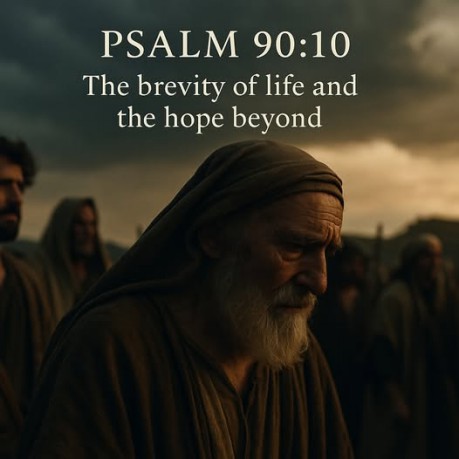
The brevity of life and the hope beyond
The days of our years are threescore years and
ten, and if by reason of strength they be fourscore years, yet is
their strength labour and sorrow, for it is soon cut off, and we
fly away.
Seventy or eighty years may sound long, but in
truth it is but a vapor. James 4:14 reminds us, What is your life?
You are just a vapor that appears for a little while and then
vanishes away.
Hebrews 9:27 declares, It is appointed for men
to die once, and after this comes judgment. No strength of man can
outlast the decree of God. Death is certain. Philo, the Jewish
philosopher, described life as a stage play swiftly acted, where
the curtain falls before one realizes it has begun (On the Life of
Moses 1.2). This view echoes Moses words, soon cut off, and then we
fly away.
We fly away. These words carry more than
the image of death. They point to the release of the soul, leaving
behind a frail body for the presence of God. Paul says, To be
absent from the body is to be present with the Lord (2 Corinthians
5:8).
Psalm
90:12 gives the answer: So teach us to number our days, that we may
present to You a heart of wisdom. The wise man sees life's brevity
and orders his days in righteousness.
Life
is seventy or eighty years at best, and even then it is full of
labor and sorrow. Soon it is cut off, and we fly away. But for the
believer in Christ, this flying away is not to despair, but to
eternal joy in the presence of God.
†
Josephus, Wars of the Jews 4.8.4
† Numbers
14:29-34
† Philo, On the Life of Moses
1.2
† 1 Clement 17
†
Chrysostom, Homily on Matthew 7
†
Augustine, City of God 19.10
† Tertullian,
On the Resurrection of the Flesh 43
†
Eusebius, Ecclesiastical History 5.1
Links