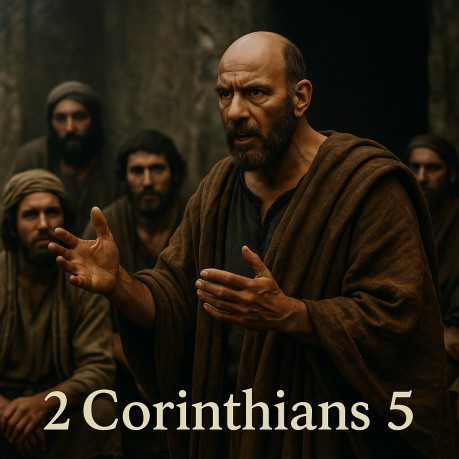
2 Corinthians 5 2 Corinthians 5:1 † Paul contrasts the temporary body with the
eternal dwelling from God. 2 Corinthians 5:2-3 † Believers long for transformation, not
disembodiment. 2 Corinthians 5:4 † The goal is not the loss of the body but
transformation into life. 2 Corinthians 5:5 † The Spirit guarantees the transformation to
come. 2 Corinthians 5:6-7 † Life in the body is marked by faith, not
sight. 2 Corinthians 5:8 † Paul's desire is for full communion with the
Lord, beyond mortal limitations. 2 Corinthians 5:9-10 † Pleasing Christ is the aim of life and
death. 2 Corinthians 5:11 † Ministry is driven by reverence for the
Lord. 2 Corinthians 5:12-13 † Paul defends his ministry against superficial
judgments. 2 Corinthians 5:14-15 † The cross redefines life, all have died in
Christ. 2 Corinthians 5:16-17 † Paul insists on a spiritual view, not a
fleshly one. 2 Corinthians 5:18-19 † Reconciliation is God's work through
Christ. 2 Corinthians 5:20 † Believers serve as Christ's ambassadors,
speaking His appeal to the world. 2 Corinthians 5:21 † The heart of the gospel: Christ bore sin for
us, we receive His righteousness. How it applies to us today † This is the fulfilled perspective we proclaim at
Fulfilled Prophecies † Source Index
By Dan Maines
For we know that if our
earthly tent, which is our house, is torn down, we have a building
from God, a house not made by hands, eternal in the heavens.
† The "tent"
points to mortality, while the "building" points to the
resurrection life in Christ.
† Philo (On the
Migration of Abraham 18) described the body as a tent, aligning with
Paul's imagery.
For indeed, in this
house we groan, longing to be clothed with our dwelling from heaven,
since in fact after putting it on, we will not be found naked.
† Nakedness represents shame,
but being clothed with the heavenly dwelling shows completeness.
For indeed, we who are in
this tent groan, being burdened, because we do not want to be
unclothed but to be clothed, so that what is mortal will be swallowed
up by life.
† Mortality is
absorbed into immortality.
† Isaiah 25:8
foretold, "He will swallow up death for all time," which
Paul echoes here.
Now He who prepared us for
this very purpose is God, who gave us the Spirit as a pledge.
† Believers already have the down
payment of glory within.
Therefore, being always
of good courage, and knowing that while we are at home in the body we
are absent from the Lord, for we walk by faith, not by sight.
† Full fellowship with the Lord
belongs to the new creation.
† Clement of
Rome (1 Clement 50) exhorted believers to live by faith until the
final appearing of the Lord.
But we are of good courage
and prefer rather to be absent from the body and to be at home with
the Lord.
† Death for
the believer is not defeat but presence with Christ.
Therefore we also have
as our ambition, whether at home or absent, to be pleasing to Him.
For we must all appear before the judgment seat of Christ, so that
each one may receive compensation for his deeds done through the
body, in accordance with what he has done, whether good or bad.
† Judgment is certain for all, based
on deeds done in the body.
† Josephus
(Antiquities 18.1.3) recorded Jewish belief in accountability after
death, aligning with Paul's teaching.
Therefore, knowing the
fear of the Lord, we persuade people, but we are revealed to God, and
I hope that we are revealed also in your consciences.
† Paul's sincerity is known to God and
should be evident to believers.
We are not commending
ourselves to you again, but are giving you an opportunity to be proud
of us, so that you will have an answer for those who take pride in
appearance and not in heart. For if we have lost our minds, it is for
God; if we are of sound mind, it is for you.
† His devotion, even when
misunderstood, is for God and the church.
For the love of Christ
controls us, having concluded this, that one died for all, therefore
all died, and He died for all, so that those who live would no longer
live for themselves, but for Him who died and rose on their behalf.
† Believers live for Him who died and
rose again.
† Ignatius (Letter to the
Smyrnaeans 4) affirmed living only for Christ who died and rose.
Therefore from now on
we recognize no one by the flesh; even though we have known Christ by
the flesh, yet now we know Him in this way no longer. Therefore if
anyone is in Christ, this person is a new creation; the old things
passed away, behold, new things have come.
† In Christ, new creation has
come, old things are gone.
† Justin Martyr
(Dialogue with Trypho 116) declared believers as the new people of
God, fulfilling this truth.
Now all these things
are from God, who reconciled us to Himself through Christ and gave us
the ministry of reconciliation, namely, that God was in Christ
reconciling the world to Himself, not counting their wrongdoings
against them, and He has committed to us the word of reconciliation.
† Believers are entrusted with the
ministry of reconciliation.
Therefore, we are
ambassadors for Christ, as though God were making an appeal through
us; we beg you on behalf of Christ, be reconciled to God.
† The
church carries the message of reconciliation.
He made Him who knew no
sin to be sin in our behalf, so that we might become the
righteousness of God in Him.
†
Athanasius (On the Incarnation 20) explained Christ taking our sin so
we might share His righteousness.
†
2 Corinthians 5 proclaims the hope of transformation, the certainty
of judgment, and the ministry of reconciliation.
†
In the fulfilled kingdom, believers are a new creation, clothed in
Christ's righteousness.
† Our calling is to
live as ambassadors, urging all to be reconciled to God.
†
We live not for ourselves but for Christ who died and rose for us.
† Philo, On
the Migration of Abraham 18 - the body as a tent
†
Isaiah 25:8 - death swallowed up in victory
†
Clement of Rome, 1 Clement 50 - living by faith
†
Josephus, Antiquities 18.1.3 - accountability after death
†
Ignatius, Letter to the Smyrnaeans 4 - living for Christ who rose
†
Justin Martyr, Dialogue with Trypho 116 - believers as the new people
of God
† Athanasius, On the Incarnation 20 -
Christ bearing sin, giving righteousness
Links