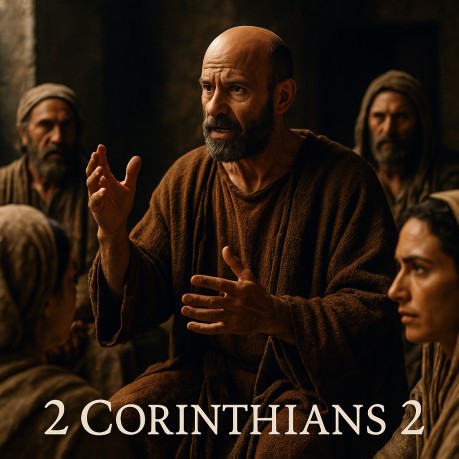
2 Corinthians 2 2 Corinthians 2:1-2 † Paul delayed his visit to avoid causing more
grief. His desire was to bring joy, not sadness. 2 Corinthians 2:3-4 † Paul's severe letter came from deep love and
anguish, not from anger. 2 Corinthians 2:5-7 † Discipline had its effect, but now the
offender needed forgiveness and restoration. 2 Corinthians 2:8-9 † Forgiveness is a test of obedience to
Christ. 2 Corinthians 2:10-11 † Forgiveness removes opportunity for Satan to
divide and destroy. 2 Corinthians 2:12-13 † Even with an open door for ministry, Paul was
restless because of concern for Titus and the Corinthians. 2 Corinthians 2:14 † Paul describes ministry as a triumphal
procession, spreading the fragrance of Christ. 2 Corinthians 2:15-16 † The message of Christ divides, to some, life,
to others, death. 2 Corinthians 2:17 † Unlike false teachers, Paul ministers with
sincerity before God. How it applies to us today † This is the fulfilled perspective we proclaim at
Fulfilled Prophecies † Source Index
By Dan Maines
But I decided this for
my own sake, that I would not come to you in sorrow again. For if I
cause you sorrow, who then will be the one making me glad but the one
who is made sorrowful by me?
†
Leadership in Christ requires sensitivity, balancing correction with
encouragement.
This is the very thing I
wrote you, so that when I came, I would not have sorrow from those
who ought to make me rejoice, having confidence in you all that my
joy would be the joy of you all. For out of much affliction and
anguish of heart I wrote to you with many tears, not so that you
would be sorrowful, but that you might know the love which I have
especially for you.
† True correction is
rooted in love, even when it causes temporary grief.
†
Clement of Rome (1 Clement 47) recalled Paul's love and hardships,
showing his sincerity toward the Corinthians.
But if anyone has caused
sorrow, he has caused sorrow not for me, but in some degree, in order
not to say too much, for all of you. Sufficient for such a person is
this punishment which was imposed by the majority, so that on the
other hand, you should forgive and comfort him, otherwise such a
person might be overwhelmed by excessive sorrow.
†
Discipline without restoration can crush a repentant heart.
†
The early church fathers, like Tertullian (On Modesty 13), stressed
the importance of restoration after repentance.
Therefore I urge you to
reaffirm your love for him. For to this end I also wrote, so that I
might put you to the test, whether you are obedient in all things.
† Love must be reaffirmed, not
withheld.
But one whom you
forgive anything, I also forgive, for indeed what I have forgiven, if
I have forgiven anything, I did so for your sakes in the presence of
Christ, so that no advantage would be taken of us by Satan, for we
are not ignorant of his schemes.
† Unforgiveness is one of
Satan's schemes against the church.
† Origen
(Homilies on Leviticus 16.10) connected unforgiveness with spiritual
bondage, aligning with Paul's warning.
Now when I came to
Troas for the gospel of Christ and when a door was opened for me in
the Lord, I had no rest for my spirit, not finding Titus my brother,
but saying goodbye to them, I went on to Macedonia.
†
Ministry fruitfulness is tied to genuine concern for people, not just
opportunities.
But thanks be to God, who
always leads us in triumph in Christ, and through us reveals the
fragrance of the knowledge of Him in every place.
†
Triumph is not in worldly victory but in the knowledge of Christ
spreading through all nations.
† Josephus
(Wars 7.5.4) recorded Roman triumphal processions, imagery Paul
transforms for Christ's victory.
For we are a fragrance
of Christ to God among those who are being saved and among those who
are perishing, to the one an aroma from death to death, to the other
an aroma from life to life. And who is adequate for these things?
† Paul humbly admits no one
is adequate apart from God's power.
†
Ignatius (Letter to the Ephesians 8) spoke of believers as the
fragrance of Christ in a world of corruption.
For we are not like the
many, acting deceitfully with the word of God, but as from sincerity,
but as from God, we speak in Christ in the sight of God.
† His words are not for
profit but for truth in Christ.
† Eusebius
(Ecclesiastical History 2.25) noted Paul's unmatched sincerity
compared to false apostles.
†
2 Corinthians 2 shows the importance of forgiveness and restoration
within the body of Christ.
† Satan seeks
advantage where unforgiveness remains, but grace destroys his
schemes.
† Ministry is a triumphal procession
in Christ, not worldly glory.
† We are the
fragrance of Christ, bringing life to some and exposing death to
others.
† Clement of
Rome, 1 Clement 47 - Paul's love and hardships with Corinth
†
Tertullian, On Modesty 13 - restoration after repentance
†
Origen, Homilies on Leviticus 16.10 - unforgiveness as bondage
†
Josephus, Wars 7.5.4 - Roman triumph imagery
†
Ignatius, Letter to the Ephesians 8 - fragrance of Christ
†
Eusebius, Ecclesiastical History 2.25 - Paul's sincerity against
false apostles
Links