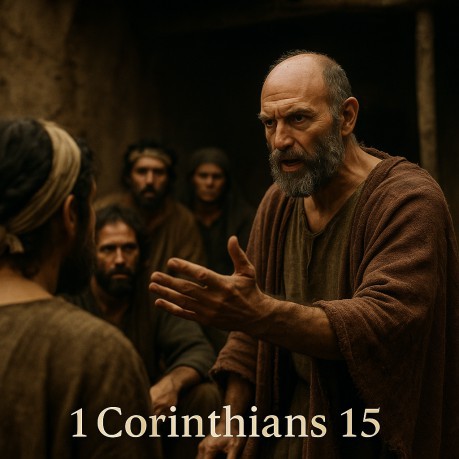
1 Corinthians 15 1 Corinthians 15:1-2 † Paul begins with the foundation, the gospel
itself. 1 Corinthians 15:3-4 † The gospel is centered on Christ's death,
burial, and resurrection. 1 Corinthians 15:5-8 † The resurrection was verified by eyewitness
testimony. 1 Corinthians 15:9-11 † Paul magnifies God's grace in his
apostleship. 1 Corinthians 15:12-14 † Denying the resurrection undermines the
gospel itself. 1 Corinthians 15:15-19 † Without resurrection, faith collapses, sins
remain, and hope is lost. 1 Corinthians 15:20-22 † Christ's resurrection is the guarantee of the
resurrection of His people. 1 Corinthians 15:23-24 † The resurrection is ordered: Christ, then His
people at His coming, then the consummation. 1 Corinthians 15:25-26 † Christ reigns now, subduing His enemies. 1 Corinthians 15:27-28 † Paul emphasizes God's final victory and
unity. 1 Corinthians 15:29 † The obscure practice of baptism for the dead
made no sense without resurrection. 1 Corinthians 15:30-32 † Paul's constant suffering makes sense only if
the resurrection is true. 1 Corinthians 15:33-34 † False teaching leads to corrupt living. 1 Corinthians 15:35-38 † Paul explains resurrection through the
metaphor of sowing seed. 1 Corinthians 15:39-41 † Diversity in creation illustrates God's power
to provide new, glorious bodies. 1 Corinthians 15:42-44 † The resurrection body is transformed,
imperishable, glorious, and spiritual. 1 Corinthians 15:45-49 † Adam brought natural life, Christ gives
spiritual life. 1 Corinthians 15:50-53 † Paul reveals the mystery of transformation. 1 Corinthians 15:54-57 † Paul quotes Isaiah 25:8 and Hosea 13:14 to
proclaim death's defeat. 1 Corinthians 15:58 † Paul concludes with exhortation: stand firm,
labor faithfully, because resurrection guarantees victory. How it applies to us today † This is the fulfilled perspective we proclaim at
Fulfilled Prophecies † Source Index
By Dan Maines
Now I make known to
you, brothers and sisters, the gospel which I preached to you, which
you also received, in which you also stand, by which you also are
saved, if you hold firmly to the word which I preached to you, unless
you believed in vain.
† Salvation is tied to holding fast
to what was preached, not wavering.
For I handed down to
you as of first importance what I also received, that Christ died for
our sins according to the Scriptures, and that He was buried, and
that He was raised on the third day according to the Scriptures.
† This was foretold
in the Hebrew Scriptures (Isaiah 53, Psalm 16).
†
Justin Martyr (Dialogue with Trypho 97) argued that the prophets
foretold the resurrection on the third day.
And that He appeared to
Cephas, then to the twelve. After that He appeared to more than five
hundred brothers and sisters at one time, most of whom remain until
now, but some have fallen asleep. Then He appeared to James, then to
all the apostles, and last of all, as to one untimely born, He
appeared to me also.
† Paul includes himself as the
final witness of the risen Christ.
† Clement
of Rome (1 Clement 42) upheld the apostolic witness as trustworthy.
For I am the least of
the apostles, and not fit to be called an apostle, because I
persecuted the church of God. But by the grace of God I am what I am,
and His grace toward me did not prove vain, but I labored even more
than all of them, yet not I, but the grace of God with me. Whether
then it was I or they, so we preach, and so you believed.
† The message was the same,
whether preached by Paul or the others.
Now if Christ is
preached, that He has been raised from the dead, how do some among
you say that there is no resurrection of the dead? But if there is no
resurrection of the dead, then not even Christ has been raised, and
if Christ has not been raised, then our preaching is in vain, your
faith also is in vain.
† The resurrection of Christ
and of the dead are inseparably connected.
Moreover, we are even
found to be false witnesses of God, because we testified against God
that He raised Christ, whom He did not raise, if in fact the dead are
not raised. For if the dead are not raised, then not even Christ has
been raised, and if Christ has not been raised, your faith is
worthless, you are still in your sins. Then also those who have
fallen asleep in Christ have perished. If we have hoped in Christ
only in this life, we are of all people most to be pitied.
† The apostles
would be false witnesses if the resurrection were not true.
But the fact is,
Christ has been raised from the dead, the first fruits of those who
are asleep. For since by a man death came, by a man also came the
resurrection of the dead. For as in Adam all die, so also in Christ
all will be made alive.
† Adam brought
death, Christ brought life.
† Irenaeus
(Against Heresies 5.12.3) saw Christ as the new Adam reversing the
curse.
But each in his own
order: Christ the first fruits, after that those who are Christ's at
His coming, then comes the end, when He hands over the kingdom to our
God and Father, when He has abolished all rule and all authority and
power.
†
Christ's kingdom culminates in victory over all opposing powers.
For He must reign
until He has put all His enemies under His feet. The last enemy that
will be abolished is death.
†
Death, the last enemy, was defeated through His resurrection.
For He has put all
things in subjection under His feet. But when He says, "All
things are put in subjection," it is clear that this excludes
the One who put all things in subjection to Him. When all things are
subjected to Him, then the Son Himself also will be subjected to the
One who subjected all things to Him, so that God may be all in all.
† Subjection points to the Son's
perfect obedience and the Father's all-in-all glory.
For otherwise, what will
those do who are baptized for the dead? If the dead are not raised at
all, why then are they baptized for them?
† Paul
appeals to their actions as evidence that they acknowledged
resurrection.
Why are we also in
danger every hour? I affirm, brothers and sisters, by the boasting in
you which I have in Christ Jesus our Lord, I die daily. If from human
motives I fought with wild animals at Ephesus, what good is it to me?
If the dead are not raised, let's eat and drink, for tomorrow we die.
† Without
resurrection, hedonism would be the only logical response.
†
Tacitus (Annals 15.44) described Christians enduring persecution,
confirming Paul's reality of danger.
Do not be deceived:
"Bad company corrupts good morals." Sober up morally and
stop sinning, for some have no knowledge of God. I say this to your
shame.
†
Knowledge of God leads to righteousness.
But someone will say,
"How are the dead raised? And with what kind of body do they
come?" You fool! That which you sow does not come to life unless
it dies, and that which you sow, you do not sow the body which is to
be, but a bare grain, perhaps of wheat or something else. But God
gives it a body just as He wished, and to each of the seeds a body of
its own.
† The new body is
given by God's design, not identical to the old.
All flesh is not the
same flesh, but there is one flesh of mankind, another flesh of
animals, another of birds, and another of fish. There are also
heavenly bodies and earthly bodies, but the glory of the heavenly is
one, and the glory of the earthly is another. There is one glory of
the sun, another glory of the moon, and another glory of the stars,
for star differs from star in glory.
So also is the
resurrection of the dead. It is sown a perishable body, it is raised
an imperishable body, it is sown in dishonor, it is raised in glory,
it is sown in weakness, it is raised in power, it is sown a natural
body, it is raised a spiritual body. If there is a natural body,
there is also a spiritual body.
† Paul
contrasts corruption with incorruption, weakness with power.
So also it is
written: "The first man, Adam, became a living person." The
last Adam was a life-giving spirit. However, the spiritual is not
first, but the natural, then the spiritual. The first man is from the
earth, earthy, the second man is from heaven. As is the earthy one,
so also are those who are earthy, and as is the heavenly One, so also
are those who are heavenly. Just as we have borne the image of the
earthy, we will also bear the image of the heavenly.
† Believers are transformed
into His heavenly image.
Now I say this,
brothers and sisters, that flesh and blood cannot inherit the kingdom
of God, nor does the perishable inherit the imperishable. Behold, I
am telling you a mystery, we will not all sleep, but we will all be
changed, in a moment, in the twinkling of an eye, at the last
trumpet, for the trumpet will sound, and the dead will be raised
imperishable, and we will be changed. For this perishable must put on
the imperishable, and this mortal must put on immortality.
†
The living and the dead are changed together at the resurrection.
†
Josephus (Wars 6.299) wrote of signs and portents at Jerusalem's
fall, connecting to the trumpet imagery.
But when this
perishable puts on the imperishable, and this mortal puts on
immortality, then will come about the saying that is written: "Death
has been swallowed up in victory. Where, O Death, is your victory?
Where, O Death, is your sting?" The sting of death is sin, and
the power of sin is the Law, but thanks be to God, who gives us the
victory through our Lord Jesus Christ.
† Christ's
resurrection removes sin's sting and the Law's condemnation.
Therefore, my beloved
brothers and sisters, be firm, immovable, always excelling in the
work of the Lord, knowing that your labor is not in vain in the Lord.
†
1 Corinthians 15 establishes the resurrection as central to the
gospel.
† Christ's resurrection guarantees
the resurrection of His people.
† Death is
defeated, hope is secure, and labor in the Lord is never wasted.
† Justin
Martyr, Dialogue with Trypho 97 - resurrection foretold
†
Clement of Rome, 1 Clement 42 - apostolic witness upheld
†
Irenaeus, Against Heresies 5.12.3 - Christ as the new Adam
†
Tacitus, Annals 15.44 - Christians enduring persecution
†
Josephus, Wars 6.299 - trumpet signs at Jerusalem's fall
†
Isaiah 25:8, Hosea 13:14 - death swallowed up in victory
Links