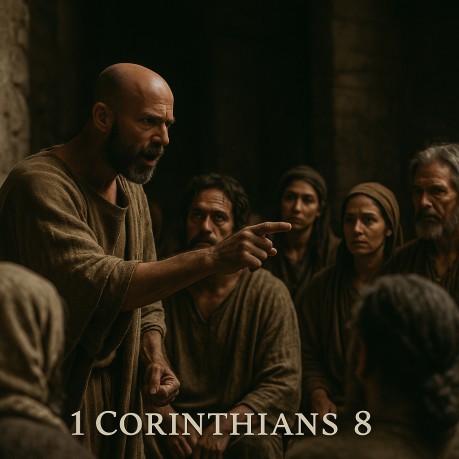
1 Corinthians 8 1 Corinthians 8:1 † Paul acknowledges their knowledge about idols
being nothing, but warns that knowledge alone can lead to
arrogance. 1 Corinthians 8:2-3 † True knowledge is humble and grounded in love
for God. 1 Corinthians 8:4-6 † Idols are powerless, mere creations of men. 1 Corinthians 8:7 † Some believers still struggled with their old
associations with idolatry. 1 Corinthians 8:8 † Food is spiritually neutral. 1 Corinthians 8:9-10 † Knowledge without love endangers weaker
believers. 1 Corinthians 8:11-12 † To wound a brother or sister in Christ is to
sin against Christ Himself. 1 Corinthians 8:13 † Paul's example shows the supremacy of love
over liberty. How it applies to us today † This is the fulfilled perspective we proclaim at
Fulfilled Prophecies † Source Index
By Dan Maines
Now concerning food
sacrificed to idols, we know that we all have knowledge. Knowledge
makes one conceited, but love edifies people.
† Love, not prideful knowledge, is
the true foundation of Christian living.
†
Clement of Rome (1 Clement 49) warned that knowledge puffs up, but
love builds up, echoing Paul's words.
If anyone thinks that he
knows anything, he has not yet known as he ought to know, but if
anyone loves God, he is known by Him.
† Being known by God is greater than
mere intellectual understanding.
Therefore, concerning
the eating of food sacrificed to idols, we know that an idol is
nothing at all in the world, and that there is no God but one. For
even if there are so-called gods whether in heaven or on earth, as
indeed there are many gods and many lords, yet for us there is only
one God, the Father, from whom are all things, and we exist for Him,
and one Lord, Jesus Christ, by whom are all things, and we exist
through Him.
†
Believers confess one God, the Father, and one Lord, Jesus Christ.
†
This confession separates Christians from the idolatrous world.
†
Philo (On the Decalogue 65) argued strongly for monotheism against
the many gods of the nations.
However, not all people
have this knowledge, but some, being accustomed to the idol until
now, eat food as if it were sacrificed to an idol, and their
conscience, being weak, is defiled.
† Their
conscience was weak, and eating such food troubled their faith.
But food will not bring us
closer to God, we are neither the worse if we do not eat, nor the
better if we do eat.
†
What matters is the heart of faith and love.
But take care that this
freedom of yours does not somehow become a stumbling block to the
weak. For if someone sees you, the one who has knowledge, dining in
an idol's temple, will his conscience, if he is weak, not be
strengthened to eat things sacrificed to idols?
† Christian liberty must never be
used to harm another's faith.
For through your
knowledge the one who is weak is ruined, the brother or sister for
whose sake Christ died. And so, by sinning against the brothers and
sisters and wounding their conscience when it is weak, you sin
against Christ.
† The cross
elevates the value of every believer, especially the weak.
Therefore, if food causes
my brother to sin, I will never eat meat again, so that I will not
cause my brother to sin.
† The welfare of others must
govern the believer's choices.
†
1 Corinthians 8 teaches that love must govern knowledge.
†
Liberty must be exercised with responsibility, never causing a weaker
believer to stumble.
† True maturity lays
down personal rights for the sake of others.
†
Being known by God is greater than any knowledge we possess.
† Clement of
Rome, 1 Clement 49 - knowledge puffs up, love builds up
†
Philo, On the Decalogue 65 - monotheism against many gods
Links