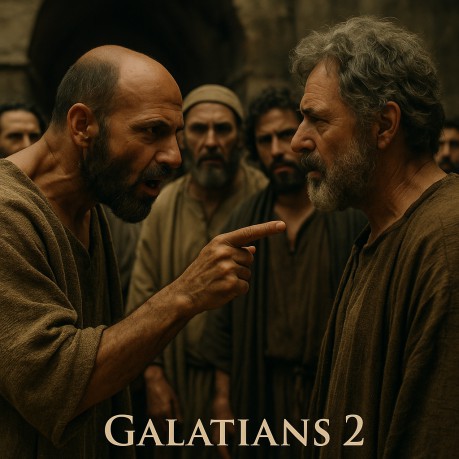
Galatians 2 Galatians 2:1-2 † Paul emphasizes that his journey was by
revelation, not human command. Galatians 2:3-5 † Titus was not forced to be circumcised,
confirming freedom from the Law. Galatians 2:6 † Paul stresses equality before God, not rank
or reputation. Galatians 2:7-9 † Paul's ministry to the Gentiles was affirmed
by the Jerusalem apostles. Galatians 2:10 † Care for the poor remained central to
apostolic mission. Galatians 2:11-12 † Paul publicly opposed Peter for hypocrisy. Galatians 2:13 † Peter's compromise influenced others, even
Barnabas. Galatians 2:14 † Paul exposed hypocrisy publicly because it
was public. Galatians 2:15-16 † Justification is by faith in Christ, not by
Law. Galatians 2:17-18 † Paul rejects the idea that grace promotes
sin. Galatians 2:19-20 † The believer dies to the Law to live to
God. Galatians 2:21 † To seek righteousness by the Law denies the
necessity of Christ's death. How it applies to us today † This is the fulfilled perspective we proclaim at
Fulfilled Prophecies † Source Index
By Dan Maines
Then after an interval of
fourteen years I went up again to Jerusalem with Barnabas, taking
Titus along also. It was because of a revelation that I went up, and
I submitted to them the gospel which I preach among the Gentiles, but
I did so in private to those who were of reputation, for fear that
somehow I might be running, or had run, in vain.
† Titus, a
Greek, became a living test case of the gospel's freedom from the
Law.
† Josephus (Antiquities 20.2.3)
described divisions among Jewish leaders, showing why Paul carefully
presented his gospel privately to avoid immediate conflict.
But not even Titus, who was
with me, though he was a Greek, was compelled to be circumcised. Yet
it was a concern because of the false brothers secretly brought in,
who had sneaked in to spy on our freedom which we have in Christ
Jesus, in order to enslave us. But we did not yield in subjection to
them, even for an hour, so that the truth of the gospel would remain
with you.
† False
brothers sought to enslave believers under the Law, but Paul stood
firm.
† The Dead Sea Scrolls (CD 6.14-19)
spoke of infiltrators corrupting the covenant, parallel to Paul's
warning about false brothers.
But from those who were of
considerable reputation (what they were makes no difference to me,
God shows no favoritism) — well, those who were of reputation
contributed nothing to me.
† Even the pillars in
Jerusalem added nothing to Paul's gospel, confirming it came directly
from Christ.
† Clement of Rome (1 Clement 37)
emphasized God shows no favoritism in choosing servants.
But on the contrary, seeing
that I had been entrusted with the gospel to the uncircumcised, just
as Peter had been to the circumcised (for He who was at work for
Peter in his apostleship to the circumcised was at work for me also
to the Gentiles), and recognizing the grace that had been given to
me, James, Cephas, and John, who were reputed to be pillars, gave me
and Barnabas the right hand of fellowship, so that we might go to the
Gentiles and they to the circumcised.
† There is one
gospel, but distinct missions.
† Ignatius
(Letter to the Smyrnaeans 7) highlighted unity among the apostles
despite diverse missions.
They only asked us to
remember the poor, the very thing I also was eager to do.
† Acts 11:29-30 records
Paul's eagerness to help famine-stricken believers.
But when Cephas came to
Antioch, I opposed him to his face, because he stood condemned. For
prior to the coming of certain men from James, he used to eat with
the Gentiles, but when they came, he began to withdraw and separate
himself, fearing those from the circumcision.
†
The fear of man corrupted fellowship in the gospel.
†
Josephus (Wars 2.17.2) described fear of pressure groups among Jews,
similar to Peter's wavering.
The rest of the Jews joined
him in hypocrisy, with the result that even Barnabas was carried away
by their hypocrisy.
† Hypocrisy spreads quickly when
leaders stumble.
But when I saw that they were
not straightforward about the truth of the gospel, I said to Cephas
in the presence of all, "If you, being a Jew, live like the
Gentiles and not like the Jews, how is it that you compel the
Gentiles to live like Jews?"
† The gospel truth demanded
correction, even among apostles.
† Tertullian
(Against Marcion 1.20) cited this event as proof of Paul's authority
and integrity.
We are Jews by nature and
not sinners from the Gentiles, nevertheless, knowing that a person is
not justified by works of the Law but through faith in Christ Jesus,
even we have believed in Christ Jesus, so that we may be justified by
faith in Christ and not by works of the Law, since by works of the
Law no flesh will be justified.
† This is the heart of Paul's gospel
message.
† Philo (On Abraham 270) noted
righteousness was credited by faith before the Law, supporting Paul's
teaching.
But if, while seeking to
be justified in Christ, we ourselves have also been found sinners, is
Christ then a servant of sin? Far from it! For if I rebuild what I
have once destroyed, I prove myself to be a wrongdoer.
† Returning to the Law after receiving
Christ makes one a transgressor.
For through the Law I died
to the Law, so that I might live for God. I have been crucified with
Christ, and it is no longer I who live, but Christ lives in me, and
the life which I now live in the flesh I live by faith in the Son of
God, who loved me and gave Himself up for me.
† Life in Christ means Christ living in
the believer.
† Origen (On Romans 4.8.3)
explained this as the transformation of identity into Christ's life.
I do not nullify the grace of
God, for if righteousness comes through the Law, then Christ died
needlessly.
† Grace is
nullified if the Law still justifies.
†
Augustine (On the Spirit and the Letter 15) affirmed that
righteousness cannot come by the Law but only by grace.
†
Galatians 2 warns against compromising the gospel for tradition or
pressure.
† Justification by faith alone must
never be diluted with human works.
† Courage
like Paul's is needed to confront error, even among leaders.
†
In the fulfilled kingdom, Christ lives in His people, making the Law
obsolete for righteousness.
† Josephus,
Antiquities 20.2.3 - divisions among Jewish leaders
†
Dead Sea Scrolls, CD 6.14-19 - infiltrators corrupting covenant
†
Clement of Rome, 1 Clement 37 - God shows no favoritism
†
Ignatius, Letter to the Smyrnaeans 7 - unity among apostles
†
Josephus, Wars 2.17.2 - fear of pressure groups among Jews
†
Tertullian, Against Marcion 1.20 - Paul's integrity in rebuke
†
Philo, On Abraham 270 - righteousness by faith before Law
†
Origen, On Romans 4.8.3 - transformation into Christ's life
†
Augustine, On the Spirit and the Letter 15 - grace not Law for
righteousness
Links