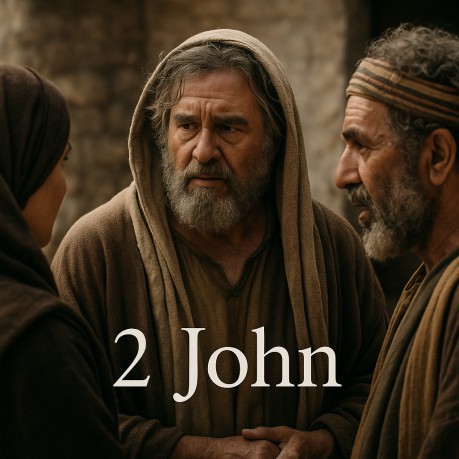
2 John 2 John 1 † John writes as "the elder," showing
his pastoral authority. 2 John 2-3 † John anchors his blessing in eternal truth. 2 John 4 † John rejoices when believers walk faithfully
in the truth. 2 John 5-6 † The command to love is central, old yet
always new. 2 John 7 † The danger was active in John's day: false
teachers denied Christ's incarnation. 2 John 8 † Believers must remain vigilant, not
forfeiting the reward through deception. 2 John 9 † Progress beyond Christ's teaching is
apostasy, not advancement. 2 John 10-11 † Hospitality must not extend to false
teachers. 2 John 12-13 † John longs for face-to-face fellowship, not
just written words. How it applies to us today † This is the fulfilled perspective we proclaim at
Fulfilled Prophecies † Source Index
By Dan Maines
The elder, to the chosen lady and
her children, whom I love in truth; and not only I, but also all who
know the truth.
† The "chosen
lady and her children" likely refers to a local church and its
members.
† Clement of Rome (1 Clement 1) also
addressed the whole church in familial terms, showing this was common
language.
Because of the truth which
remains in us and will be with us forever: Grace, mercy, and peace
will be with us, from God the Father and from Jesus Christ, the Son
of the Father, in truth and love.
†
Grace, mercy, and peace are covenant gifts that flow through
Christ.
† Ignatius (Letter to the Trallians
3) also emphasized truth and love as the mark of the church.
I was overjoyed to find some of
your children walking in truth, just as we received commandment to do
from the Father.
† Faithfulness to the Father's
commandment proves genuine discipleship.
†
Josephus (Antiquities 4.6.12) noted how obedience to God's commands
defined Israel's covenant standing, which John now applies to the
church.
Now I ask you, lady, not as
though I were writing to you a new commandment, but the one which we
have had from the beginning, that we love one another. And this is
love, that we walk according to His commandments. This is the
commandment, just as you have heard from the beginning, that you are
to walk in it.
† Love is defined by obedience to
God's commands, not by feelings alone.
†
Clement of Rome (1 Clement 49) declared that love fulfills the law
and unites the church.
For many deceivers have gone out
into the world, those who do not acknowledge Jesus Christ as coming
in the flesh. This is the deceiver and the antichrist.
†
Denying the flesh of Christ was the mark of antichrist.
†
Ignatius (Letter to the Smyrnaeans 5) directly opposed these
heresies, affirming Christ's real flesh.
Watch yourselves, that you do not
lose what we have accomplished, but that you may receive a full
reward.
†
Faithfulness secures the full inheritance.
Anyone who goes too far and does
not remain in the teaching of Christ, does not have God; the one who
remains in the teaching has both the Father and the Son.
† True knowledge
of God is bound to Christ's teaching.
†
Irenaeus (Against Heresies 3.24.1) condemned those who claimed hidden
teachings beyond the apostles.
If anyone comes to you and does
not bring this teaching, do not receive him into your house, and do
not give him a greeting; for the one who gives him a greeting
participates in his evil deeds.
† To support them is to share in
their error.
† The Didache (ch. 11)
instructed churches not to welcome false prophets, paralleling John's
command.
Though I have many things to
write to you, I do not want to do so with paper and ink; but I hope
to come to you and speak face to face, so that your joy may be made
complete. The children of your chosen sister greet you.
† The chosen sister
likely refers to another church, showing inter-church fellowship.
†
Eusebius (Ecclesiastical History 3.23) recorded how churches
exchanged greetings and letters, echoing John's practice.
†
2 John warns us to love in truth, guarding against deception.
†
The antichrists of John's time denied Christ in the flesh, but the
church must hold firmly to apostolic teaching.
†
Supporting false teachers makes us participants in their evil, so
vigilance remains vital today.
† Josephus,
Antiquities 4.6.12 - obedience defined covenant standing
†
Clement of Rome, 1 Clement 1 - church addressed in family terms
†
Clement of Rome, 1 Clement 49 - love fulfilling the law
†
Ignatius, Letter to the Trallians 3 - truth and love in the church
†
Ignatius, Letter to the Smyrnaeans 5 - Christ's true flesh affirmed
†
Irenaeus, Against Heresies 3.24.1 - false teachers with hidden
doctrines condemned
† The Didache 11 -
warning against welcoming false prophets
†
Eusebius, Ecclesiastical History 3.23 - churches exchanging greetings
Links