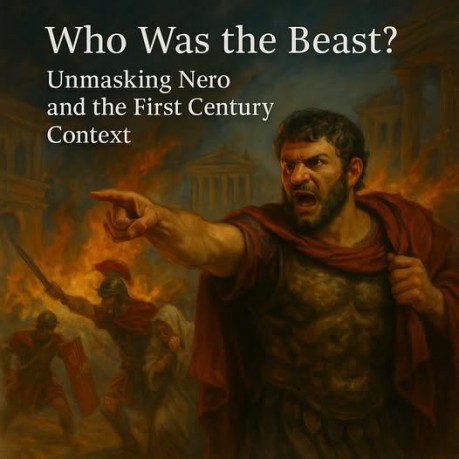
WHO
WAS THE BEAST? - UNMASKING NERO AND THE FIRST CENTURY CONTEXT INTRODUCTION
The
Beast of Revelation has long been a source of confusion and wild
speculation. But scripture gives us clear identifiers. Revelation 13
and 17, when understood alongside Daniel 7 and Roman history, reveal
the Beast as the Roman imperial line that persecuted the early
church. Nero Caesar was the sixth head of this Beast, and after his
death the Beast revived through Vespasian and his son Titus.
Revelation describes a system that regenerates, where one head is
slain but the Beast lives on through succeeding emperors. THE COMPOSITE BEAST – REVELATION 13 AND DANIEL
7
Revelation 13:1-2
"Then I
saw a beast coming up out of the sea, having ten horns and seven
heads, and on his horns were ten crowns, and on his heads were
blasphemous names. And the beast that I saw was like a leopard, and
his feet were like those of a bear, and his mouth like the mouth of
a lion. And the dragon gave him his power and his throne and great
authority." The Beast is described with
features of the beasts in Daniel 7: lion, bear, leopard, Babylon,
Medo-Persia, Greece, showing that this Beast continues the legacy
of empires, specifically Rome. The dragon (Satan) gives the Beast its power and authority
(Revelation 12:9, 13:2). THE SEVEN HEADS – KINGS OF THE ROMAN EMPIRE
Revelation
17:9-10
"Here is the mind which has wisdom. The
seven heads are seven mountains upon which the woman sits, and they
are seven kings; five have fallen, one is, the other has not yet
come; and when he comes, he must remain a short time." The seven heads represent seven
kings. Counting from Julius Caesar:
◦ Julius
◦
Augustus
◦ Tiberius
◦ Caligula
◦ Claudius
◦
Nero (the sixth, who "is" during the writing) "The other has not yet come" is Galba, who reigned
only seven months, "must remain a short time." This aligns with a pre-70 AD
authorship of Revelation. Nero's death is the critical turning
point. THE MORTAL WOUND AND HEALING – THE BEAST
REGENERATES
Revelation 13:3
"I
saw one of his heads as if it had been fatally wounded, and his
fatal wound was healed. And the whole earth was amazed and followed
after the beast." Nero died in AD 68, triggering
the Year of the Four Emperors. Galba, Otho, and Vitellius ruled
briefly. According to Josephus, Wars
4.9.2, Vespasian paused military action after Nero's death:
"But
now Vespasian was in suspense about the affairs at Rome, by reason
of the civil war that was begun. So he permitted the affairs of the
Jews to rest for a while..." (Josephus, Wars 4.9.2) Vespasian took the throne in late
AD 69, reviving the empire.
Josephus, Wars 4.11.5 confirms:
"Now the Romans were greatly divided about who should be their
emperor… and Vespasian at last was declared Caesar." The Beast recovered. The fatal head wound was healed,
symbolizing the restoration of imperial power. Revelation 17:11
"The beast which was
and is not, is himself also an eighth king, and is one of the seven,
and he goes to destruction." Titus, Vespasian's son, is
identified as the eighth king, and "of the seven" by
family and function. Though Titus did not officially become emperor until AD 79,
he exercised Caesar's authority under Vespasian in the destruction
of Jerusalem. Revelation identifies the eighth king as coming from
among the seven, not necessarily reigning immediately but
continuing their work. TITUS AND THE WAR AGAINST THE SAINTS Vespasian was commissioned by
Nero to crush the Jewish revolt in AD 66.
Josephus, Wars
3.1.1: "Now Nero was informed that the affairs of Galilee were
in a bad condition… so he sent Vespasian... to correct what was
amiss." After Nero's death, Vespasian
delayed, awaiting the political outcome in Rome. Titus, during this pause, held
the siege lines outside Jerusalem and later finished the assault. Josephus, Wars 6.10.1:
"Titus
retired into the tower of Antonia... and gave orders to set fire to
the gates. Then they came into the temple and burnt it down..." Titus destroyed Jerusalem in AD
70, fulfilling Luke 21:20-24 and Matthew 24:2. Titus was not emperor at the time, but he acted under
Vespasian's imperial authority and completed what began under Nero.
He thus fits Revelation's description of the eighth king who is "of
the seven." THE HARLOT CITY BURNED BY THE BEAST
Revelation
17:16-17
"And the ten horns which you saw, and
the beast, these will hate the prostitute and will make her desolate
and naked, and will eat her flesh and will burn her up with fire.
For God has put it in their hearts to execute His purpose." The Beast and its allies burn the
harlot, Old Covenant Jerusalem. Titus commanded the burning of
the temple and the city, carrying out divine judgment. This fulfilled Jesus' words in Matthew 22:7: "But the
king was enraged, and he sent his armies and destroyed those
murderers and set their city on fire." THE NUMBER OF THE BEAST – 666
Revelation
13:18
"Here is wisdom. Let him who has
understanding calculate the number of the beast, for the number is
that of a man, and his number is 666." The Greek spelling "Neron
Kaisar" (נרון קסר)
adds up to 666 in Hebrew gematria. Some early manuscripts say 616,
which matches the Latin spelling "Nero Caesar." This identifies Nero as the sixth king and the archetype of
the Beast. DOMITIAN WAS NOT A HEAD OF THE BEAST Domitian ruled from AD 81–96,
after the destruction of Jerusalem. Domitian was also the son of
Vespasian and the brother of Titus, but he played no role in the
Jewish War or the judgment on Jerusalem. He was not involved in the events
of Revelation or the judgment against the harlot city. Revelation's Beast is tied to the
burning of Jerusalem and the persecution of the saints before AD
70. Titus, not Domitian, fulfilled that role. Titus was of the
same imperial line and completed the work of judgment. ECONOMIC CONTROL AND IMPERIAL WORSHIP
Revelation
13:17
"No one will be able to buy or to sell,
except the one who has the mark, either the name of the beast or the
number of his name." Participation in Roman commerce
often required showing loyalty to Caesar. Imperial coins bore Caesar's
image and inscriptions calling him divine. Refusal to honor Caesar excluded
Christians from trade (Revelation 2:9-10, 3:9). The mark of the Beast represents allegiance to the
persecuting power of Rome. CONCLUSION - THE BEAST IS ROME'S PERSECUTING CAESARS, NOT
A FUTURE DICTATOR The Beast was not just Nero, but
the line of emperors that made war against the saints. Nero was the sixth king who
initiated persecution and war. Galba came briefly. Vespasian revived the empire. Titus finished the destruction of
Jerusalem. The Beast was judged, just as Revelation foretold. Revelation 19:20
"And the beast was
seized, and with him the false prophet... these two were thrown
alive into the lake of fire." The persecuting empire fell. Christ triumphed. The kingdom was established. We are not waiting for a future Beast, we live in the
victory of the Lamb. APPENDIX – SOURCES AND
REFERENCES (if interested) 1. The Beast is a line of kings, not a generic system Revelation 17:10-11 calls the
Beast one of seven kings and also an eighth. These are individual rulers,
emperors of Rome, linked together by imperial succession and
persecution. Revelation 13:1-2 connects this line to Daniel's beasts,
confirming it continues the legacy of pagan empires. 2. The seven heads are Roman Caesars Revelation 17:9-10 List: Julius, Augustus, Tiberius,
Caligula, Claudius, Nero = six Galba = short reign (7th) This matches the timeline prior to the destruction of
Jerusalem. 3. Nero's death = mortal wound; Vespasian = healing Revelation 13:3 Nero died in AD 68; Rome
descended into civil war Vespasian revived the empire in
late AD 69 Josephus, Wars 4.9.2 and 4.11.5 confirm the transition 4. Titus completed the Jewish War under Vespasian's rule Titus was not emperor during the
destruction of Jerusalem in AD 70 He commanded the Roman army under
his father's authority Josephus, Wars 6.10.1 confirms he
led the assault and burned the temple Revelation 17:16-17 describes the Beast (Rome) burning the
prostitute (Jerusalem) 5. The number 666 = Nero Caesar Revelation 13:18 “Neron Kaisar” in Hebrew =
666 “Nero Caesar” in Latin = 616
(seen in variant manuscripts) Supported by early witness: Irenaeus, Against Heresies
5.30.3 6. Domitian was not part of the Beast Domitian ruled from AD 81–96 Jerusalem was already destroyed Revelation's Beast is identified with the destruction of the
harlot city, not later persecution 7. Economic restrictions tied to emperor worship Revelation 13:17 Coins and trade guilds required
allegiance to Caesar Refusal led to exclusion
(Revelation 2:9-10, 3:9) Mark of the Beast = loyalty to the empire, not technology
By Dan Maines
Links