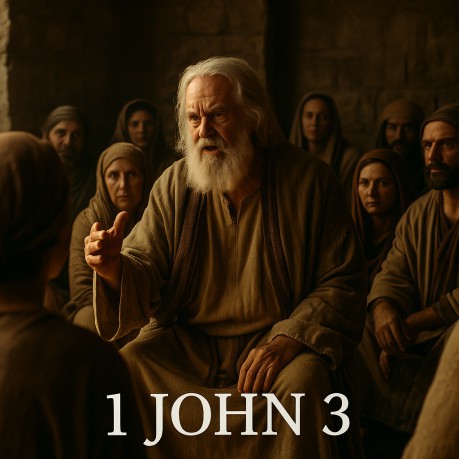
1 John 3 1 John 3:1 † God's love is shown in adopting us as His
children. 1 John 3:2 † Transformation into Christ's likeness was the
promise of His appearing. 1 John 3:3 † Hope in Christ produces holiness, not
lawlessness. 1 John 3:4 † Sin is defined as lawlessness, rebellion
against God's will. 1 John 3:5 † Christ's mission was to remove sin, and His
own sinlessness qualified Him as Savior. 1 John 3:6 † John contrasts abiding in Christ with a
lifestyle of sin. 1 John 3:7 † Righteous conduct proves true
righteousness. 1 John 3:8 † A lifestyle of sin reveals allegiance to the
devil. 1 John 3:9 † New birth changes conduct, for God's seed
abides in the believer. 1 John 3:10 † Conduct divides God's children from the
devil's. 1 John 3:11 † Love is the foundational command, rooted in
Christ's teaching. 1 John 3:12 † Cain is the model of hatred and murder. 1 John 3:13 † Hatred from the world is expected for God's
children. 1 John 3:14 † Love is the evidence of spiritual life. 1 John 3:15 † Hatred equals murder in God's eyes. 1 John 3:16 † Christ's sacrificial death defines true
love. 1 John 3:17 † Love must be practical, expressed in
generosity. 1 John 3:18 † Love is shown in actions, not empty words. 1 John 3:19-20 † Assurance comes from God's knowledge and
mercy, not our own feelings. 1 John 3:21-22 † Confidence in prayer flows from obedience. 1 John 3:23 † Faith in Christ and love for one another sum
up God's commandment. 1 John 3:24 † Obedience is the evidence of abiding in
Christ. How it applies to us today † This is the fulfilled perspective we proclaim at
Fulfilled Prophecies † Source Index
By Dan Maines
See how great a love the Father
has given us, that we would be called children of God, and in fact we
are. For this reason the world does not know us: because it did not
know Him.
† The world rejects believers
because it rejected Christ first.
† Ignatius
(Letter to the Magnesians 8) reminded the church that the world's
hatred proves their identity with Christ.
Beloved, now we are children of
God, and it has not appeared as yet what we will be. We know that
when He appears, we will be like Him, because we will see Him just as
He is.
† To see Him is to
share His glory.
† Irenaeus (Against Heresies
5.36.1) taught that believers' transformation confirmed the hope John
declared.
And everyone who has this hope
set on Him purifies himself, just as He is pure.
† Philo (On the Special Laws
4.133) affirmed that true hope leads to moral purification, aligning
with John.
Everyone who practices sin also
practices lawlessness, and sin is lawlessness.
† Josephus (Wars 4.5.2)
described Jerusalem filled with lawlessness before its fall,
illustrating John's warning.
You know that He appeared in
order to take away sins; and in Him there is no sin.
†
Isaiah 53:9 had foretold His sinless life.
No one who remains in Him sins
continually; no one who sins continually has seen Him or knows Him.
† Sin is incompatible with
truly knowing Christ.
Little children, make sure no one
deceives you; the one who practices righteousness is righteous, just
as He is righteous.
† Deceivers denied that
conduct mattered, but John insists it is essential.
The one who practices sin is of
the devil, for the devil has been sinning from the beginning. The Son
of God appeared for this purpose, to destroy the works of the devil.
† Christ appeared to destroy the
devil's works, fulfilling Genesis 3:15.
†
Justin Martyr (Dialogue with Trypho 45) declared that Christ defeated
the devil's power through His appearing.
No one who has been born of God
practices sin, because His seed remains in him; and he cannot sin
continually, because he has been born of God.
† This seed is the
word and Spirit, producing new life.
By this the children of God and
the children of the devil are obvious: anyone who does not practice
righteousness is not of God, nor the one who does not love his
brother and sister.
† Love and righteousness are the
evidence of true sonship.
For this is the message which
you have heard from the beginning, that we are to love one another.
† Clement of Rome (1
Clement 49) exalted love as the bond of perfection, echoing John.
Not as Cain, who was of the evil
one and murdered his brother. And for what reason did he murder him?
Because his own deeds were evil, but his brother's were righteous.
†
Hatred of the righteous stems from envy and evil deeds.
†
Josephus (Antiquities 1.2.1) recounted Cain's jealousy and murder of
Abel, confirming John's example.
Do not be surprised, brothers
and sisters, if the world hates you.
† Jesus foretold this in John
15:18-19.
We know that we have passed out
of death into life, because we love the brothers and sisters. The one
who does not love remains in death.
†
Absence of love is evidence of death.
Everyone who hates his brother
or sister is a murderer, and you know that no murderer has eternal
life remaining in him.
†
Eternal life cannot abide in the one consumed by hate.
We know love by this, that He
laid down His life for us; and we ought to lay down our lives for the
brothers and sisters.
† Believers are called to the same
sacrificial love.
† Ignatius (Letter to the
Romans 6) urged believers to imitate Christ even unto death.
But whoever has worldly goods
and sees his brother or sister in need, and closes his heart against
him, how does the love of God remain in him?
† To close one's heart to need is
to deny God's love.
† The Dead Sea Scrolls
(Community Rule 1QS 5.2) condemned withholding aid from the needy,
paralleling John.
Little children, let's not love
with word or with tongue, but in deed and truth.
†
Clement of Rome (1 Clement 49) likewise exhorted to love in deed and
truth.
We will know by this that we
are of the truth, and will set our heart at ease before Him, that if
our heart condemns us, that God is greater than our heart, and He
knows all things.
† When
conscience condemns, God's grace is greater.
Beloved, if our heart does
not condemn us, we have confidence before God; and whatever we ask,
we receive from Him, because we keep His commandments and do the
things that are pleasing in His sight.
†
God delights to answer those who walk in His ways.
This is His commandment, that we
believe in the name of His Son Jesus Christ, and love one another,
just as He commanded us.
† These are inseparable
marks of true believers.
The one who keeps His
commandments remains in Him, and He in him. We know by this that He
remains in us, by the Spirit whom He has given us.
† The Spirit is the confirming
witness of this abiding relationship.
†
Eusebius (Ecclesiastical History 3.24) recorded how the Spirit's
presence marked early believers, confirming John's words.
†
1 John 3 shows that love and righteousness mark the children of God,
while hatred and sin mark the children of the devil.
†
Christ's sacrifice defines true love, and our calling is to live out
that same love in action.
† Today, in the
fulfilled kingdom, we live as God's children, walking in light,
truth, and love.
† Josephus,
Antiquities 1.2.1 - Cain's jealousy and murder of Abel
†
Josephus, Wars 4.5.2 - lawlessness in Jerusalem
†
Philo, On the Special Laws 4.133 - hope leads to purity
†
Clement of Rome, 1 Clement 49 - love in deed and truth
†
Ignatius, Letter to the Magnesians 8 - world's hatred of believers
†
Ignatius, Letter to the Romans 6 - imitating Christ in sacrifice
†
Irenaeus, Against Heresies 5.36.1 - transformation into Christ's
likeness
† Justin Martyr, Dialogue with
Trypho 45 - Christ defeated the devil's works
†
Dead Sea Scrolls, 1QS 5.2 - aid for the needy commanded
†
Eusebius, Ecclesiastical History 3.24 - Spirit's presence among
believers
† Isaiah 53:9 - prophecy of
Christ's sinlessness
† Genesis 3:15 - Christ
destroys the devil's works
† John 15:18-19 -
the world's hatred foretold
Links