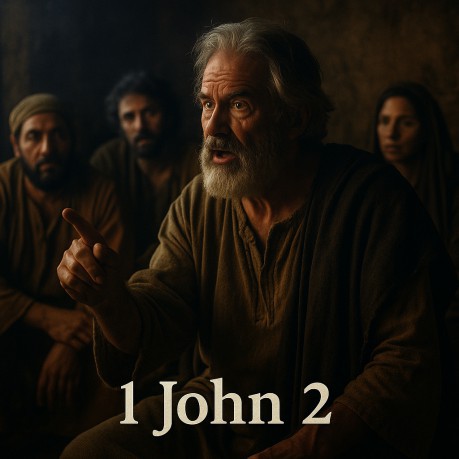
1 John 2 1 John 2:1 † John addresses believers tenderly as "little
children," showing pastoral care. 1 John 2:2 † Christ's sacrifice is sufficient for all, not
limited to a single people. 1 John 2:3-4 † True knowledge of God is proven by
obedience. 1 John 2:5-6 † Obedience proves maturity in love. 1 John 2:7-8 † The command to love is both old and new,
rooted in the law yet renewed in Christ. 1 John 2:9-11 † Hatred contradicts the Light, while love
proves abiding in it. 1 John 2:12-14 † John addresses every stage of faith,
affirming forgiveness, knowledge, and victory. 1 John 2:15-17 † Love for the world excludes love for God. 1 John 2:18-19 † John identifies his own time as the last
hour, marked by the rise of many antichrists. 1 John 2:20-21 † Believers are anointed by the Spirit,
granting knowledge of truth. 1 John 2:22-23 † Antichrist is defined as denying Jesus as the
Christ. 1 John 2:24-25 † Holding fast to the original gospel
guarantees fellowship and eternal life. 1 John 2:26-27 † False teachers sought to deceive, but the
Spirit's anointing preserved believers in truth. 1 John 2:28-29 † Remaining in Christ brings confidence at His
appearing. How it applies to us today † This is the fulfilled perspective we proclaim at
Fulfilled Prophecies † Source Index
By Dan Maines
My little children, I am writing
these things to you so that you may not sin. And if anyone sins, we
have an Advocate with the Father, Jesus Christ the righteous.
†
Christ is our Advocate, a legal defender before the Father.
†
Philo (On the Special Laws 3.12) described advocates in courts,
making John's picture vivid to his audience.
And He Himself is the
propitiation for our sins, and not for ours only, but also for the
sins of the whole world.
† His blood
removed wrath and reconciled us to God.
†
Ignatius (Letter to the Ephesians 18) affirmed that Christ's death
was the ransom for the world.
By this we know that we have
come to know Him, if we keep His commandments. The one who says, "I
have come to know Him," and does not keep His commandments, is a
liar, and the truth is not in him.
† To claim to know God while
disobeying Him is self-deception.
† Josephus
(Antiquities 4.6.12) noted that Israel's disobedience always brought
judgment, confirming John's principle.
But whoever follows His word,
in him the love of God has truly been perfected. By this we know that
we are in Him: the one who says that he remains in Him ought, himself
also, walk just as He walked.
†
To remain in Christ is to imitate His life.
†
Clement of Rome (1 Clement 33) exhorted believers to walk in
holiness, echoing John's teaching.
Beloved, I am not writing a new
commandment to you, but an old commandment which you have had from
the beginning. The old commandment is the word which you have heard.
On the other hand, I am writing a new commandment to you, which is
true in Him and in you, because the darkness is passing away and the
true Light is already shining.
†
Darkness was already passing away in John's generation, showing
fulfillment was near.
† The Dead Sea Scrolls
(1QS 1.9) contrasted light and darkness, imagery John applies to
Christ.
The one who says that he is in
the Light and yet hates his brother or sister is in the darkness
until now. The one who loves his brother and sister remains in the
Light, and there is nothing in him to cause stumbling. But the one
who hates his brother or sister is in the darkness and walks in the
darkness, and does not know where he is going, because the darkness
has blinded his eyes.
† Darkness blinds those
who reject love, just as it blinded Israel's leaders.
†
Josephus (Wars 4.5.2) described Jerusalem's factions destroying one
another in hatred, an example of walking in darkness.
I am writing to you, little
children, because your sins have been forgiven you on account of His
name. I am writing to you, fathers, because you know Him who has been
from the beginning. I am writing to you, young men, because you have
overcome the evil one. I have written to you, children, because you
know the Father. I have written to you, fathers, because you know Him
who has been from the beginning. I have written to you, young men,
because you are strong, and the word of God remains in you, and you
have overcome the evil one.
†
The repetition emphasizes their strength in Christ.
†
Clement of Rome (1 Clement 2) praised the early church for its
strength and knowledge, echoing John's affirmation.
Do not love the world nor the
things in the world. If anyone loves the world, the love of the
Father is not in him. For all that is in the world, the lust of the
flesh, the lust of the eyes, and the boastful pride of life, is not
from the Father, but is from the world. The world is passing away and
also its lusts, but the one who does the will of God continues to
live forever.
†
The world system of lust and pride was passing away in John's time.
†
Tacitus (Histories 5.13) wrote of the collapse of worldly powers,
confirming John's statement.
Children, it is the last
hour, and just as you heard that antichrist is coming, even now many
antichrists have appeared; from this we know that it is the last
hour. They went out from us, but they were not really of us; for if
they were of us, they would have remained with us; but they went out,
so that it would be evident that they all are not of us.
†
These antichrists were former members of the church who abandoned the
truth.
† Irenaeus (Against Heresies 3.7.2)
described heretics who left the church, confirming John's warning.
But you have an anointing
from the Holy One, and you all know. I have not written to you
because you do not know the truth, but because you do know it, and
because no lie is of the truth.
† John writes to
affirm what they already know.
Who is the liar except the
one who denies that Jesus is the Christ? This is the antichrist, the
one who denies the Father and the Son. Whoever denies the Son does
not have the Father; the one who confesses the Son has the Father
also.
† To reject the Son is to reject the
Father.
† Ignatius (Letter to the Trallians
9) condemned those who denied the reality of Christ, echoing John's
definition of antichrist.
As for you, see that what you
heard from the beginning remains in you. If what you heard from the
beginning remains in you, you also will remain in the Son and in the
Father. This is the promise which He Himself made to us: eternal
life.
†
Apostolic teaching, once delivered, cannot be replaced.
These things I have written
to you concerning those who are trying to deceive you. As for you,
the anointing which you received from Him remains in you, and you
have no need for anyone to teach you, but as His anointing teaches
you about all things, and is true and is not a lie, and just as it
has taught you, you remain in Him.
†
The Spirit ensures discernment and perseverance.
†
Clement of Rome (1 Clement 59) prayed that God would preserve the
church in truth, reflecting John's message.
Now, little children, remain
in Him, so that when He appears, we may have confidence and not draw
back from Him in shame at His coming. If you know that He is
righteous, you know that everyone who practices righteousness also
has been born of Him.
† Righteous living is the evidence
of being born of God.
† Eusebius
(Ecclesiastical History 3.23) noted how the early church lived in
expectation of Christ's appearing in their generation, aligning with
John's urgency.
†
1 John 2 reminds us that obedience, love, and fellowship prove true
knowledge of God.
† The antichrists of John's
time revealed the reality of the last hour and the urgency of holding
to Christ.
† Today, we remain in the same
truth, confessing the Son and walking in the Light.
† Josephus,
Antiquities 4.6.12 - disobedience brings judgment
†
Josephus, Wars 4.5.2 - factions in Jerusalem walking in darkness
†
Philo, On the Special Laws 3.12 - advocates in law courts
†
Clement of Rome, 1 Clement 2 - strength of the early church
†
Clement of Rome, 1 Clement 33 - call to holiness
†
Clement of Rome, 1 Clement 46 - unity in fellowship
†
Clement of Rome, 1 Clement 59 - prayer for preservation in truth
†
Ignatius, Letter to the Ephesians 18 - Christ's death as ransom
†
Ignatius, Letter to the Trallians 9 - denial of Christ condemned
†
Irenaeus, Against Heresies 3.7.2 - heretics who left the church
†
Tacitus, Histories 5.13 - collapse of worldly powers
†
Dead Sea Scrolls, 1QS 1.9 - imagery of light and darkness
†
Eusebius, Ecclesiastical History 3.23 - expectation of Christ's
appearing
Links