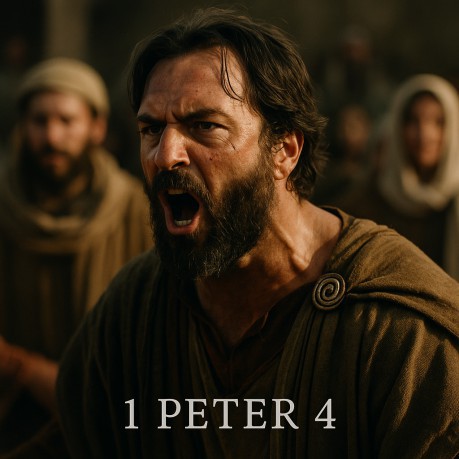
1 Peter 4 1 Peter 4:1-2 † Believers are to imitate Christ's willingness
to suffer, showing that suffering purifies and separates us from
sin. 1 Peter 4:3-4 † Peter reminds them of their former sins,
urging separation from Gentile excesses. 1 Peter 4:5 † Those who mock believers will answer to
Christ, the Judge of all. 1 Peter 4:6 † The gospel reached those who had already
died, showing God's justice and mercy extended even to them. 1 Peter 4:7 † Peter emphasizes the nearness of the end,
referring to the imminent close of the old covenant age and the
destruction of Jerusalem. 1 Peter 4:8 † Love is the greatest command, for it restores
relationships and maintains unity. 1 Peter 4:9 † Hospitality was vital for the scattered
church, especially when persecution made travel dangerous. 1 Peter 4:10-11 † Every gift is to be used for service, not
self. Speaking must reflect God's word, and serving must reflect His
strength. 1 Peter 4:12-13 † Trials are not strange but part of the
believer's calling, sharing in Christ's sufferings. 1 Peter 4:14 † Insults for Christ's sake are marks of
blessing, for they show God's Spirit resting on the faithful. 1 Peter 4:15-16 † Suffering must not come from wrongdoing but
from faithfulness to Christ. 1 Peter 4:17-18 † Judgment began with God's household, meaning
the first-century church endured trials first. 1 Peter 4:19 † Final exhortation: suffering believers must
entrust their souls to God, their faithful Creator. How it applies to us today † This is the fulfilled perspective we proclaim at
Fulfilled Prophecies † Source Index
By Dan Maines
Therefore, since Christ has
suffered in the flesh, arm yourselves also with the same purpose,
because the one who has suffered in the flesh has ceased from sin, so
as to live the rest of the time in the flesh no longer for human
lusts, but for the will of God.
† Suffering for righteousness reveals a
life surrendered to God's will.
† Clement of
Rome (1 Clement 55) urged believers to endure suffering as Christ
did, showing their obedience to God.
For the time already past is
sufficient for you to have carried out the desire of the Gentiles,
having pursued a course of indecent behavior, lusts, drunkenness,
carousing, drinking parties, and wanton idolatries. In all this they
are surprised that you do not run with them into the same excesses of
debauchery, and they slander you.
†
Tacitus (Annals 14.15) describes drunken feasts and parties common in
the Roman world, reflecting the context of Peter's warning.
†
Their refusal to participate made believers targets of slander and
suspicion.
But they will give an account to
Him who is ready to judge the living and the dead.
† Acts 10:42
confirms that Christ was appointed by God to judge the living and the
dead.
† Josephus (Wars 6.5.3) speaks of
Jerusalem's leaders being judged for their corruption, reflecting how
divine justice falls on the unrepentant.
For the gospel has for this
purpose been preached even to those who are dead, that though they
are judged in the flesh as people, they may live in the spirit
according to the will of God.
†
This demonstrates the universality of Christ's reign, where the dead
are not beyond His reach.
† Clement of
Alexandria taught that this passage refers to Christ's victory over
death, ensuring no one was excluded from His judgment and mercy.
The end of all things is near;
therefore, be of sound judgment and sober spirit for the purpose of
prayer.
† Jesus had warned
in Matthew 24:33-34 that these things would happen
within that generation.
† Tacitus (Histories
5.13) wrote of portents and signs before Jerusalem's fall, confirming
the sense of urgency.
Above all, keep fervent in your
love for one another, because love covers a multitude of sins.
† Proverbs
10:12 says love covers all offenses, which Peter echoes.
†
Clement of Rome (1 Clement 49) reminded believers that brotherly love
reflects God's forgiveness.
Be hospitable to one another
without complaint.
†
Josephus (Antiquities 20.2.3) notes how hospitality was honored in
Jewish culture, and Peter ties this to Christian love.
As each one has received a
special gift, employ it in serving one another as good stewards of
the multifaceted grace of God. Whoever speaks is to do so as one who
is speaking actual words of God; whoever serves is to do so as one
who is serving by the strength which God supplies; so that in all
things God may be glorified through Jesus Christ, to whom belongs the
glory and dominion forever and ever. Amen.
† The Dead Sea Scrolls (1QS 8.9-10)
describe community members as stewards of God's gifts, paralleling
Peter's teaching.
† All is to bring glory to
Christ, whose dominion is eternal.
Beloved, do not be surprised
at the fiery ordeal among you, which comes upon you for your testing,
as though something strange were happening to you; but to the degree
that you share the sufferings of Christ, keep on rejoicing, so that
at the revelation of His glory you may also rejoice and be overjoyed.
†
Tacitus (Annals 15.44) details fiery ordeals endured by Christians in
Rome under Nero.
† Those who endured could
rejoice, knowing that glory would soon be revealed.
If you are insulted for the
name of Christ, you are blessed, because the Spirit of glory, and of
God, rests upon you.
†
Jesus promised in Matthew 5:11-12 that those
insulted for His name are blessed and rewarded.
Make sure that none of you
suffers as a murderer, or thief, or evildoer, or a troublesome
meddler; but if anyone suffers as a Christian, he is not to be
ashamed, but is to glorify God in this name.
† The term
"Christian" was originally used in mockery, yet Peter tells
them to embrace it for God's glory.
† Tacitus
(Annals 15.44) records "Christian" as a name of reproach,
yet believers carried it with honor.
For it is time for judgment
to begin with the household of God; and if it begins with us first,
what will be the outcome for those who do not obey the gospel of God?
And if it is with difficulty that the righteous is saved, what will
become of the godless person and the sinner?
†
Jesus foretold in Matthew 24:9-13 that His followers
would face tribulation before judgment fell on the world.
†
Josephus (Wars 4.5.2) wrote of purges and trials within Jerusalem
before the city's destruction, echoing Peter's warning.
Therefore, those also who
suffer according to the will of God are to entrust their souls to a
faithful Creator in doing what is right.
†
Clement of Rome (1 Clement 55) called on the church to entrust
themselves to God in persecution, echoing Peter's words.
†
1 Peter 4 teaches us that suffering is part of faithfulness to
Christ. Love, hospitality, and service must define God's people.
†
The nearness of the end in Peter's day reminds us that God kept His
word, bringing judgment on Jerusalem.
† For
us, the lesson is to remain faithful, enduring trials with trust in
the faithful Creator.
† Josephus, Wars 4.5.2
– purges and trials in Jerusalem
†
Josephus, Wars 6.5.3 – judgment on corrupt leaders
†
Josephus, Antiquities 20.2.3 – hospitality honored
†
Philo, On the Virtues 19 – vanity of adornment condemned
†
Tacitus, Annals 14.15 – drunken Roman feasts
†
Tacitus, Annals 15.44 – fiery ordeals and slander of Christians
†
Tacitus, Histories 5.13 – signs and portents before Jerusalem's
fall
† Dead Sea Scrolls, 1QS 8.9-10 –
stewardship of God's gifts
† Clement of Rome,
1 Clement 49 – love covering sins
† Clement
of Rome, 1 Clement 55 – endurance in suffering
†
Clement of Rome, 1 Clement 55-56 – entrusting to God in
persecution
† Clement of Alexandria, Stromata
6.6 – Christ's victory over death
† Isaiah
8:12-13 – do not fear men, fear God
†
Proverbs 10:12 – love covers offenses
†
Psalm 34:8 – taste and see the Lord is good
†
Matthew 5:11-12 – blessed when insulted for Christ
†
Matthew 24:9-13, 33-34 – tribulation before judgment in that
generation
† Acts 10:42 – Christ appointed
Judge
† Hebrews 12:14 – pursuit of peace
and holiness
Links