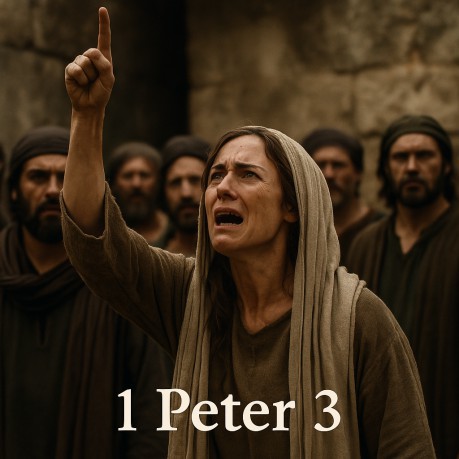
1 Peter 3 1 Peter 3:1-2 † Peter exhorts wives to win unbelieving
husbands not with arguments but with godly conduct. 1 Peter 3:3-4 † True beauty is inward, not external. The
hidden person of the heart matters most. 1 Peter 3:5-6 † Sarah is given as the model of obedience and
faith. 1 Peter 3:7 † Husbands are to honor their wives,
recognizing them as co-heirs of grace. 1 Peter 3:8-9 † Believers are to reflect the character of
Christ in unity, humility, and blessing. 1 Peter 3:10-12 † Peter quotes Psalm 34:12-16, teaching that
righteous living brings God's favor. 1 Peter 3:13-14 † Generally good conduct silences critics, but
even if suffering comes, it is blessed by God. 1 Peter 3:15-16 † Believers must always be ready to defend
their hope in Christ, but with gentleness and respect. 1 Peter 3:17 † Suffering for righteousness aligns believers
with Christ, while suffering for sin carries no honor. 1 Peter 3:18 † Christ's suffering was substitutionary, the
righteous for the unrighteous. 1 Peter 3:19-20 † Peter points to Christ's proclamation to the
spirits of the disobedient, tied to the days of Noah. 1 Peter 3:21-22 † Baptism is not a mere washing but a pledge of
faith and conscience before God. How it applies to us today † This is the fulfilled perspective we proclaim at
Fulfilled Prophecies † Source Index
By Dan Maines
In the same way, you wives, be
subject to your own husbands so that even if any of them are
disobedient to the word, they may be won over without a word by the
behavior of their wives, as they observe your pure and respectful
behavior.
†
This reflects the power of visible holiness, which often speaks
louder than words.
† Clement of Rome (1
Clement 21) praised the influence of godly women in drawing men to
the faith.
Your adornment must not be
merely the external, braiding the hair, wearing gold jewelry, or
putting on dresses; but it should be the hidden person of the heart,
with the imperishable quality of a gentle and quiet spirit, which is
precious in the sight of God.
†
Philo (On the Virtues 19) warned against pride in external adornment,
showing the continuity of Jewish moral teaching.
†
God esteems the imperishable adornment of gentleness and quietness.
For in this way the holy women
of former times, who hoped in God, also used to adorn themselves,
being subject to their own husbands, just as Sarah obeyed Abraham,
calling him lord. And you have proved to be her children if you do
what is right without being frightened by any fear.
† Genesis 18:12 records Sarah
referring to Abraham as "lord," which Peter cites.
†
Early Jewish writings revered Sarah's submission as an example for
later generations.
You husbands in the same way,
live with your wives in an understanding way, as with someone weaker,
since she is a woman; and show her honor as a fellow heir of the
grace of life, so that your prayers will not be hindered.
†
Failure to honor wives disrupts spiritual fellowship and even hinders
prayer.
† Josephus (Against Apion 2.25)
records the Jewish custom of marriage as honorable, but Peter
elevates it by demanding mutual respect rooted in grace.
To sum up, all of you be
harmonious, sympathetic, loving, compassionate, and humble; not
returning evil for evil, or insult for insult, but giving a blessing
instead; for you were called for the very purpose that you would
inherit a blessing.
†
Jesus taught in Matthew 5:44 to bless enemies, not
retaliate.
† Tacitus (Histories 5.5) noted
how Christians were accused falsely, yet their response was often one
of patience, which confirmed Peter's exhortation.
For, "The one who
desires life, to love and see good days, must keep his tongue from
evil and his lips from speaking deceit. He must turn away from evil
and do good; he must seek peace and pursue it. For the eyes of the
Lord are toward the righteous, and His ears attend to their prayer,
but the face of the Lord is against evildoers."
† The
promise of God's attention to the righteous encouraged believers
suffering injustice.
† The Dead Sea Scrolls
(1QS 4.6) also emphasized separation from evil speech and pursuit of
peace.
And who is there to harm you
if you prove zealous for what is good? But even if you should suffer
for the sake of righteousness, you are blessed. And do not fear their
intimidation, and do not be in dread.
†
Isaiah 8:12-13 is echoed here: do not fear what others fear, but
honor the Lord.
† Josephus (Wars 7.8.7)
mentions how Jews feared Roman threats, but Peter redirects fear
toward God alone.
But sanctify Christ as Lord
in your hearts, always being ready to make a defense to everyone who
asks you to give an account for the hope that is in you, but with
gentleness and respect; and keep a good conscience so that in the
thing in which you are slandered, those who disparage your good
behavior in Christ will be put to shame.
†
Apologetics begins with sanctifying Christ in the heart before
answering with words.
† Tacitus (Annals
15.44) records how Christians were slandered, yet their integrity
often silenced opponents.
For it is better, if God should
will it so, that you suffer for doing what is right rather than for
doing what is wrong.
†
This echoes Jesus' teaching in Matthew 5:10,
"Blessed are those who have been persecuted for the sake of
righteousness."
For Christ also suffered for
sins once for all time, the just for the unjust, so that He might
bring us to God, having been put to death in the flesh, but made
alive in the spirit.
† His death
was once for all, never needing repetition.
†
Clement of Rome (1 Clement 49) declared that through Christ's
suffering, believers were brought near to God.
In which He also went and
made proclamation to the spirits in prison, who once were
disobedient, when the patience of God kept waiting in the days of
Noah, during the construction of the ark, in which a few, that is,
eight persons, were brought safely through the water.
†
The flood serves as a type of salvation, where only a remnant was
saved.
† Josephus (Antiquities 1.3.1)
confirms the tradition of Noah's family being preserved while the
ungodly perished.
Corresponding to that,
baptism now saves you, not the removal of dirt from the flesh, but an
appeal to God for a good conscience, through the resurrection of
Jesus Christ, who is at the right hand of God, having gone into
heaven, after angels and authorities and powers had been subjected to
Him.
† Its saving
power rests in the resurrection of Christ, not in outward ritual.
†
The Dead Sea Scrolls (1QS 3.7-9) connected water cleansing with inner
purity, but Peter shows this fully realized in baptism through
Christ's resurrection.
†
1 Peter 3 calls us to live with humility, purity, and patience in
suffering.
† Wives and husbands model
Christ's love in the home, while all believers must sanctify Christ
in their hearts and be ready to give a defense of their hope.
†
Baptism is shown as the pledge of a good conscience, rooted in the
victory of Christ, who reigns at God's right hand.
† Josephus,
Antiquities 1.3.1 – Noah and the flood
†
Josephus, Against Apion 2.25 – marriage honor in Jewish custom
†
Josephus, Wars 5.10.5 – envy and slander in Jerusalem factions
†
Josephus, Wars 7.8.7 – Jews fearing Roman threats
†
Philo, On the Virtues 19 – external adornment condemned
†
Tacitus, Annals 15.44 – Christians slandered and persecuted
†
Tacitus, Histories 5.5 – Christians accused falsely
†
Clement of Rome, 1 Clement 21 – influence of godly women
†
Clement of Rome, 1 Clement 49 – Christ's suffering bringing
salvation
† Dead Sea Scrolls, 1QS 3.7-9 –
water cleansing tied to inner purity
† Dead
Sea Scrolls, 1QS 4.6 – rejection of evil speech, pursuit of peace
†
Isaiah 8:12-13 – do not fear men, fear God
†
Isaiah 53:9 – prophecy of Christ's innocence
†
Psalm 34:12-16 – keep from evil, seek peace
†
Genesis 18:12 – Sarah calls Abraham "lord"
†
Matthew 5:10 – blessed are the persecuted
†
Matthew 5:44 – love your enemies
† John
20:29 – blessed are those who believe without seeing
Links