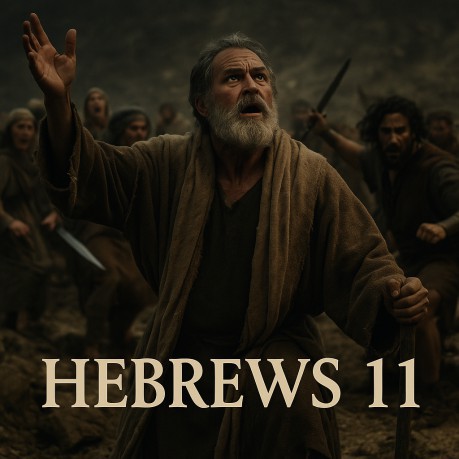
Hebrews 11 Hebrews 11:1 † Faith gives present substance to what is
future and unseen. It is not guesswork, it is trust in God's
character and word. Hebrews 11:2 † Scripture commended the elders, not for
perfect performance, but for persevering trust. Hebrews 11:3 † Faith looks behind the visible to the
creating word. The unseen is not unreal, it is ultimate. Hebrews 11:4 † Abel's offering showed a heart of trust. His
testimony continues, righteousness is by faith, not by form alone. Hebrews 11:5-6 † Enoch's translation shows faith's reward,
life in God's presence. Seeking God in trust is the only path that
pleases Him. Hebrews 11:7 † Noah believed God about future judgment, so
his obedience proved his faith. Hebrews 11:8-10 † Faith goes without full maps, trusting the
Caller. Abraham lived as a pilgrim because his eyes were set on God's
built city. Hebrews 11:11-12 † Sarah's faith focused on the Promiser, not on
her age. The promise created a people where there was no human power
left. Hebrews 11:13-16 † Faith lives as an exile, eyes fixed on the
better country. The patriarchs did not turn back, they looked ahead
to God's city. Hebrews 11:17-19 † Faith trusts God with the promise itself.
Abraham reasoned that God could raise the dead, so he placed the
promise on the altar. Hebrews 11:20-22 † Faith speaks blessings into the future
because it trusts God's word beyond present sight. Hebrews 11:23-26 † Faith fears God more than any king. Moses
chose suffering with God's people rather than ease without God. Hebrews 11:27-28 † Faith endures by seeing the Invisible. The
Passover blood prefigured Christ, deliverance by substitution and
promise. Hebrews 11:29-31 † Faith obeys instructions that look strange to
the world. God toppled walls and opened seas when His people trusted
and walked. Hebrews 11:32-35a † Israel's history shows victory by faith, not
by numbers or strength. Lions, flames, swords, none could stop a
people who trusted God. Hebrews 11:35b-38 † Faith also suffers. Refusing easy release,
the faithful chose a better resurrection. Hebrews 11:39-40 † The story finds its goal with the new
covenant people. The elders waited for the better thing God would
complete in Christ. Their perfection arrived with the fulfillment in
the first century, when the old order gave way to the kingdom
established by the Son. Application for us today † Faith is not vague optimism, it is concrete
trust in God's finished work in Christ. † This is the fulfilled perspective we proclaim at
Fulfilled Prophecies † Source Index
By Dan Maines
Now faith is the assurance of
things hoped for, the conviction of things not seen.
† Habakkuk 2:4 anchors
this chapter, the righteous will live by faith.
†
1QpHab, the Habakkuk Pesher from Qumran, applies Habakkuk 2:4 to a
faithful remnant who live by trust in God's promises.
†
Sirach 44 opens, Let us now praise famous men, linking faith with the
deeds of Israel's ancestors, a theme Hebrews gathers into one great
line.
For by it the people of old
received their commendation.
†
Clement of Rome, 1 Clement 9, appeals to these same elders as
examples for the church.
By faith we understand that the
worlds were prepared by the word of God, so that what is seen was not
made out of things which are visible.
†
Philo, On the Creation 16, speaks of God's Logos ordering what is
seen, a Jewish way of saying what Hebrews affirms.
By faith Abel offered to God a
better sacrifice than Cain, through which he was approved as
righteous, God testifying to his gifts, and through faith, though
dead, he still speaks.
†
1 Clement 4 recalls Abel as the first righteous martyr, whose faith
still speaks.
By faith Enoch was taken so
that he would not see death, and he was not found because God took
him, for he obtained the witness that before his taking he was
pleasing to God. And without faith it is impossible to please Him,
for the one who comes to God must believe that He exists and that He
rewards those who seek Him.
† Jewish tradition held Enoch up
as a model of walking with God, see Sirach 44:16.
By faith Noah, being warned
about things not yet seen, in reverent fear prepared an ark for the
salvation of his household, by which he condemned the world and
became an heir of the righteousness that is according to faith.
† Josephus,
Antiquities 1.3.1, recounts Noah's trust and obedience as the ground
of his deliverance.
By faith Abraham, when he
was called, obeyed by going out to a place he was to receive for an
inheritance, and he went out not knowing where he was going. By faith
he lived as a stranger in the land of promise, dwelling in tents with
Isaac and Jacob, heirs with him of the same promise, for he was
looking for the city that has foundations, whose architect and
builder is God.
† Philo, On Abraham 70, praises
Abraham's readiness to leave homeland for God's call.
†
Josephus, Antiquities 1.7.1, highlights Abraham's departure by trust
rather than sight.
By faith even Sarah herself
received power to conceive, even beyond the proper time of life,
since she considered Him faithful who had promised. Therefore there
was born of one man, and him as good as dead, descendants as many as
the stars of heaven and as innumerable as the sand by the seashore.
† Mishnah Avot 5:3 remembers Abraham's
ten trials, which included trust in God's promise concerning
offspring.
All these died in faith,
not having received the promises, but seeing them and welcoming them
from a distance, and confessing that they were strangers and exiles
on the earth. For those who say such things make it clear that they
are seeking a country of their own. If they had been remembering that
land from which they went out, they would have had opportunity to
return. But as it is, they desire a better country, that is, a
heavenly one.
† Wisdom of Solomon 10
celebrates how Wisdom led the patriarchs as sojourners, a theme
Hebrews applies to faith.
By faith Abraham, when he
was tested, offered up Isaac, and he who had received the promises
was offering up his only son, of whom it was said, In Isaac your
descendants shall be called. He considered that God is able to raise
people even from the dead, from which, figuratively speaking, he also
received him back.
† Philo, On Abraham
167, notes Abraham's logic of trust, that God's promise could not
fail even when Isaac lay on the altar.
†
Josephus, Antiquities 1.13.3, recounts Abraham's trial as the peak
display of faith.
By faith Isaac blessed
Jacob and Esau concerning things to come. By faith Jacob, when dying,
blessed each of Joseph's sons and worshiped, leaning on the top of
his staff. By faith Joseph, when dying, made mention of the exodus of
the sons of Israel and gave orders concerning his bones.
†
Joseph's orders about his bones show confidence that God would bring
Israel out, see Genesis 50, also Josephus, Antiquities 2.8.2.
By faith Moses, when he was
born, was hidden by his parents for three months, because they saw he
was a beautiful child, and they were not afraid of the king's edict.
By faith Moses, when he had grown up, refused to be called the son of
Pharaoh's daughter, choosing rather to be mistreated with the people
of God than to enjoy the temporary pleasures of sin, considering the
reproach of the Christ greater riches than the treasures of Egypt,
for he was looking to the reward.
†
Philo, Life of Moses 1.5, describes Moses rejecting Egyptian honors
for the sake of virtue and piety.
† Josephus,
Antiquities 2.9.6, recounts Moses' decision to align with his people,
a faith choice with real cost.
By faith he left Egypt, not
fearing the wrath of the king, for he endured as seeing Him who is
unseen. By faith he kept the Passover and the sprinkling of the
blood, so that the destroyer would not touch their firstborn.
† Wisdom of Solomon 18:21 celebrates
the power of God's appointed sign to shield the people, a parallel to
Hebrews' point.
By faith they passed
through the Red Sea as through dry land, and the Egyptians, when they
attempted it, were drowned. By faith the walls of Jericho fell after
they had been encircled for seven days. By faith Rahab the harlot did
not perish with those who were disobedient, after she had welcomed
the spies in peace.
† Josephus, Antiquities 5.1.2,
records Jericho's fall and Rahab's preservation, noting her reception
of the spies.
† 1 Clement 12 praises Rahab's
faith as a model for the church.
And what more shall I say,
for time would fail me if I tell of Gideon, Barak, Samson, Jephthah,
David and Samuel and the prophets, who by faith conquered kingdoms,
performed acts of righteousness, obtained promises, shut the mouths
of lions, quenched the power of fire, escaped the edge of the sword,
were made strong from weakness, became mighty in war, put foreign
armies to flight. Women received back their dead by resurrection.
† Sirach 46 to 48
surveys judges, kings, and prophets in similar fashion, highlighting
faith that acts.
Others were tortured, not
accepting release, so that they might obtain a better resurrection.
Others experienced mocking and flogging, chains and imprisonment,
they were stoned, they were sawn in two, they were tempted, they were
put to death with the sword, they went about in sheepskins and
goatskins, destitute, afflicted, ill treated, the world was not
worthy of them, wandering in deserts and mountains and caves and
holes in the ground.
† 2
Maccabees 6 to 7 records Eleazar and the seven brothers who accepted
torture rather than deny the Law, a clear background to Hebrews'
line.
† 4 Maccabees 9 to 18 reflects on those
same martyrs, praising their endurance.
† The
tradition that Isaiah was sawn in two appears in the Ascension of
Isaiah 5, a likely allusion behind this verse.
†
1 Maccabees 2:28, 2:29 shows faithful ones fleeing to the wilderness,
matching Hebrews' picture of exiles and caves.
And all these, having
gained approval through their faith, did not receive what was
promised, because God had provided something better for us, so that
apart from us they would not be made perfect.
† Eusebius,
Ecclesiastical History 3.7, connects the end of the old order with
the rise of the new, clarifying how the promise reached its goal
together with us.
†
Faith obeys even when directions look strange, it walks around
Jericho, it builds an ark before rain, it leaves home with no map.
†
Faith endures when suffering arrives, it values reproach with Christ
above the treasures of Egypt, it refuses release that costs
fidelity.
† Faith looks for God's city, not
for a revival of the old covenant. The elders aimed beyond land and
temple, and so do we.
† Faith now lives in
the reality those elders awaited. Christ has brought the better
covenant, the better country, and the opened way. Hold fast to that
confession.
† Genesis 4, 5, 6 to
9, 12 to 22, 49 to 50, Exodus 1 to 14, Joshua 2 and 6
†
Habakkuk 2:4, the righteous live by faith
†
Sirach 44 to 50, praise of the ancestors
†
Wisdom of Solomon 10 and 18, Wisdom guides the patriarchs, the
protecting sign
† 1 Maccabees 2:28 to 29,
faithful flee to the wilderness
† 2 Maccabees
6 to 7, Eleazar and the seven brothers
† 4
Maccabees 9 to 18, endurance of the martyrs
†
Ascension of Isaiah 5, tradition of Isaiah sawn in two
†
1QpHab, Habakkuk Pesher, the righteous live by faith
†
Philo, On the Creation 16, God's Logos orders what is seen
†
Philo, On Abraham 70 and 167, Abraham's departure and trial
†
Philo, Life of Moses 1.5, Moses rejects Egyptian honors
†
Josephus, Antiquities 1.3.1, 1.7.1, 1.13.3, 2.8.2, 2.9.6, faith of
Noah, Abraham, Joseph, Moses
† Josephus,
Antiquities 5.1.2, Jericho and Rahab
†
Clement of Rome, 1 Clement 4, 9 to 12, Abel, the elders, Rahab
†
Eusebius, Ecclesiastical History 3.7, end of the old order and rise
of the new
Links